
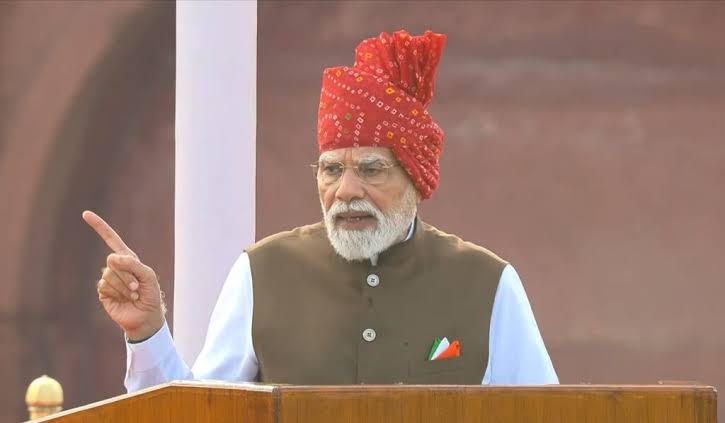
Prime Minister Narendra Modi on Saturday urged Indians to set bigger goals for the country as he renewed his call for building a developed India by 2047. Addressing the nation from the Red Fort on India’s 80th Independence Day, Modi said the country’s ambitions must match its growing capabilities and potential.
The Prime Minister presented the vision of Viksit Bharat as a long-term national objective and called on citizens to move beyond limited aspirations. He said India must think on a much larger scale if it is to realise its ambition of becoming a developed nation by the time it completes 100 years of Independence.
“Small dreams are not sufficient anymore,” Modi said while emphasising the need for bigger dreams and stronger national resolve.
According to the Prime Minister, when a country as large and populous as India makes a determined commitment to becoming developed, the world will be compelled to view it differently. He argued that ambitious national goals can also push the country’s capabilities to higher levels.
Viksit Bharat 2047 becomes a central national goal
The year 2047 holds particular importance in the government’s long-term development vision because it will mark 100 years of India’s Independence. The Viksit Bharat objective seeks to transform India into a developed country by that milestone.
Modi said India’s progress over recent years has demonstrated that major transformations are possible when the country combines ambition with sustained effort. He pointed to developments across several sectors as evidence of India’s changing economic and technological capabilities.
The Prime Minister’s message was therefore not limited to a single policy area. Instead, he described development as a broad national mission requiring progress across manufacturing, infrastructure, technology, defence, energy, agriculture and other strategic sectors.
Modi highlights India’s progress across sectors
During his address, Modi highlighted what he described as the accelerated pace of India’s development over the past 12 years.
He cited growth in defence production, electronics manufacturing, railway coach production and mobile phone manufacturing. According to figures presented in his speech, defence production has increased fourfold, electronic manufacturing sevenfold, high-tech railway coach production 21-fold and mobile phone manufacturing 33-fold during this period.
He also pointed to the expansion of India’s digital ecosystem. Internet users have increased substantially, while patent grants and digital transactions have also grown significantly.
The Prime Minister used these developments to argue that India’s development trajectory has changed considerably and that the country now has the capacity to pursue more ambitious objectives.
Self-reliance placed at the centre of development strategy
A major component of Modi’s vision for a developed India is self-reliance. He stressed that India cannot remain excessively dependent on other countries for critical goods, technologies and resources.
The Prime Minister highlighted the government’s push for domestic manufacturing and encouraged citizens to support locally produced goods. He connected the broader idea of self-reliance with India’s efforts to expand semiconductor manufacturing and strengthen its technological capabilities.
Semiconductors have become increasingly important to India’s economic and strategic ambitions because they are essential to industries ranging from automobiles and telecommunications to electronics, artificial intelligence and defence.
Modi said semiconductor production has already begun in India and indicated that further expansion is expected in the coming years.
Energy security emerges as another major priority
Energy security was another important element of the Prime Minister’s development vision. Modi argued that a developed India must have reliable and secure access to energy.
He highlighted developments in the nuclear power sector and pointed to the country’s long-term target of significantly increasing nuclear generation capacity. The government has set an ambition of reaching 100 GW of nuclear power capacity by 2047.
The Prime Minister also referred to the Prototype Fast Breeder Reactor at Kalpakkam in Tamil Nadu, describing it as an important development in India’s efforts to strengthen its nuclear capabilities.
Energy security has acquired additional importance amid geopolitical tensions and disruptions in international energy markets. Modi said India’s efforts to strengthen domestic energy capabilities are intended to reduce vulnerability to external shocks.
Railway electrification cited as an example of faster development
Modi also used railway electrification to illustrate the pace of infrastructure development.
He said only about 30 per cent of India’s railway network had been electrified during the first 90 years after electrification began, while the remaining 70 per cent was completed within the subsequent decade.
The Prime Minister presented this comparison as an example of the accelerated pace at which large infrastructure projects can be executed.
He also highlighted India’s move towards hydrogen-powered railway technology, describing it as part of the country’s broader efforts to adopt cleaner and more advanced technologies.
Technology and innovation expected to drive India’s future
Technology remains central to the government’s vision for India’s development. Modi highlighted digital infrastructure, innovation, semiconductor production and advanced technological capabilities as areas where India needs to continue expanding.
The development of domestic technology is increasingly viewed as important not only for economic growth but also for national security and strategic independence.
India’s ambitions in areas such as artificial intelligence, electronics, data infrastructure and advanced manufacturing are expected to create new opportunities for businesses and workers while strengthening the country’s position in the global technology economy.
For the Viksit Bharat objective, however, technological expansion will need to be accompanied by investment in education and skills so that India’s workforce can participate effectively in emerging industries.
Youth expected to be key to India’s 2047 ambition
India’s young population is likely to play a decisive role in determining whether the country’s long-term development goals are achieved.
The young generation that is entering education and employment today will form a major part of India’s workforce in 2047. Their skills, productivity, entrepreneurial activity and participation in emerging sectors will therefore have a direct impact on the country’s economic future.
Modi’s call for bigger dreams was consequently aimed not only at policymakers but also at ordinary citizens, particularly young Indians. The Prime Minister’s broader message was that India’s transformation requires participation across society.
Education, employment, entrepreneurship, innovation and access to technology will remain important factors in ensuring that India’s demographic advantage translates into sustained economic growth.
Global crises underline the importance of resilience
Modi also referred to recent global crises and argued that India needs greater economic and strategic resilience.
He recalled concerns raised during previous periods of international disruption, including the Covid-19 pandemic and the recent instability in West Asia. According to the Prime Minister, India’s efforts to strengthen domestic production and supply chains helped the country manage external pressures.
The argument reflects a broader shift in economic policy, with governments around the world increasingly focusing on supply-chain security and domestic capacity after a series of global disruptions.
For India, the objective is to ensure that essential goods, energy resources and strategic technologies remain available even when international conditions become uncertain.
Development must extend beyond economic growth
The ambition of becoming a developed country cannot be measured solely through economic output. It also involves improving living standards, infrastructure, education, employment opportunities and technological access.
A developed India by 2047 would therefore require sustained progress across multiple dimensions of national development.
This includes creating productive employment for a large workforce, improving human capital, strengthening public infrastructure, expanding access to quality education and healthcare, and ensuring that economic growth benefits a broad section of society.
The scale of the ambition also means that progress will need to be maintained over several political and economic cycles.
From a vision to measurable outcomes
The 2047 deadline provides India with a long-term target, but turning that objective into reality will require consistent implementation.
Large-scale development depends on investment, policy stability, institutional capacity and cooperation between governments, industries, researchers, entrepreneurs and citizens.
India will also face challenges from global economic uncertainty, geopolitical tensions, climate change, energy requirements and rapid technological disruption.
The ability to respond to these challenges while maintaining economic momentum will be crucial to the country’s long-term development trajectory.
Modi’s message: India must aim higher
The central message of Modi’s Independence Day address was that India’s ambitions should reflect its growing capabilities.
He argued that limited goals are no longer sufficient for a country seeking to play a larger role in the world. Instead, India must set ambitious targets and build the capacity required to achieve them.
The Viksit Bharat by 2047 vision therefore represents a long-term national project extending well beyond individual government programmes. Its success will ultimately depend on whether ambitious targets can be translated into sustained economic growth, technological progress, stronger infrastructure, greater self-reliance and improved living standards.
With more than two decades remaining before the 2047 milestone, the Prime Minister’s message was clear: the transformation of India into a developed nation will require not only big dreams but also sustained action, innovation and collective national effort.