
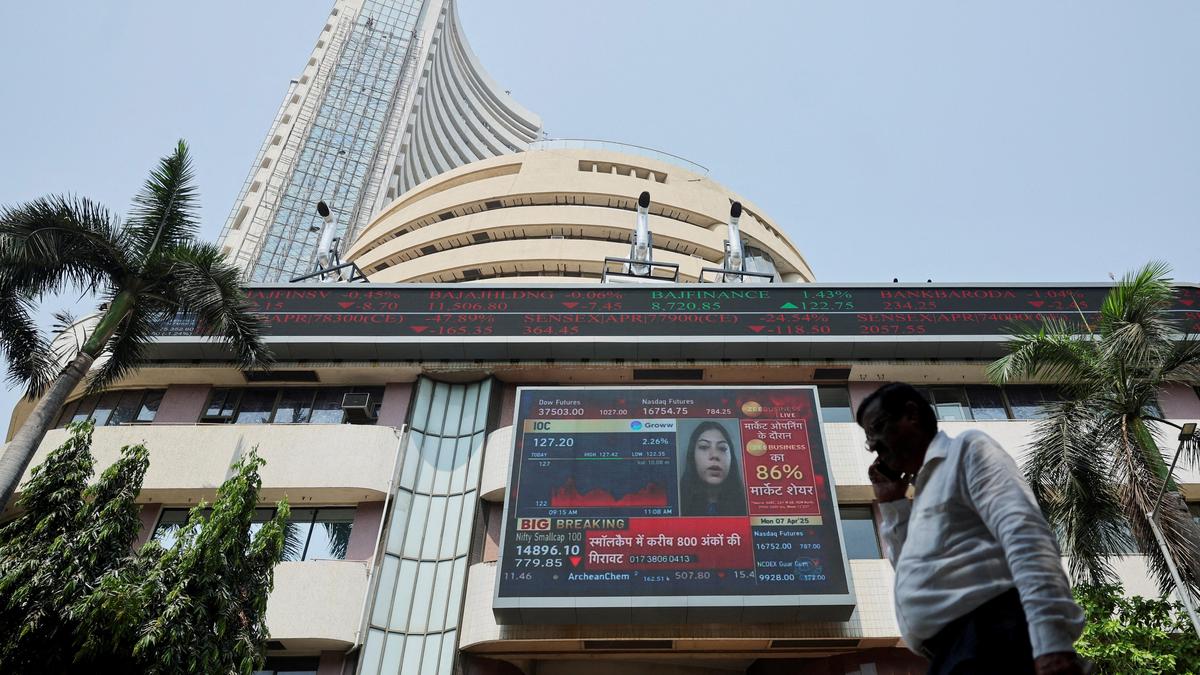
Indian benchmark equity indices opened lower on Tuesday as elevated crude oil prices and renewed geopolitical uncertainty weighed on investor sentiment. The Sensex and Nifty came under pressure in early trading, with investors adopting a cautious approach amid concerns over developments surrounding the Strait of Hormuz and uncertainty over negotiations between the United States and Iran.
The 30-share BSE Sensex declined 320.14 points to trade at 78,204.40 in early deals, while the broader NSE Nifty fell 94.35 points to 24,490.85. The decline reflected renewed caution among market participants after global developments pushed crude oil prices higher and created concerns about the potential impact on inflation, corporate costs and economic growth.
Crude oil remains a major concern
The movement in crude oil prices has emerged as one of the key factors influencing Indian equities. Brent crude, the international benchmark, was trading at around $87.61 per barrel, while West Texas Intermediate crude moved closer to the $82-per-barrel level.
Higher crude prices are particularly important for India because the country depends heavily on imports to meet its energy requirements. A sustained increase in international oil prices can raise the cost of fuel and transportation and may also increase input expenses for companies across several industries.
Investors are therefore closely monitoring developments in the Middle East, particularly the situation surrounding the Strait of Hormuz, a strategically important route for global energy shipments. Any prolonged disruption or uncertainty around the waterway could keep crude prices elevated and increase volatility across international financial markets.
Geopolitical uncertainty keeps markets cautious
Market sentiment was also affected by uncertainty surrounding discussions between the United States and Iran. The possibility of prolonged tensions has made investors more reluctant to take large positions in equities.
Market analysts said the renewed geopolitical uncertainty has contributed to a rebound in crude prices and created a weaker backdrop for equities. Investors are expected to remain focused on headlines from the region as they assess the possibility of further disruptions to energy supplies.
The uncertainty has also affected global markets. US equities ended lower in the previous session, while Asian markets presented a mixed picture during Tuesday’s trading session. South Korea’s KOSPI traded higher, whereas the Shanghai Composite and Hong Kong’s Hang Seng remained under pressure.
Several major stocks decline
The weakness in the domestic market was visible among several prominent companies included in the Sensex. InterGlobe Aviation, Axis Bank, UltraTech Cement, Bharti Airtel, Eternal and Bajaj Finance were among the stocks that declined during early trading.
In contrast, some technology stocks provided support to the market. Titan, HCL Technologies, Tech Mahindra and Infosys were among the notable gainers.
The mixed movement among individual stocks highlighted the selective nature of trading, with investors continuing to evaluate company-specific factors alongside broader concerns related to crude oil and geopolitical developments.
Foreign investors provide some support
Despite the cautious market environment, foreign institutional investors remained a positive factor for Indian equities. Foreign investors purchased shares worth ₹1,974.76 crore on Monday, according to exchange data.
The continued participation of foreign investors could provide some support to domestic equities if buying momentum persists. However, analysts caution that sustained foreign investment will depend on global risk appetite, currency movements, interest-rate expectations and developments in international markets.
Domestic investors are also expected to closely track the ongoing earnings season. With several companies having already reported their quarterly results, stock-specific developments are likely to remain important in determining the performance of individual sectors and companies.
Oil-sensitive sectors remain under pressure
Higher crude prices could create additional pressure for industries that have significant exposure to fuel and transportation costs. Aviation, logistics, paints, chemicals and other sectors that rely heavily on energy inputs could face higher operating expenses if oil prices remain elevated for an extended period.
At the same time, oil-producing and energy-related companies may respond differently depending on international prices, domestic policies and currency movements. This divergence could lead to greater stock-specific volatility in the coming sessions.
For the wider economy, an extended period of expensive crude could increase inflationary pressures and complicate expectations surrounding monetary policy. Investors are therefore watching oil prices not only as a commodity-market indicator but also as a potential influence on India’s broader economic outlook.
Markets likely to remain headline-driven
Analysts expect Indian equities to remain sensitive to global developments in the near term. Any progress in US-Iran negotiations or improvement in the situation around the Strait of Hormuz could ease pressure on crude prices and improve investor confidence.
On the other hand, further escalation of geopolitical tensions or indications of prolonged disruption to energy supplies could push oil prices higher and increase selling pressure in risk-sensitive assets.
With uncertainty still elevated, investors are likely to favour a wait-and-watch strategy rather than making aggressive directional bets. Domestic corporate earnings, foreign fund flows, crude oil prices, currency movements and global equity trends will remain important indicators for the market.
For now, the Indian stock market remains caught between positive domestic factors, including corporate earnings and foreign investor buying, and external risks arising from elevated crude prices and geopolitical uncertainty. The direction of the market in the coming sessions is likely to depend heavily on whether these global risks ease or intensify.