
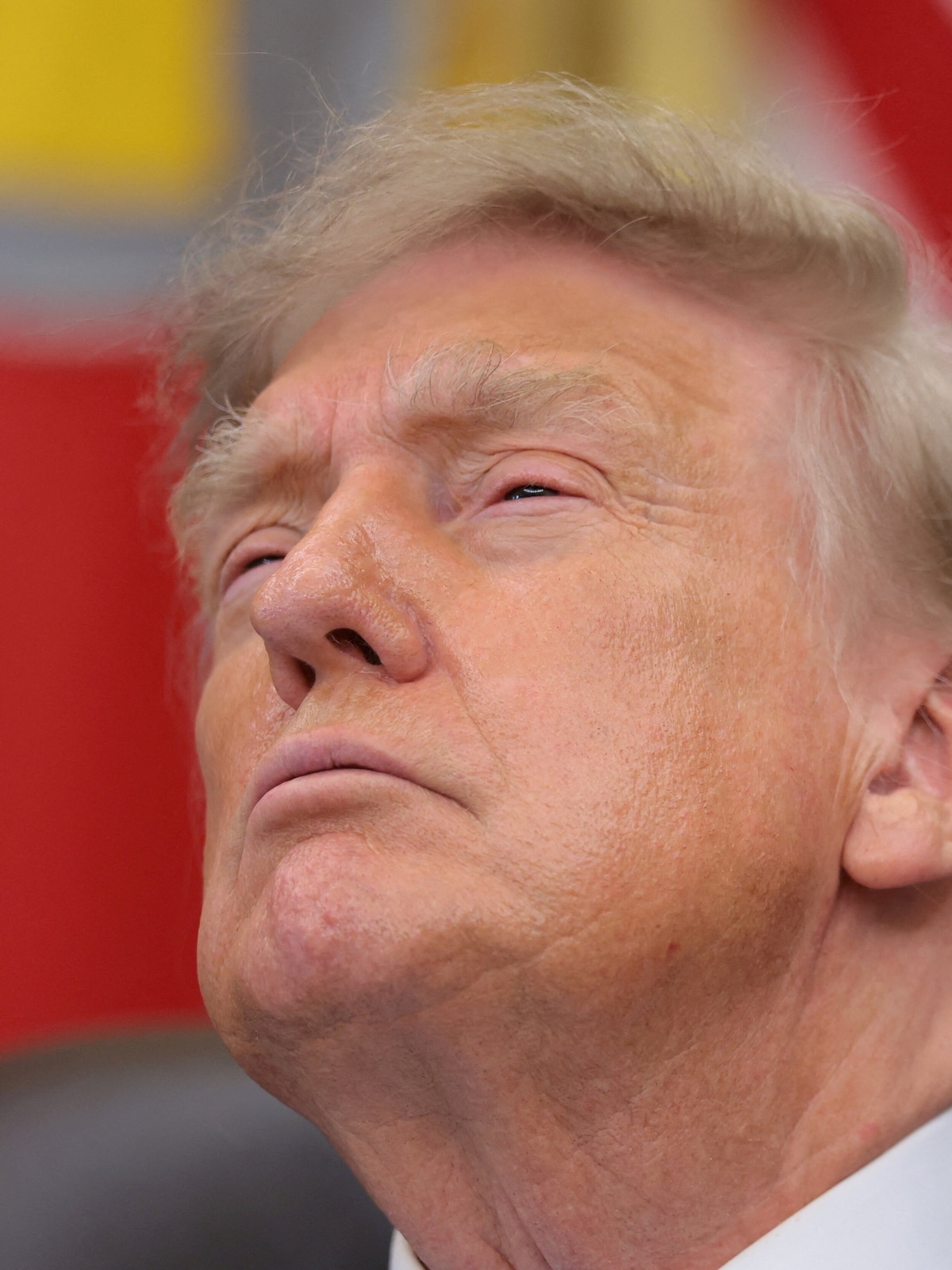
A brief moment during a White House ceremony involving President Donald Trump has triggered a fresh political and social-media debate after footage appeared to show the president closing his eyes and lowering his head while an official was speaking.
The incident occurred during an Oval Office event on Monday, August 10, where Trump signed an executive order concerning federal policy on childhood vaccine recommendations. The short clip quickly circulated online, with critics arguing that the president appeared to be falling asleep during an official engagement.
The episode has since developed into a wider political argument, with Democratic critics questioning Trump’s alertness and ability to carry out the responsibilities of the presidency. Supporters of the president, however, rejected the interpretation that he was asleep, saying that briefly closing one’s eyes or nodding does not establish that someone had fallen asleep.
What happened during the Oval Office ceremony?
Trump was attending a ceremony at the Oval Office when National Institutes of Health Director Dr Jay Bhattacharya was addressing those present. During the remarks, Trump appeared to close his eyes and tilt his head downward for a brief period.
The moment was enough to attract widespread attention online. Video clips of the event were shared and discussed by users who interpreted Trump’s posture and closed eyes as evidence that he had dozed off.
However, there was no independent confirmation that Trump actually fell asleep during the ceremony. The available footage only showed a brief moment in which his eyes appeared to be closed and his head moved downward.
The distinction has become central to the political debate surrounding the incident.
Trump’s vaccine policy order
The Oval Office event was held as Trump signed an executive order aimed at changing the federal government’s approach to childhood vaccine recommendations.
The order forms part of a broader effort by the administration to alter aspects of federal health policy. The issue has already generated considerable controversy, particularly because of continuing disagreements over vaccine policy and claims linking vaccines to autism.
Health and Human Services Secretary Robert F. Kennedy Jr., who has for years expressed strong criticism of aspects of vaccine policy, has also played a prominent role in the administration’s health agenda.
The ceremony therefore had significant policy implications, even though much of the immediate public discussion shifted toward Trump’s appearance during the event. :max_bytes(150000):strip_icc():focal(749x0:751x2)/donald-trump-oval-office-111925-3-164bcb6e223340df894c840f0d723e5c.jpg)
Democrats accuse Trump of being asleep on the job
Democratic Representative Yassamin Ansari sharply criticised the president following the footage, arguing that his apparent drowsiness should not be dismissed as an insignificant moment.
Ansari described the incident as part of what she considers a broader concern about Trump’s ability to remain fully engaged while carrying out presidential responsibilities. She also criticised Republicans in Congress for continuing to support the president.
Her comments added a political dimension to what initially appeared to be a brief moment captured on camera.
For Trump’s opponents, the episode is not simply about whether the president closed his eyes for a few seconds. They argue that the president’s physical alertness and ability to participate fully in official duties are matters of public importance, particularly given the scope of presidential responsibilities.
Laura Loomer rejects claims that Trump was sleeping
Conservative commentator Laura Loomer pushed back strongly against the allegations.
Loomer argued that Trump was looking downward rather than sleeping and dismissed the interpretation that a brief closing of his eyes necessarily meant that he had fallen asleep.
Her response quickly became part of the online debate, with supporters defending Trump and critics continuing to argue that his posture appeared consistent with someone who had dozed off.
The disagreement illustrates how even a short piece of footage involving a major political figure can quickly become a partisan issue, with different groups interpreting the same visual moment in sharply different ways.
Social media reactions divided
Social-media users offered a wide range of reactions to the footage.
Some users insisted that Trump’s posture clearly indicated that he was asleep, while others argued that there was insufficient evidence to make such a conclusion. A number of commenters also treated the incident humorously, turning the brief moment into a subject of jokes and political commentary.
The debate was further amplified because Trump has previously been the subject of similar discussions after appearing to close his eyes during public events.
Previous incidents have also drawn attention
The latest controversy is not the first time Trump’s closed eyes during an official event have prompted questions about whether he was sleeping.
During a Cabinet meeting in December 2025, Trump was similarly reported to have appeared to close his eyes. At the time, White House Chief of Staff Susie Wiles rejected suggestions that he had fallen asleep, saying that closing his eyes did not mean he was asleep.
Another incident was reported in July when Trump appeared to close his eyes during the funeral of Senator Lindsey Graham. A White House spokesperson subsequently said that Trump was reflecting on the loss of his friend after delivering a eulogy.
These earlier episodes have contributed to the renewed interest in the latest Oval Office footage. For Trump’s critics, they represent a recurring pattern. For his defenders, they demonstrate how brief visual moments are being interpreted politically without sufficient evidence.
No confirmation that Trump actually fell asleep
Despite the political claims and extensive online discussion, the footage itself does not establish with certainty that Trump was asleep.
Closing one’s eyes, lowering one’s head or briefly appearing drowsy can have several explanations, and a short video clip cannot by itself determine a person’s state of consciousness.
The incident therefore remains largely a matter of interpretation. Democrats have used it to raise broader concerns about Trump’s performance and alertness, while his supporters have rejected those concerns and accused critics of exaggerating a fleeting moment.
The controversy also highlights the increasingly important role of short video clips in political news cycles. A few seconds of footage can rapidly spread across social media, generate competing narratives and become part of a much larger political argument.
For now, the central fact remains that Trump appeared to close his eyes and lower his head during the Oval Office ceremony. Whether that moment represented sleep, brief fatigue, concentration or simply looking downward has not been independently established.