
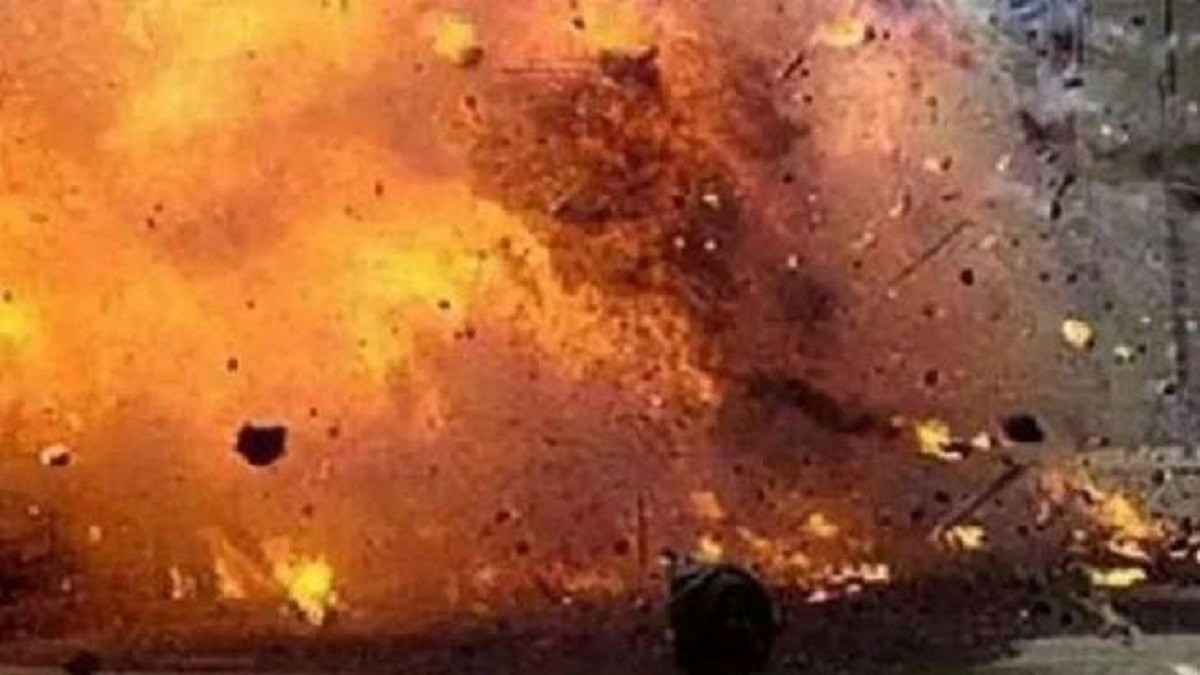
A powerful explosion that ripped apart a parked SUV in Karnataka’s Bagalkot district has triggered a detailed police and forensic investigation, with authorities examining whether an improvised explosive device (IED) was responsible for the blast.
The incident took place late Sunday night near a liquor shop in Hipparagi village, where the vehicle had been parked outside the premises. The force of the explosion was substantial enough to overturn the SUV and leave it severely damaged, with fragments and debris reportedly scattered across an area extending roughly 40 metres from the vehicle.
The blast occurred at approximately 10.45 pm while the vehicle’s owner, 35-year-old Hanumantha Sanagond Athani, was inside the establishment completing the day’s accounts. Athani is understood to be the leaseholder of several liquor outlets in the Bagalkot area, including the shop near which the explosion occurred.
A passer-by, identified as 22-year-old Yallaling Pujari, was injured in the incident. The explosion did not result in a major fire, as the vehicle’s fuel tank reportedly remained intact. Investigators are now working to establish exactly what caused the blast and whether it was the result of a deliberate attack, an accidental chemical reaction or another technical cause.
Police investigate possible IED use
The possibility of an IED has emerged as one of the central lines of investigation after investigators reportedly detected traces of ammonium nitrate and recovered a piece of wiring from the vicinity of the blast.
Preliminary observations suggested that the explosion originated beneath the vehicle, particularly on the left side near the engine compartment. This has led investigators to examine whether an explosive device could have been placed underneath the SUV before it detonated.
However, police officials have stressed that there is no conclusive evidence at this stage confirming that an IED was used.
Bagalkot Superintendent of Police Siddharth Goyal said forensic experts had collected samples from the scene, including control samples from nearby locations. Investigators are expected to compare the material recovered from the blast site with samples collected from the surrounding area before reaching any definitive conclusion about the presence and role of ammonium nitrate.
The presence of ammonium nitrate alone, officials noted, does not necessarily establish that an explosive device was involved. The chemical can also be found in fertiliser products, which are commonly used in rural agricultural areas. Since the incident took place close to farmland, investigators are considering the possibility that traces detected at the location may have originated from an ordinary agricultural source rather than an explosive device.
No detonator recovered so far
The investigation has also focused on a piece of wire reportedly discovered around 30 metres from the damaged SUV. While the presence of wiring initially raised questions about a possible connection to an explosive mechanism, police have not yet established a direct link between the wire and the blast.
Officials said no detonator had been recovered from the scene so far. The wire may instead be connected to a nearby borewell installation, according to the preliminary assessment.
The absence of a confirmed detonator, combined with uncertainty over the origin of the ammonium nitrate traces and the recovered wire, has made it difficult for investigators to determine whether the explosion was deliberately engineered.
Forensic teams are therefore examining the physical evidence in detail. The debris pattern, location of the blast, nature of the damage to the SUV and chemical traces found at the site are all expected to play an important role in determining the cause. 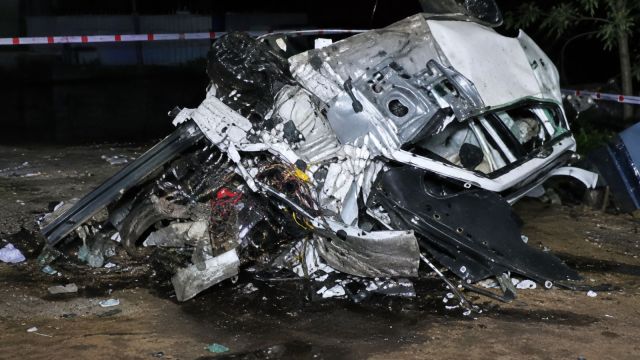
CCTV footage being examined
Police are also analysing CCTV footage from the area as part of the investigation. The footage reportedly shows the SUV being parked near the liquor outlet and remaining under surveillance for more than six hours before the explosion.
Investigators have so far not identified any suspicious activity involving the vehicle during that period. The footage is nevertheless being scrutinised to determine whether anyone approached the SUV, tampered with it or placed any material beneath or around the vehicle before the explosion.
The CCTV evidence could prove significant in establishing the sequence of events leading up to the blast. Investigators are expected to examine the movements of people and vehicles in the area, particularly during the period between the SUV being parked and the explosion.
The absence of immediately suspicious activity in the available footage does not, however, rule out the possibility of prior tampering. Police are continuing to assess whether the available recordings cover all relevant areas and whether additional footage from nearby locations can provide further clues.
Business disputes among possible angles
Alongside the suspected IED angle, police are examining other possible motives behind the incident.
Investigators are looking into Athani’s business activities and personal circumstances to determine whether he had any disputes, financial disagreements or rivalries that could have contributed to the explosion.
Athani reportedly operates around a dozen liquor outlets on lease and is also believed to be involved in informal money-lending activities. Police are therefore examining whether any business-related conflict or financial dispute could be connected to the incident.
At this stage, there is no confirmed evidence publicly establishing a motive or identifying any individual responsible for the explosion. The investigation remains open, with officers considering multiple possibilities rather than treating the incident solely as a suspected terror or criminal attack.
The vehicle itself, a Mahindra XUV 300 purchased approximately three years ago, is registered in Athani’s wife’s name, according to the police.
Vehicle manufacturer, mechanics and forensic experts consulted
To determine the technical cause of the explosion, investigators have sought assistance from the vehicle manufacturer, local mechanics and forensic specialists.
The involvement of technical experts is expected to help police establish whether a mechanical or electrical malfunction could have triggered the blast. At the same time, forensic analysis will focus on determining whether explosive substances were present and whether the damage pattern is consistent with an externally placed device.
The fact that the explosion occurred beneath the SUV has become a key aspect of the investigation. Investigators are examining the underside of the vehicle and the surrounding debris for signs that could indicate the placement of an explosive device.
Forensic teams will also be required to distinguish between material that may have been present naturally or through routine agricultural activity and substances that could have been deliberately introduced as part of an explosive mechanism.
Investigation continues
The Bagalkot SUV blast has raised several unanswered questions for investigators. The most important is whether the explosion was caused by a deliberately planted device or by another source.
While the discovery of ammonium nitrate traces and wiring has prompted police to investigate the possibility of an IED, authorities have maintained that the evidence is not yet sufficient to confirm that theory. The lack of a recovered detonator and the possibility that the wiring may be unrelated to the vehicle have added further uncertainty.
At the same time, police are examining the circumstances surrounding the vehicle’s owner, including his business interests and possible disputes, to determine whether the blast could have been motivated by personal or commercial rivalry.
The investigation is expected to rely heavily on forensic examination, CCTV analysis and technical assessment of the damaged vehicle. The results of laboratory testing and the comparison of samples collected from the blast site with control samples from nearby areas could be crucial in establishing whether the explosion involved an explosive substance.
For now, investigators have not reached a final conclusion about the cause of the blast. As forensic experts continue their examination and police pursue multiple lines of inquiry, authorities are seeking to establish whether the incident was a targeted criminal act, an accidental explosion or the result of another unidentified cause.