
A powerful 7.1-magnitude earthquake struck Japan’s southern Kumamoto prefecture, setting off a major emergency that was compounded by a suspected gas explosion at a shopping mall and leaving at least 13 people dead, several others missing and dozens injured.
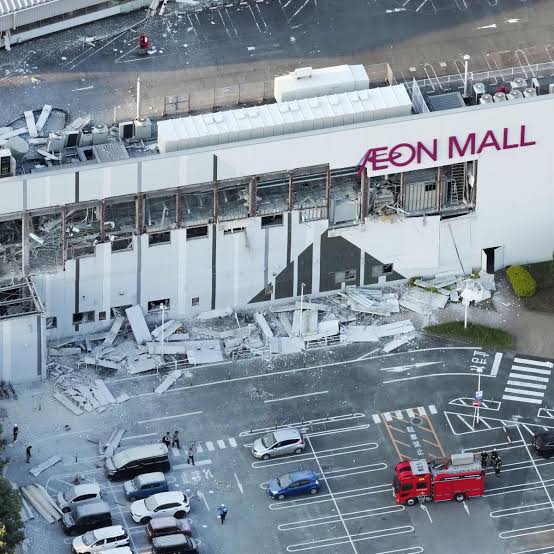
The earthquake hit the Kyushu region on Tuesday, causing widespread damage to buildings and infrastructure and forcing residents to evacuate vulnerable areas. The disaster took an even more dangerous turn roughly an hour later when an explosion tore through the Aeon shopping mall in Kashima town, partially bringing down sections of the building.
The blast occurred after shoppers and employees had reportedly been evacuated following the earthquake. However, the subsequent collapse trapped people in the damaged structure, prompting a large-scale rescue operation involving firefighters, police officers and members of Japan’s Self-Defence Forces.
At least eight people were initially pulled from the rubble of the shopping complex. Three of those rescued later died, according to authorities. The number of missing people remained uncertain as emergency teams continued searching through the debris and authorities worked to establish the full scale of the casualties.
The mall operator also reported that several employees could not immediately be accounted for following checks involving its workforce. Separately, emergency services were responding to another incident at a paper manufacturing facility in Yatsushiro, where a collapsed chimney reportedly left additional people unaccounted for.
Rescue Teams Race Against Time
Japan’s emergency response was quickly expanded as the extent of the destruction became clear. Thousands of personnel were deployed across the affected region, including soldiers, firefighters and police officers.
Prime Minister Sanae Takaichi described the rescue effort as a race against time and directed emergency agencies to use all available resources to locate and save people who could still be trapped beneath collapsed structures.
A significant number of troops were assigned specifically to rescue operations at the damaged shopping mall. However, the operation was complicated by continuing aftershocks, which raised concerns about the stability of already weakened buildings and created additional risks for rescuers.
Police and rescue teams initially faced restrictions in approaching some sections of the wreckage because of fears that further seismic activity could trigger additional collapses. More than 100 aftershocks were recorded in the region following the main earthquake, according to officials.
The search operation continued through the night as rescuers carefully moved through unstable areas in an attempt to locate survivors.
Suspected Gas Explosion Under Investigation
The exact cause of the explosion at the shopping mall had not been officially established, but authorities were investigating a possible gas leak.
Rescue workers reportedly detected the smell of gas inside the damaged building after the explosion. Emergency vehicles also warned residents to remain away from the area because of the possibility of another leak or further danger.
The shopping complex used liquefied petroleum gas, or LPG, which is typically stored in large containers rather than supplied through underground pipelines. Officials noted that gas systems are generally designed with automatic shut-off mechanisms intended to activate during major seismic events.
Despite those safety mechanisms, investigators had not yet determined how the explosion occurred or whether earthquake-related damage contributed to a gas leak. Officials stressed that the possible connection between the earthquake and the explosion remained under investigation.
The circumstances surrounding the blast are expected to be examined closely as investigators assess the condition of the building, its gas infrastructure and other possible sources that could have triggered the explosion. 
Mall Had Recently Reopened After Major Reconstruction
The incident has drawn particular attention because the shopping complex had only recently reopened following extensive redevelopment work carried out after the devastating Kumamoto earthquakes of 2016.
The earlier disaster caused widespread destruction across the region and resulted in hundreds of deaths. Buildings, roads and other infrastructure were severely damaged, while reconstruction efforts continued for years.
The shopping mall had undergone redevelopment and was presented as having improved structural and earthquake-resistant features. The latest disaster, therefore, has raised fresh questions about the effectiveness of safety measures and the challenges of protecting buildings from both direct earthquake damage and secondary hazards.
The explosion also demonstrated the complex nature of earthquake emergencies. Even when people successfully evacuate a building following a major tremor, subsequent dangers—including fires, gas leaks, structural failures and aftershocks—can continue to threaten lives.
Extensive Damage Reported Across Kumamoto
The earthquake caused significant disruption across southern Japan, with reports of cracked roads, damaged bridges, collapsed structures and fires in several areas.
Authorities issued evacuation advisories affecting hundreds of thousands of residents as emergency agencies assessed the damage and warned communities to remain prepared for further strong aftershocks.
Tens of thousands of homes were reportedly left without electricity, creating additional difficulties for residents during extremely hot summer conditions. Power disruptions also affected medical facilities, with some hospitals facing operational challenges while treating injured people and managing an influx of patients.
Transport services were also disrupted. High-speed train operations were suspended in affected areas, while some passengers were reportedly injured during the earthquake.
Authorities warned residents to remain vigilant in the days following the main tremor, particularly because continued seismic activity could increase the risk of landslides and further structural damage.
Japan’s Industrial Sector Also Hit
The earthquake’s effects extended beyond residential areas and public infrastructure, disrupting industrial activity in one of Japan’s major manufacturing regions.
Several major companies temporarily suspended operations at facilities in and around Kumamoto as a precaution. Automobile, electronics and semiconductor-related production was affected as businesses evacuated workers, inspected facilities and assessed damage.
Toyota halted operations at three factories in the region for several days. Other major manufacturers, including Sony, Honda, Renesas Electronics and Tokyo Electron, also suspended production at certain facilities.
A major semiconductor manufacturing facility operated by Taiwan Semiconductor Manufacturing Company also evacuated employees as a precaution before beginning a gradual return to operations.
The disruption highlighted the wider economic consequences that can follow a major natural disaster. Even when industrial facilities avoid significant structural damage, companies may suspend production to protect workers, inspect equipment and ensure that power and transportation systems are functioning normally.
A Region Familiar With Major Earthquakes
Kumamoto has experienced devastating earthquakes in the past, most notably in 2016, when a series of powerful tremors caused extensive destruction and claimed hundreds of lives.
The latest 7.1-magnitude earthquake has once again placed the region at the centre of a major emergency response. The disaster has also renewed attention on Japan’s long-standing efforts to strengthen earthquake preparedness, building standards and emergency response systems.
Japan lies along the Pacific Ring of Fire and experiences frequent seismic activity. Earthquake-resistant construction, emergency drills and public awareness campaigns are therefore an established part of life across much of the country.
Yet the events in Kumamoto have highlighted the difficulty of preparing for the chain reaction that can follow a major earthquake. The initial shaking can be followed by fires, explosions, infrastructure failures, landslides and further building collapses, potentially multiplying the scale of a disaster.
Search for Missing People Continues
As emergency teams continued their operations, authorities remained focused on locating missing people and determining the final casualty figures.
Rescuers faced a difficult balance between moving quickly and ensuring their own safety in unstable structures. The possibility of additional aftershocks meant that every stage of the search required careful assessment.
The rescue operation at the shopping mall remained one of the most urgent priorities, while emergency agencies also worked to respond to damage at other locations across the prefecture.
With assessments still underway, officials warned that casualty figures could change as search teams gained access to damaged buildings and authorities received updated information from affected communities.
The disaster has left southern Japan facing a complex recovery effort—one that involves not only rescuing survivors and treating the injured but also restoring electricity, transportation and essential services while addressing the damage caused by the earthquake and the suspected explosion.
The events in Kumamoto serve as a stark reminder that the consequences of a major earthquake do not necessarily end when the ground stops shaking. In this case, a suspected gas explosion and structural collapse transformed an already serious natural disaster into a wider emergency, placing additional pressure on rescue teams working against time to save lives.