
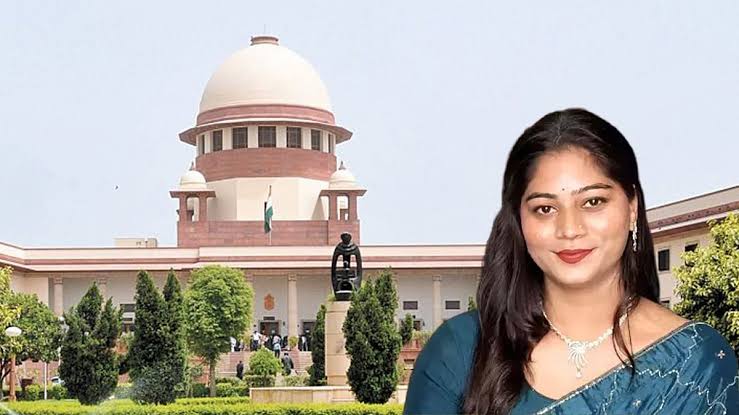
The Supreme Court has cancelled the bail granted to Sonam Raghuvanshi, who is an accused in the high-profile murder case involving the death of her husband, Raja Raghuvanshi, during their honeymoon in Meghalaya. The court has directed Sonam to surrender before the concerned trial court within three weeks, meaning she will have to return to custody as the criminal proceedings in the case move forward.
The Supreme Court’s decision marks a significant development in a case that has attracted widespread attention since the couple’s honeymoon trip ended in tragedy. Sonam is among those accused in connection with the alleged killing of Raja, and the case remains pending before the trial court.
The apex court’s intervention came after the Meghalaya government challenged the decision of the High Court that had upheld the grant of bail to Sonam. The state had argued that the bail order should not have been allowed and questioned the reasoning on which the relief was granted.
At the centre of the legal dispute was the issue of whether Sonam had been properly informed about the grounds for her arrest. The High Court had taken the view that she was entitled to bail because the mandatory grounds of arrest had not been communicated to her at the time of her arrest.
The state government, however, disputed this interpretation. Its position was that Sonam had, in fact, been informed about the reasons for her arrest and that the issue arose because of an error in the arrest documentation.
According to the state’s argument, the arrest memo contained a typographical mistake in the section of law mentioned in connection with the alleged offence. The document referred to Section 403(1), a provision that does not exist, instead of Section 103(1) of the Bharatiya Nyaya Sanhita, which deals with the offence of murder.
The state maintained that the incorrect provision in the arrest memo was only a clerical or typographical error and did not mean that Sonam was unaware of the grounds for her arrest. The matter eventually reached the Supreme Court, which considered the legal arguments surrounding the bail order and the circumstances of the arrest.
With the Supreme Court now setting aside the bail granted to Sonam, the accused has been given a period of three weeks to surrender before the trial court. The direction means that she will have to comply with the court’s order and return to custody while the legal proceedings continue.
The development is expected to have a major bearing on the next stage of the case. The trial court will continue to deal with the criminal proceedings, while the prosecution and defence will present their respective cases in accordance with the law.
The case has remained under close public scrutiny because of the circumstances surrounding Raja Raghuvanshi’s death. The couple had travelled to Meghalaya for their honeymoon, but the trip turned into a criminal investigation after Raja was allegedly killed. The investigation subsequently led to the arrest of Sonam and other accused persons in connection with the case.
The Supreme Court’s latest order does not determine the final guilt or innocence of the accused. The allegations against Sonam and the other accused will ultimately have to be established through evidence and judicial proceedings before the trial court. As with all criminal cases, the accused are entitled to the due process of law until a final verdict is delivered.
The bail dispute had primarily focused on procedural and constitutional safeguards relating to arrest and the communication of the grounds of arrest. The Supreme Court’s decision to cancel the bail now places the focus back on the ongoing criminal proceedings and the eventual trial.
The order also highlights the importance of following proper legal procedures during arrests. While the state argued that the incorrect legal section in the arrest memo was merely a typographical mistake, the issue became significant because of the legal requirement concerning communication of the grounds of arrest.
For now, Sonam has three weeks to surrender before the trial court. The case will continue to be closely watched as the judicial process progresses and further proceedings take place.
The Supreme Court’s decision represents a fresh turn in the Meghalaya honeymoon murder case, bringing the accused back under the custody framework while the trial and related legal proceedings continue. The final outcome of the case will depend on the evidence presented before the court and the findings reached through the judicial process.