
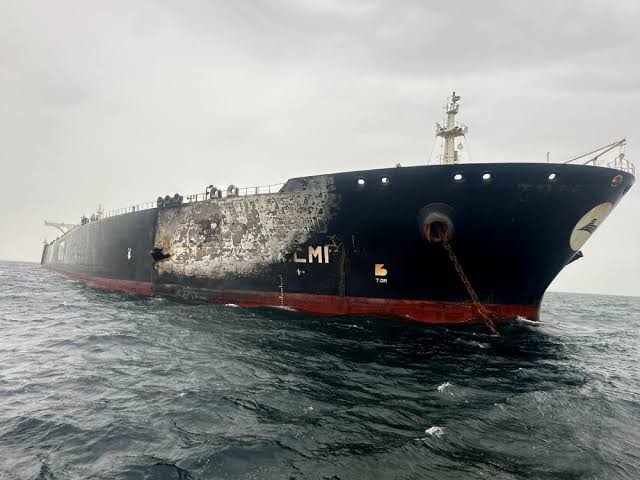
The conflict between the United States and Iran intensified further as military strikes, threats against critical infrastructure and attacks on commercial shipping raised fears of a wider regional confrontation. The latest escalation came as a Saudi-linked oil tanker was reportedly struck near Yemen, while Iran faced another round of US attacks and Kuwait reported that its air defence systems had intercepted hostile drones.
The developments have added to growing concerns over the security of vital shipping routes and energy infrastructure across the Middle East. With tensions affecting both the Strait of Hormuz and the Red Sea, global oil markets have also reacted sharply, with crude prices climbing to their highest levels in several weeks.
US carries out another round of strikes on Iran
American forces launched strikes against Iranian military targets for the 12th consecutive night, according to US military officials. The operations reportedly targeted a range of facilities linked to Iran’s military capabilities, including missile and drone storage sites, coastal surveillance installations, air defence systems and maritime assets.
The US Central Command said the operations were intended to reduce Iran’s ability to threaten commercial vessels and civilian mariners operating in regional waters. The latest mission reportedly continued for around five hours.
US officials have indicated that American forces have carried out attacks on numerous Iranian military locations during the month while maintaining pressure on Tehran through a naval blockade.
The continuing military campaign has significantly increased uncertainty across the region, particularly around strategic waterways that are crucial to international trade and energy transportation.
Trump threatens Iranian infrastructure over attacks on ships
US President Donald Trump issued a new warning to Tehran, saying Washington would respond to any further attacks on ships in the Strait of Hormuz by targeting Iranian infrastructure.
Trump said that if Iran continued firing missiles, rockets or deploying drones against vessels in the strategically important waterway, the United States would destroy a bridge or power plant in response.
The warning represents a further escalation in rhetoric between Washington and Tehran. It also raises concerns about the possibility that the conflict could expand beyond military targets to include infrastructure that supports civilian life and economic activity.
Speaking at a political rally, Trump maintained that Iran was under intense military pressure but had not yet agreed to a settlement. He suggested that Tehran could eventually become willing to negotiate, while also predicting that oil prices would decline despite the current market disruption. 
Iran vows retaliation against regional infrastructure
Iran responded to the US threat with a warning of its own. Iranian officials said any American attack on civilian infrastructure would result in a forceful response.
Iran’s military leadership reportedly warned that energy facilities, oil and gas infrastructure, electricity networks and other economic assets across the region could become targets if Washington carried out its threats.
Iranian Foreign Minister Abbas Araghchi also warned that any direct aggression against Iranian infrastructure would lead to retaliation. The message reflected Tehran’s stated intention to respond to attacks on its territory and strategic facilities.
A military source cited by Iranian media also warned that bridges and infrastructure across the region could be targeted, including facilities connected to American interests.
The exchange of threats has deepened fears that the conflict could move into a broader phase in which critical infrastructure and energy facilities become increasingly vulnerable.
Houthi attacks raise fresh concerns over Red Sea shipping
The conflict’s impact was also felt in the Red Sea, where Yemen’s Iran-backed Houthi movement claimed responsibility for attacks on two oil tankers.
A maritime monitoring organisation had earlier reported that the master of a tanker said the vessel had been struck southwest of Al Shuqaiq, along Saudi Arabia’s Red Sea coastline. Reports indicated that the ship caught fire following the attack.
The incident has heightened concerns over the safety of commercial shipping in one of the world’s most important maritime regions.
The Red Sea has gained additional importance as shipping companies seek alternatives to the Strait of Hormuz, where disruptions have affected normal commercial traffic. Any sustained attacks on vessels operating in the Red Sea could therefore create another major obstacle for global energy transportation.
The latest incident also underlines the growing complexity of the regional crisis, with the conflict involving not only the United States and Iran but also armed groups operating in strategically important areas.
Kuwait reports drone threats
Kuwait also reported a fresh security incident as its armed forces said air defence systems had responded to hostile drones.
Kuwaiti authorities said its air defence units were dealing with aerial threats and clarified that explosions heard in the country were associated with efforts to intercept hostile targets.
The reported drone activity added to concerns that the conflict could spread to neighbouring Gulf countries. Kuwait’s geographic position and proximity to regional military activity make it particularly sensitive to developments involving Iran and the wider Gulf security environment.
The incident also highlighted the growing role of drones in the conflict, with unmanned aerial systems increasingly being used as a relatively low-cost means of threatening military and commercial targets.
Reports of casualties following strikes inside Iran
Iranian state media reported fresh US missile strikes in several parts of western Iran. Areas near Ahvaz, Ramshir, Andimeshk, Abdanan and Chovar were among the locations reportedly affected.
Iranian authorities also activated air defence systems over Tehran amid the heightened military activity.
Separately, Iranian state media reported that two people were killed following a missile strike in Shalamcheh, near the country’s border with Iraq.
The reports could not immediately be independently verified in full, but the developments demonstrated the continuing intensity of the military confrontation and the risks faced by civilians living in affected areas.
Oil prices surge amid fears over energy supplies
The latest developments have also had a direct impact on global energy markets.
Brent crude prices climbed above $93 a barrel and briefly moved beyond $95 in after-hours trading, while US crude prices rose above $88 a barrel. The increase pushed oil prices to their highest levels in roughly six weeks.
The market reaction reflects growing fears that prolonged military activity could disrupt oil production, transportation and exports from the Middle East.
The Strait of Hormuz remains particularly important to global energy markets because of the enormous volume of oil and other energy products that normally pass through the waterway. Any prolonged disruption could put additional pressure on supplies and increase costs for consumers and businesses worldwide.
The possibility of simultaneous disruptions in the Strait of Hormuz and the Red Sea has further complicated the outlook for global trade. While the two waterways serve different shipping routes, both are critical to the movement of energy and commercial goods.
Regional conflict raises risk of wider escalation
The latest developments suggest that the US-Iran conflict is increasingly extending beyond direct military confrontation. Attacks involving commercial shipping, threats against energy infrastructure and reported drone activity in neighbouring countries are creating new risks for the wider Middle East.
The situation has also placed significant pressure on global markets. Higher crude prices could eventually affect transportation costs, inflation and the prices of essential goods if the disruption continues for an extended period.
For countries dependent on imported energy, prolonged instability in the region could create additional economic challenges. Meanwhile, shipping companies may face higher insurance costs and be forced to reconsider routes if attacks on commercial vessels continue.
The combination of military strikes, threats against infrastructure and disruptions to major maritime corridors has therefore created a highly volatile situation.
As the United States and Iran continue to exchange threats, the possibility of further retaliation remains a major concern. The security of commercial shipping, the stability of global energy markets and the potential involvement of additional regional actors will remain key factors in determining how the crisis develops in the days ahead.