

The Delhi Police have registered four criminal cases following the violence and clashes that broke out during the Cockroach Janta Party (CJP) march towards Parliament, with investigators preparing to file two additional cases, officials familiar with the matter said on Tuesday.
The cases have been filed in connection with several alleged offences reported during Monday’s large-scale protest, including unlawful assembly, obstruction of public servants, alleged attacks on police personnel, damage to government property and suspected attempts to provoke violence. One of the FIRs also relates to the alleged unauthorised operation of a drone in the high-security New Delhi area.
Police officials said the investigation is continuing and that further legal action will depend on the evidence collected. No arrests had been made at the time of the latest update.
The protest had drawn a large crowd to central Delhi, with demonstrators attempting to move towards the Parliament complex to demand the resignation of Union Education Minister Dharmendra Pradhan. The protesters have been raising concerns over alleged examination irregularities and repeated question paper leaks.
Four Cases Filed in Connection With Protest Violence
According to police officials, one of the four cases concerns the unauthorised flying of a drone in New Delhi, where aerial activity is subject to strict restrictions, particularly during the ongoing Parliament session.
A second case relates to an alleged conspiracy to incite violence during the protest. Investigators have claimed that they have obtained significant evidence as part of the probe but have not disclosed specific details, citing the sensitive and ongoing nature of the investigation.
The remaining two cases concern alleged obstruction of government officials in the discharge of their duties, assault on police personnel and damage to public property.
The cases have been registered at police stations including Connaught Place, Parliament Street and Kartavya Path. The FIRs also reportedly include provisions under the Arms Act in connection with allegations that some individuals were carrying prohibited weapons.
Police have alleged that sections of the protesting crowd gathered in violation of restrictions, disrupted public order, interfered with government officials and resorted to violence and vandalism. Investigators are now examining available evidence to determine individual responsibility and establish the sequence of events that led to the clashes.
Two More Cases Likely to Be Registered
The police are also expected to register two additional cases under provisions of the Bharatiya Nyaya Sanhita relating to assault. One of the proposed cases is expected to deal with allegations involving individuals who allegedly took the law into their own hands during the confrontation.
Officials have indicated that the investigation will continue before further arrests or other legal action are initiated. The police are likely to examine video recordings, statements from witnesses and other available material to identify those allegedly involved in specific incidents of violence or damage.
The absence of arrests so far does not indicate that the investigation has been closed. Police officials said action would be taken after examining the evidence and determining the role of individuals identified during the probe. 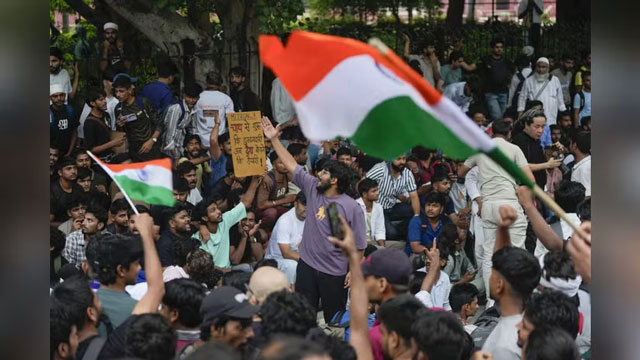
Large Protest Turns Violent in Central Delhi
The violence followed a major mobilisation in central Delhi, where thousands of protesters marched towards Parliament on Monday. The demonstration came after a 23-day sit-in and hunger strike at Jantar Mantar.
The protesters were demanding accountability over alleged examination irregularities and repeated question paper leaks, with the resignation of the Union education minister emerging as one of their key demands.
As the crowd moved towards Parliament, security forces attempted to prevent protesters from crossing barricades and advancing further into the high-security area. The situation escalated when sections of the crowd reportedly pushed through barricades, prompting security personnel to use force to control the gathering.
The Parliament complex was placed under heightened security, with its gates reportedly being sealed amid the unrest. Security personnel, including Central Industrial Security Force personnel, were deployed around the complex as authorities sought to prevent the protesters from reaching the premises.
The deployment and response during the confrontation have since become a subject of public debate, with questions being raised over the use of force against demonstrators. Police, however, maintained that the march was unauthorised and that security personnel acted to contain the situation and protect public infrastructure.
Police and Protesters Give Different Accounts of Injuries
The scale of injuries following the clashes remains a matter of competing claims.
Delhi Police said that 118 personnel, including senior officers, were injured during the confrontation. The exact number of injured protesters was not immediately clear, although police put the figure at around 60.
Other accounts suggested that the number of injured protesters could have been significantly higher. Officials at a government hospital reportedly said that at least 100 protesters had been treated for injuries following the clashes.
The conflicting figures are likely to remain part of the wider debate surrounding Monday’s confrontation, particularly as allegations have emerged regarding the use of force by security personnel and the conduct of protesters.
Authorities Underestimated Size of Gathering
The scale of the mobilisation appeared to catch authorities off guard. Officials estimated that approximately 35,000 people had gathered, while protesters and eyewitnesses claimed that the actual turnout was at least twice that number.
Around 2,000 police personnel and 20 companies of paramilitary forces were reportedly deployed to manage the situation and secure sensitive areas in central Delhi.
The large turnout included students, young professionals and people participating in protests for the first time. The gathering reportedly grew substantially over the weekend before reaching a peak on Monday.
The sudden increase in the size of the crowd created significant challenges for security agencies, particularly as the protest was taking place close to Parliament during an active session.
Background to the CJP Movement
The CJP movement emerged following controversial remarks attributed to Chief Justice of India Surya Kant, who had used the terms “cockroaches” and “parasites” while referring to certain individuals. He later clarified that the comments were not directed at the country’s youth but at people who, according to him, had entered professions such as law and media using fake or bogus degrees.
The remarks triggered a strong reaction on social media and contributed to the formation of the CJP platform, which subsequently gained a substantial online following.
The movement’s campaign expanded into a broader protest against alleged irregularities in the examination system. A sit-in began at Jantar Mantar on June 6, with protesters demanding the resignation of Education Minister Dharmendra Pradhan over alleged question paper leaks and other examination-related concerns.
The movement received further attention following the removal of activist Sonam Wangchuk from the protest site, an incident that reportedly intensified public mobilisation.
Investigation to Determine Individual Responsibility
With four cases already registered and two more expected, the Delhi Police investigation is likely to focus on identifying individuals allegedly involved in specific acts of violence, obstruction and property damage.
The authorities will also examine allegations concerning the use of prohibited weapons and the alleged conspiracy to provoke violence. The drone-related case is expected to be investigated separately because of the heightened security restrictions surrounding Parliament and other sensitive government locations.
Police officials have not announced any arrests so far and have indicated that decisions will be based on evidence collected during the investigation.
The developments have added a new legal dimension to a protest that began as a campaign over examination irregularities but escalated into a major confrontation between demonstrators and security personnel in central Delhi. As the investigation progresses, attention is likely to remain focused on the evidence gathered by police, the circumstances surrounding the violence and the accountability of those found responsible.
The incident has also renewed discussion over the balance between the right to peaceful protest and the responsibility of authorities to maintain public order and protect sensitive government institutions. Further legal proceedings and the expected filing of additional cases are likely to determine the next phase of the matter.