
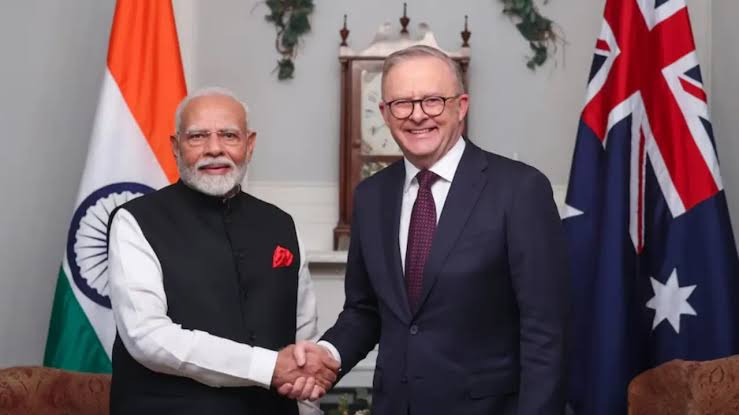
Prime Minister Narendra Modi commenced his official visit to Australia with a ceremonial Guard of Honour, marking the beginning of an important diplomatic engagement aimed at further strengthening the growing strategic partnership between India and Australia. The visit is expected to focus on expanding cooperation across defence, trade, investment, critical minerals, clean energy, technology, education, and regional security, reinforcing the close ties between the two Indo-Pacific nations.
The visit comes at a significant time as India and Australia continue to deepen their comprehensive strategic partnership amid evolving geopolitical developments in the Indo-Pacific region. Leaders from both countries are expected to discuss a wide range of bilateral and global issues while exploring new avenues for long-term collaboration.
Ceremonial Welcome Marks Beginning of High-Level Engagements
Upon his arrival in Australia, Prime Minister Modi received a formal Guard of Honour, underscoring the importance Australia places on its relationship with India. The ceremonial reception set the tone for a series of official engagements, including bilateral discussions with senior Australian leadership, meetings with business representatives, and interactions focused on strengthening people-to-people ties.
The ceremonial welcome reflected the steady evolution of India-Australia relations over recent years, with both governments placing increasing emphasis on political cooperation, economic integration, and shared regional interests.
Bilateral Talks to Cover Wide-Ranging Cooperation
One of the central highlights of the visit is the bilateral meeting between Prime Minister Modi and his Australian counterpart. The discussions are expected to cover several strategic sectors that have emerged as pillars of the India-Australia partnership.
Trade and investment are likely to remain key priorities, with both countries seeking to increase bilateral commerce, encourage greater business participation, and improve market access. Officials are also expected to review progress made under existing economic agreements while identifying opportunities for expanding cooperation in emerging industries.
Defence and security collaboration will also feature prominently in the talks. India and Australia have steadily enhanced military cooperation through joint exercises, maritime security initiatives, intelligence sharing, and defence dialogues. With increasing strategic challenges in the Indo-Pacific, both countries are expected to reaffirm their commitment to maintaining a free, open, inclusive, and rules-based regional order.
Focus on Critical Minerals and Clean Energy
Critical minerals have become an increasingly important area of cooperation between India and Australia. Australia possesses significant reserves of lithium, cobalt, and other essential minerals required for electric vehicles, renewable energy infrastructure, and advanced manufacturing.
India, which is rapidly expanding its clean energy and electric mobility sectors, views Australia as a reliable partner for securing resilient supply chains. The leaders are expected to discuss ways to strengthen cooperation in mining, mineral processing, and technology partnerships that support sustainable industrial growth.
Clean energy collaboration is also expected to receive considerable attention. Both nations have shown growing interest in renewable energy, hydrogen technology, climate resilience, and sustainable development initiatives aimed at reducing carbon emissions while supporting economic growth.
Technology and Innovation to Drive Future Partnership
Technology has emerged as another important pillar of India-Australia cooperation. The bilateral discussions are expected to explore collaboration in artificial intelligence, cybersecurity, digital infrastructure, semiconductor development, quantum technologies, and advanced research.
Innovation partnerships involving universities, research institutions, and technology companies are likely to receive renewed attention as both governments seek to build resilient digital ecosystems and promote knowledge sharing.
Educational cooperation, including student exchanges, research collaborations, and skill development initiatives, is also expected to be discussed as both countries continue to strengthen academic and cultural connections.
Strengthening Economic Relations
Economic cooperation between India and Australia has witnessed significant momentum in recent years. Bilateral trade has expanded steadily, supported by stronger commercial engagement and policy initiatives designed to facilitate investment.
During the visit, both sides are expected to encourage greater participation from businesses, promote investment opportunities, and identify sectors where private industry can play a larger role. Infrastructure, manufacturing, renewable energy, agriculture, logistics, and digital services are expected to remain areas of mutual interest.
Business leaders from both countries are also expected to participate in discussions aimed at creating stronger commercial partnerships and encouraging long-term investment.
Shared Vision for the Indo-Pacific
Regional security remains a major element of India-Australia relations. As important partners in the Indo-Pacific, both countries continue to work together on issues concerning maritime security, regional stability, disaster response, and supply chain resilience.
The leaders are expected to exchange views on regional developments while reaffirming their shared commitment to international law, freedom of navigation, peaceful dispute resolution, and multilateral cooperation.
Their discussions are also likely to address broader global challenges, including economic uncertainty, climate change, energy security, and international peace.
Growing Comprehensive Strategic Partnership
India and Australia have transformed their bilateral relationship into a Comprehensive Strategic Partnership through consistent high-level engagement and expanding cooperation across multiple sectors.
Over the years, collaboration has extended beyond government-to-government interactions to include stronger business ties, educational exchanges, scientific research partnerships, defence cooperation, and growing people-to-people connections.
Prime Minister Modi’s visit is expected to build on this momentum by identifying new opportunities for collaboration while reviewing the progress made under existing bilateral initiatives.
Outlook
The Australia visit represents another significant step in strengthening one of India’s most important strategic partnerships in the Indo-Pacific region. As both countries continue to expand cooperation across defence, trade, technology, clean energy, education, and regional security, the discussions are expected to lay the foundation for deeper collaboration in the years ahead.
With shared democratic values, complementary economic interests, and a common vision for regional stability, India and Australia are positioning their partnership as an increasingly important pillar of cooperation in the evolving global landscape.