
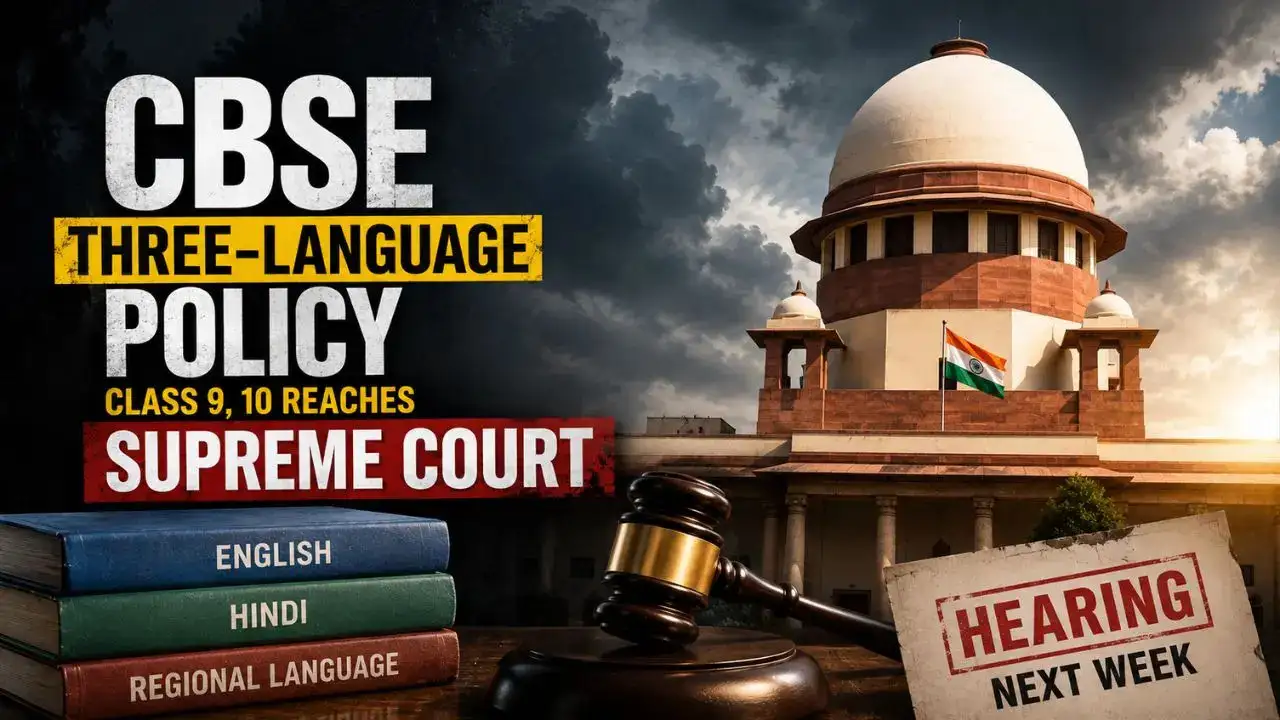
The Supreme Court is set to hear a petition challenging the Central Board of Secondary Education’s (CBSE) implementation of a three-language requirement for students entering Class 9, a move that has reignited debate over language policy, educational autonomy, and constitutional rights in India’s school system.
The case has attracted national attention as it touches upon sensitive issues related to linguistic diversity, federalism, and the balance between educational reforms and regional preferences. Petitioners opposing the policy argue that the mandatory language structure may place an unfair burden on students and schools, particularly in states where language politics has historically been a contentious issue.
Background of the Controversy
The dispute centers around CBSE’s direction linked to the implementation of the three-language formula in secondary education. The policy framework, aligned with broader educational reforms introduced under the National Education Policy (NEP) 2020, seeks to encourage multilingual learning among students across the country.
Under the framework, students are expected to study three languages during their school education. Supporters of the policy argue that multilingual education enhances cognitive development, promotes national integration, and preserves linguistic heritage. However, critics claim that enforcing such a structure without sufficient flexibility could adversely affect students, especially those from non-Hindi-speaking regions.
The plea before the apex court reportedly questions whether the policy effectively imposes linguistic preferences that may conflict with constitutional protections and state-level educational priorities. 
Petitioners Raise Constitutional and Academic Concerns
Those challenging the mandate contend that compulsory implementation of a three-language structure may violate principles of equality and educational freedom. The petition reportedly raises concerns that students could face additional academic pressure due to mandatory language requirements alongside already demanding curricula in science, mathematics, and social sciences.
Legal arguments are also expected to focus on whether a central education board can enforce language policies in a manner perceived to undermine regional linguistic autonomy. Petitioners may argue that education, especially language instruction, is closely tied to cultural identity and state rights.
Another key concern revolves around practical implementation. Critics claim that many schools may lack adequately trained language teachers or resources to effectively offer multiple language options. This, they argue, could create disparities between urban and rural institutions and place economically weaker students at a disadvantage.
Broader Debate Over Language Policy in India
Language has long remained a politically and culturally sensitive subject in India. The three-language formula itself has undergone multiple interpretations since its original introduction decades ago. While intended to promote multilingualism and national unity, implementation has varied widely among states.
Several southern and northeastern states have historically expressed reservations about perceived attempts to promote Hindi through national education policies. Some regional political parties and educational groups have repeatedly emphasized the importance of preserving local languages and ensuring that students are not compelled to adopt linguistic frameworks that conflict with regional educational models.
The current legal challenge is therefore being viewed not merely as an educational dispute, but also as part of a larger national conversation about cultural representation, diversity, and policymaking in a multilingual democracy. 
CBSE and Education Reform Perspective
Supporters of the three-language approach maintain that multilingual education prepares students for a more interconnected and competitive future. Educational experts advocating the policy argue that learning multiple languages can improve communication skills, broaden career opportunities, and foster cross-cultural understanding.
The National Education Policy 2020 strongly encourages mother tongue-based education and multilingual learning, presenting language diversity as a core strength of India’s education system. Proponents insist that the framework is intended to offer flexibility rather than compulsion and that fears surrounding linguistic imposition are often exaggerated.
Education policymakers may defend the move by highlighting the importance of preserving Indian languages while also equipping students with broader linguistic competencies in an increasingly globalized environment.
Supreme Court Hearing Expected to Have Wider Implications
The upcoming hearing is expected to have significant implications for school education policy across India. Legal experts believe the court’s observations could shape future interpretations of educational autonomy, language rights, and the powers of national education boards.
A ruling or interim direction from the Supreme Court could influence how language policies are implemented not only within CBSE-affiliated schools but also across other educational institutions that follow central guidelines.
The case may also prompt renewed discussions between the Union government, state governments, educators, and civil society groups regarding the need for flexibility and inclusiveness in language education policies.
As the matter comes before the country’s highest court, students, parents, schools, and policymakers alike will be closely watching the proceedings, given their potential long-term impact on India’s evolving educational landscape.