
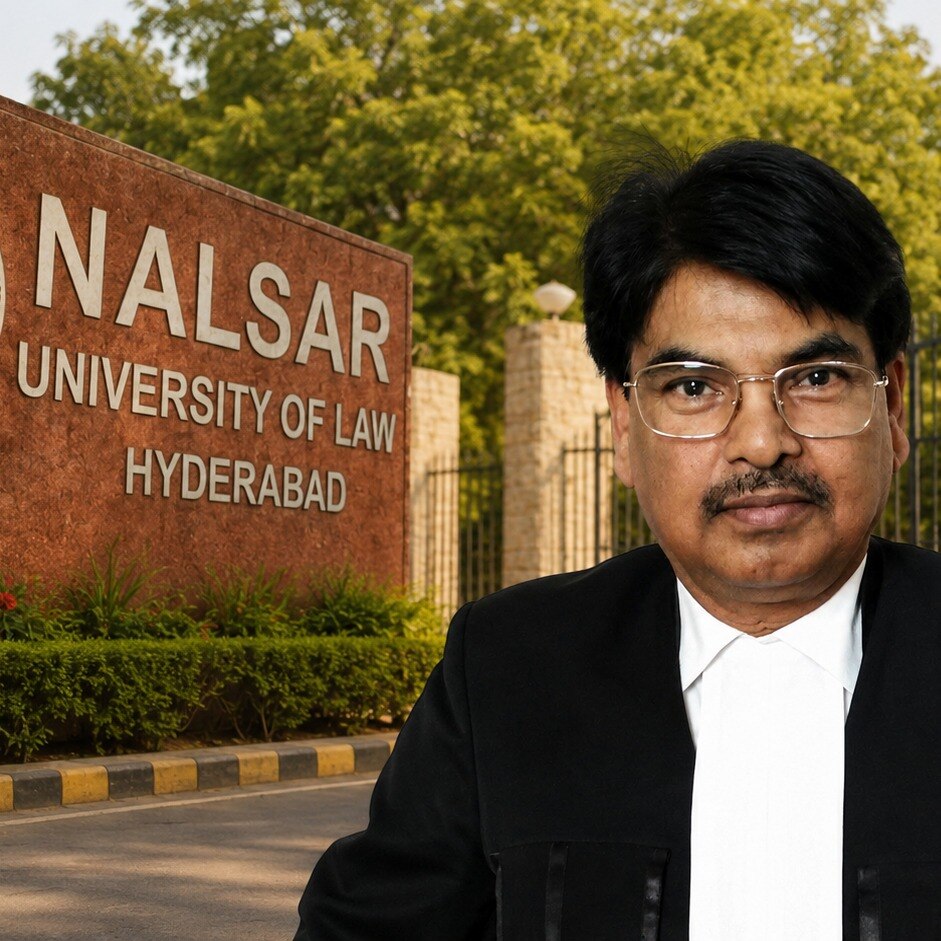
The Supreme Court has questioned the authority of the Bar Council of India (BCI) to initiate disciplinary action against law students, observing that the statutory regulator does not have the power to penalise students who have not yet entered the legal profession.
The observation came during proceedings linked to the controversy involving students of the National Academy of Legal Studies and Research (NALSAR) in Hyderabad and the BCI’s decision to intervene after a section of students opposed the proposed participation of Chief Justice of India Surya Kant as the chief guest at the university’s convocation.
The dispute has raised wider questions about the limits of the BCI’s statutory powers, the rights of students to express dissent and the extent to which a professional regulatory body can intervene in matters involving individuals who have not yet been enrolled as advocates.
Supreme Court questions BCI’s jurisdiction
During the hearing, the Supreme Court made it clear that the BCI’s disciplinary jurisdiction primarily concerns advocates and does not automatically extend to law students.
The court questioned why the BCI had sought to take action against students who were still pursuing or had recently completed their legal education and had not yet been enrolled as advocates.
The issue assumed importance after the BCI initially directed State Bar Councils not to enrol the 2026 graduating batch of NALSAR as advocates. The move followed a campaign by a section of students over the invitation extended to the Chief Justice of India for the university’s convocation.
The Supreme Court’s intervention brought the focus back to the statutory framework governing the BCI and State Bar Councils and whether the regulator could use its professional powers against students before they formally entered the legal profession.
Dispute began over CJI’s convocation invitation
The controversy originated at NALSAR after a group of students objected to the proposed invitation of Chief Justice Surya Kant as the chief guest for the university’s convocation.
The students expressed their disagreement through a campaign and representation to the university. Their action was linked to concerns over remarks attributed to the CJI during earlier court proceedings.
Rather than treating the issue solely as an internal university matter, the BCI became involved and sought information about the campaign and those allegedly responsible for organising it.
The regulator subsequently issued directions affecting the enrolment of the university’s graduating students, triggering a major debate within legal and academic circles.
The initial directive affected the entire 2026 graduating batch, rather than being limited to students who had allegedly participated in the campaign. This aspect became one of the most contentious elements of the dispute.
BCI withdraws enrolment directive
The BCI’s initial decision was subsequently withdrawn.
The Council later clarified that the large majority of NALSAR students were not responsible for the campaign and should not suffer because of the actions of a smaller group. It also indicated that the proceedings concerning the students would ultimately be closed.
The rapid reversal, however, did not end the legal questions surrounding the episode.
Instead, the controversy prompted scrutiny of the statutory basis for the BCI’s intervention and whether its authority could extend to students who had not yet become advocates.
Difference between students and enrolled advocates
At the centre of the dispute is an important distinction under the Advocates Act.
State Bar Councils are responsible for admitting eligible persons to their rolls as advocates. The BCI, meanwhile, has significant responsibilities relating to professional standards, legal education, recognition of law degrees and supervision of State Bar Councils.
Its disciplinary jurisdiction is principally concerned with professional misconduct by advocates.
A law graduate who has not been enrolled as an advocate does not occupy the same legal position as a practising lawyer. Consequently, the question of whether disciplinary provisions applicable to advocates can be used against students became a crucial issue before the Supreme Court.
The court’s observations therefore have implications beyond the NALSAR dispute. They could reinforce the principle that regulatory powers must remain within the limits established by legislation and cannot automatically be expanded to cover individuals who fall outside the statutory framework.
Right to peaceful protest also comes under scrutiny
The case has also brought the constitutional protection of freedom of speech and peaceful expression into focus.
The Supreme Court indicated that students have the right to peacefully express their views, including disagreement with public figures and institutions, provided their conduct remains within the boundaries of law.
The fact that the students were challenging the proposed appearance of the Chief Justice at their convocation became particularly significant because the dispute involved a public institution and a senior constitutional authority.
The court’s approach underlined the distinction between legitimate dissent and unlawful conduct. Merely expressing disagreement, without more, cannot automatically be treated as professional misconduct.
The episode has consequently generated a broader discussion about the role of law schools in encouraging debate, critical thinking and constitutional awareness.
CJI says students have right to protest peacefully
During the proceedings, Chief Justice Surya Kant himself strongly disapproved of the BCI’s intervention.
He observed that if students were protesting peacefully, there was no justification for another institution to intervene in what he described as a matter between the students and himself.
The comments were significant because the controversy had originated from opposition to the CJI’s proposed presence at the NALSAR convocation.
The court’s position indicated that disagreement with a constitutional functionary, by itself, does not remove a student’s right to express an opinion.
The intervention also helped shift the focus of the dispute from the original disagreement over the convocation to the larger constitutional and statutory questions surrounding institutional power.
Questions over collective action against an entire batch
Another major concern was the BCI’s initial decision to halt enrolment of the entire graduating batch.
Critics questioned the basis for imposing consequences on students who may have had no involvement in the campaign.
A blanket restriction potentially affects students differently despite their individual conduct. Such an approach raises questions about proportionality and procedural fairness, particularly when professional enrolment can have a direct impact on a young law graduate’s career.
The controversy therefore highlighted the importance of individual responsibility in disciplinary proceedings. If particular students are alleged to have violated rules, any action ordinarily requires identification of the individuals concerned and adherence to the appropriate legal process.
Broader implications for legal education
The NALSAR controversy has developed into a larger debate about the relationship between legal education and professional regulation.
Law schools are expected to train students to understand constitutional principles, question legal arguments and critically examine the exercise of public power. At the same time, professional regulators have a responsibility to maintain standards within the legal profession.
The episode has raised questions about where that regulatory responsibility begins and ends.
The Supreme Court’s observations suggest that statutory authority cannot be assumed merely because an organisation has a broad regulatory role. The nature of the individual involved, the stage of professional entry and the specific statutory provision being invoked are all relevant when determining whether disciplinary action is legally permissible.
A test of institutional restraint
The dispute also highlights the importance of institutional restraint.
The BCI is a statutory body with significant responsibilities in India’s legal system. Its decisions can have direct consequences for students, lawyers and legal institutions.
The rapid sequence of events — from the initial enrolment restriction to its withdrawal and the subsequent judicial scrutiny — has consequently placed attention on the need for decisions affecting professional careers to be supported by clear statutory authority and due process.
For law students, the controversy has an added significance. The profession they are preparing to enter is built around principles such as natural justice, procedural fairness, freedom of expression and accountability under law.
The Supreme Court’s intervention has therefore turned the NALSAR dispute into a broader examination of how those principles should apply to the institutions that regulate the legal profession itself.
What the case could mean going forward
The immediate controversy over NALSAR’s graduating class may have been resolved through the withdrawal of the BCI’s action, but the legal questions it raised remain important.
The episode has underscored the distinction between the BCI’s authority over advocates and its responsibilities concerning legal education. It has also highlighted the need to ensure that students are not subjected to professional consequences without a clear legal basis.
At a broader level, the proceedings reaffirm the importance of peaceful dissent in an academic environment and the principle that regulatory institutions must exercise their powers within the boundaries established by law.
The Supreme Court’s intervention has thus transformed what began as a disagreement over a convocation invitation into a significant debate about statutory authority, student rights, institutional accountability and the limits of regulatory power in India’s legal education system.