
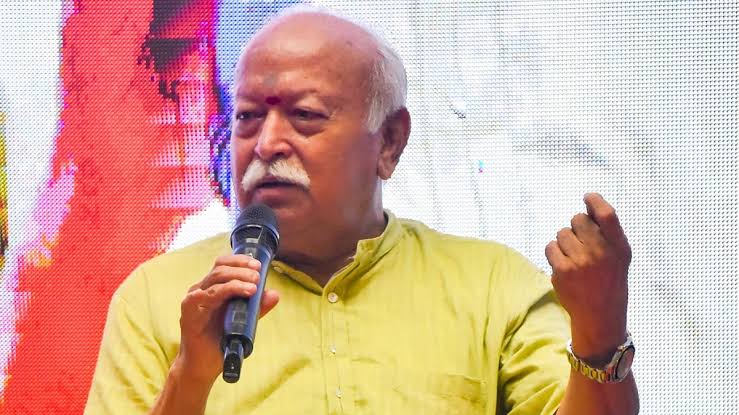
Rashtriya Swayamsevak Sangh (RSS) chief Mohan Bhagwat has urged members of the Indian diaspora in the United States to remain committed to the country where they live and work, describing America as their “karma bhumi” or land of duty, while India remains their “janma bhumi”, or land of birth.
Addressing a large gathering of Indian-Americans and interfaith leaders in New York, Bhagwat said members of the diaspora should fulfil their responsibilities towards American society while continuing to uphold the values and cultural principles they inherited from India.
His remarks came during the Universal Oneness Celebration at Madison Square Garden, an event centred on unity, diversity, interfaith understanding and shared human responsibility. The gathering brought together thousands of members of the Indian-American community, religious leaders, students and representatives of organisations from across the United States.
Bhagwat’s message to Indian-Americans
A central theme of Bhagwat’s address was the distinction between “janma bhumi” and “karma bhumi”.
He said Indians living in America have a responsibility towards the society in which they reside, earn their livelihoods and contribute to the economy. According to Bhagwat, members of the diaspora should therefore conduct themselves as responsible members of American society and remain loyal to the country that has become their place of work and action.
He argued that an emotional or cultural connection with India does not diminish the responsibilities an individual has towards the country where they currently live.
Bhagwat said that India would continue to remain the diaspora’s land of birth and that Indians abroad could contribute to their ancestral homeland if they wished to do so. However, he stressed that such efforts should come after fulfilling their responsibilities towards their country of residence.
The RSS chief also linked this responsibility to the values associated with Indian civilisation. He said the connection with India should not be understood merely through geography or nationality, but through the values that individuals carry with them and demonstrate in their daily lives.
‘Unity in diversity’ at the centre of Bhagwat’s address
Another major focus of the speech was the concept of unity in diversity.
Bhagwat said diversity and unity should not be treated as opposing ideas. Instead, he described diversity as something that adds richness to the underlying sense of human unity.
Drawing comparisons between India and the United States, he highlighted pluralism in American society and India’s long-standing idea of unity in diversity.
According to Bhagwat, the ability of people with different cultures, traditions, beliefs and backgrounds to coexist is an important principle for both societies.
He said diversity should be celebrated, respected and accepted while maintaining an understanding that human beings remain connected despite their differences.
The message was also reflected in the structure of the New York event, where cultural performances showcased traditions from India as well as several other parts of the world.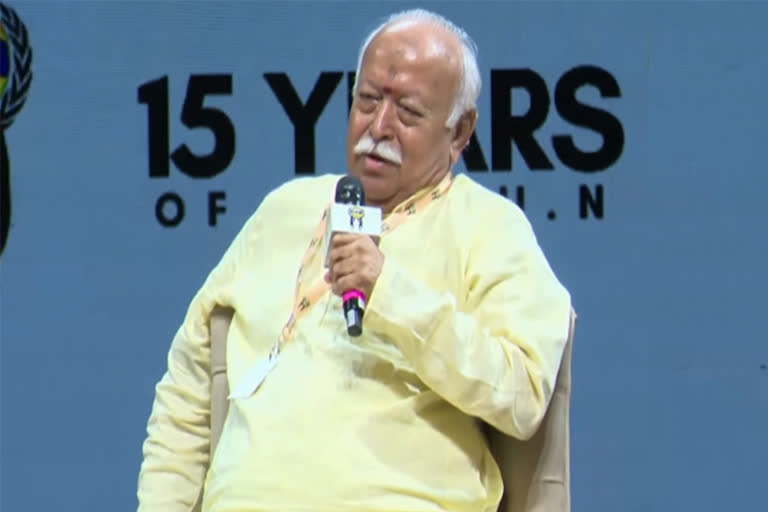
Emphasis on shared human responsibility
Bhagwat expanded his argument beyond the Indian diaspora and spoke about the broader responsibilities individuals have towards society and humanity.
He suggested that human progress cannot be measured only through personal achievements, financial success or material possessions. Instead, individuals should consider what they contribute to other people and to the communities around them.
He emphasised the importance of giving back to society, arguing that people receive resources, opportunities and support from others throughout their lives and therefore have a corresponding responsibility to contribute to the wider community.
The RSS chief also spoke about the relationship between individuals, society and the environment. He argued that development should not be viewed exclusively through the progress of individuals or economic growth, but should involve a balance between personal wellbeing, social development and environmental sustainability.
Material success is not the only measure of achievement
Bhagwat also questioned the idea that financial achievement alone determines whether a person has lived a successful life.
He stressed that earning money is only one part of human activity and that the manner in which wealth and resources are used is equally important.
His remarks placed greater emphasis on generosity, social responsibility and service rather than solely on accumulation of wealth.
He also referred to broader Indian philosophical ideas concerning material aspirations and higher human goals, suggesting that material prosperity and spiritual or social responsibility can coexist when approached with balance.
Cultural identity and responsibility
The RSS chief further argued that members of the Indian diaspora can preserve their cultural identity while becoming fully engaged in the societies where they live.
For Indians settled in the United States, this means maintaining their connection with India without allowing that connection to undermine their responsibilities towards American society.
Bhagwat presented Indian cultural values as principles that could be carried across national boundaries. In his view, values such as human unity, respect for diversity, responsibility towards others and harmony with nature could remain relevant regardless of where an individual lives.
His remarks therefore attempted to connect cultural identity with civic responsibility rather than presenting the two as contradictory.
Interfaith participation highlights message of coexistence
The New York programme also featured participation from religious and community leaders representing different faith traditions.
Speakers highlighted themes including compassion, dialogue, cooperation and solidarity among communities. The programme sought to promote the idea that people belonging to different religious and cultural backgrounds can work together while retaining their distinct identities.
Cultural performances by young Indian-American participants added another dimension to the event. Performances drew upon traditions from India and other parts of the world, reinforcing the programme’s emphasis on cultural diversity and shared humanity.
The event also brought together religious leaders from several countries, with discussions focusing on cooperation between communities and collective responsibility in addressing social challenges.
Bhagwat’s wider message
Bhagwat’s New York address formed part of his broader international outreach and came during his visit to the United States.
The speech combined several themes: responsibility towards one’s country of residence, continued connection with one’s country of birth, respect for cultural diversity, service to society and the importance of human unity.
For the Indian diaspora, his most direct message was that cultural roots and civic responsibilities can coexist. While India remains an important part of their historical and cultural identity, their immediate responsibilities lie with the societies in which they live and work.
He also presented unity in diversity as a principle that extends beyond India, arguing that a world marked by differences can still maintain a fundamental sense of interconnectedness.
The address ultimately placed the ideas of duty, identity, service and coexistence at the centre of Bhagwat’s message to Indian-Americans.