
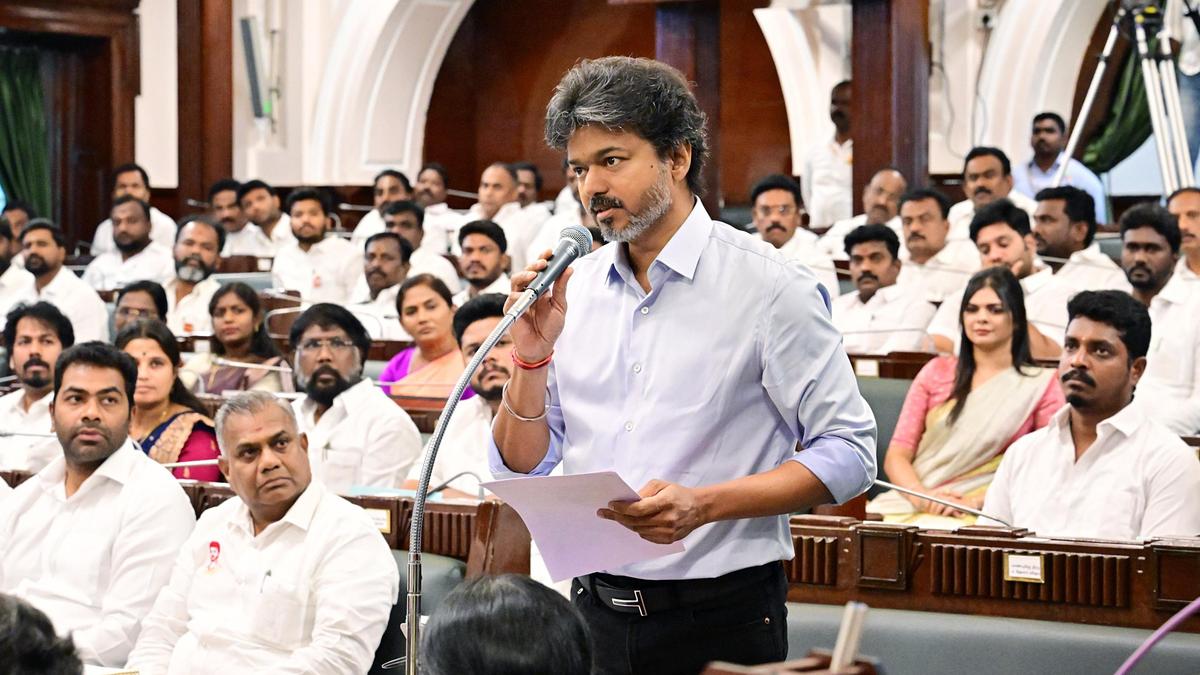
Tamil Nadu Chief Minister C Joseph Vijay has announced that his government will abandon the proposed greenfield airport project at Parandur, bringing a major policy shift to Chennai’s long-pending plans for a second airport. The decision, announced in the state Assembly, has triggered a political confrontation, with the opposition DMK accusing the government of undermining Tamil Nadu’s economic and industrial interests.
The government, however, has defended the move by citing the impact of the proposed airport on farmers, agricultural land, residential areas and local water resources. Vijay said his administration would continue working towards a second airport for Chennai but would search for an alternative location where the acquisition of farmland and displacement of residents could be minimised.
The Parandur airport proposal had been under consideration for several years as Chennai’s existing airport faced increasing passenger and cargo demand. The project had also become a major point of contention because residents of Parandur and surrounding villages had opposed the acquisition of their land.
Vijay government abandons Parandur plan
Speaking in the Assembly, Vijay said the government had decided not to proceed with the steps taken to establish the airport at Parandur. He maintained that the decision was driven by concerns raised by local residents and farmers who feared losing their agricultural land, homes and livelihoods.
The chief minister recalled his interaction with residents of Eganapuram and neighbouring villages, where protests against the airport project had continued for years. Vijay said he had listened to the concerns of the affected communities and had previously expressed his opposition to the proposed location.
The chief minister stressed that his government was not against development or the expansion of aviation infrastructure. Instead, he argued that development projects must be planned in a way that does not impose disproportionate costs on local communities.
According to the government, the proposed site contained extensive water bodies and wetlands, raising questions about the suitability of the area for a large airport project and the potential consequences of construction for drainage and flooding.
Chennai still needs a second airport
Although the Parandur proposal has been dropped, the government has made it clear that Chennai still requires an additional airport.
The existing airport at Meenambakkam currently has the capacity to handle about 30 million passengers annually. Vijay said the government plans to expand the existing facility, including the development of a new passenger terminal with additional capacity.
The administration also intends to improve airport facilities and manage passenger traffic more effectively while a suitable location for a second airport is identified.
Chennai is one of India’s major industrial and commercial centres, with significant activity in automobile manufacturing, electronics, technology, logistics and other sectors. The government believes that expanded aviation infrastructure will be essential to support the city’s future economic requirements.
The challenge now will be to identify a new site that can accommodate a major airport without creating the same level of conflict over land, livelihoods and environmental concerns.
Farmers welcome the decision
The decision has been welcomed by residents and farmers in villages that would have been affected by the proposed airport.
The Parandur project had faced sustained opposition since it was first announced. Local residents had expressed concern that large-scale land acquisition would disrupt farming activities and force families to relocate.
The protests also focused on the presence of water bodies and wetlands in the proposed project area. Residents argued that the ecological and agricultural importance of the land should be considered before undertaking a major construction project.
Vijay’s decision is therefore being viewed by supporters as the fulfilment of a political commitment to affected communities.
For the government, the move also allows the chief minister to reinforce his position that infrastructure development should be balanced with the protection of livelihoods and natural resources.
DMK attacks the government
The announcement immediately triggered a strong response from the opposition DMK, which had initiated and pursued the Parandur airport proposal while in government.
Former chief minister and DMK president MK Stalin criticised Vijay’s decision, arguing that scrapping the project could set Tamil Nadu’s development plans back by several years.
Stalin maintained that the airport was important for Chennai’s future industrial expansion and that considerable work had already been undertaken to advance the project. He argued that abandoning the selected location and beginning the process again could result in further delays, additional expenditure and uncertainty for investors.
The DMK has also argued that Chennai needs a world-class second airport to maintain Tamil Nadu’s position as one of India’s leading destinations for industrial investment.
According to the opposition, delays in creating additional aviation capacity could affect the state’s ability to attract new businesses, expand exports and generate employment.
Opposition stages Assembly walkout
The dispute escalated inside the Tamil Nadu Assembly after opposition members attempted to raise questions over the government’s decision.
DMK legislators and their allies staged a walkout, objecting to the manner in which the announcement was made and seeking an opportunity to debate the issue.
The confrontation reflects the political significance of the airport project. For the DMK, Parandur represents a major infrastructure initiative linked to the state’s economic strategy. For the ruling government, abandoning the project represents a commitment to residents who opposed land acquisition and environmental disruption.
The disagreement is likely to remain a prominent issue in Tamil Nadu politics as the government works on identifying an alternative location.
Debate over development and environmental concerns
The controversy surrounding Parandur highlights a broader challenge faced by governments across India: how to balance large infrastructure projects with the interests of communities living in proposed development zones.
Airports require substantial areas of land and often lead to changes in surrounding regions. New roads, commercial developments, warehouses, logistics facilities and industrial projects can emerge around airports, potentially creating employment and investment opportunities.
At the same time, airport construction can result in the loss of agricultural land and displacement of residents. In areas containing wetlands and water bodies, large-scale construction can also raise environmental and flood-management concerns.
The Parandur debate has brought these competing priorities into sharp focus.
Vijay has argued that Tamil Nadu can pursue economic growth without necessarily choosing a location that causes significant disruption to farming communities.
Industry worried about delays
While farmers and several groups opposed to the Parandur site have welcomed the government’s announcement, sections of the industrial community have expressed concern about the potential delay in creating Chennai’s second airport.
Tamil Nadu is one of India’s most important manufacturing states, and Chennai serves as a major hub for automobile, electronics and technology-related industries. Businesses depend on efficient passenger and cargo transportation to connect the region with other parts of India and international markets.
Industry representatives have therefore urged the government to identify an alternative site quickly and ensure that the process does not remain stalled for years.
Critics of the decision have warned that selecting a new location would require fresh technical assessments, land-related procedures, environmental evaluations, regulatory approvals and other administrative steps.
The government will consequently face pressure to demonstrate that dropping Parandur does not amount to abandoning Chennai’s second-airport requirement.
Search for an alternative site begins
The Tamil Nadu government has said it will examine alternative locations for the proposed second airport.
The new site is expected to be evaluated on several parameters, including technical feasibility, connectivity, land requirements, environmental impact and the effect on local communities.
The administration has indicated that agricultural land acquisition should be kept to a minimum and that residential settlements and livelihoods should not be significantly disrupted.
The government will also have to consider the long-term needs of Chennai. A replacement site must be capable of supporting a major airport and associated infrastructure for decades rather than simply solving the city’s immediate capacity concerns.
Existing airport expansion to provide interim relief
Until an alternative location is finalised, the government plans to increase the capacity of the existing Chennai airport.
The expansion is intended to provide additional passenger-handling capacity while the longer-term second-airport project is reconsidered.
The strategy could help ease pressure on the existing facility, but it is unlikely to remove the need for a second airport altogether if passenger and cargo traffic continues to grow.
This makes the search for an alternative site one of the most important infrastructure challenges facing the Vijay government.
A political and economic test for Vijay
The decision to abandon Parandur carries both political advantages and risks for the government.
On one side, Vijay can point to his support for farmers and residents who have opposed the airport for years. The decision reinforces his administration’s claim that major infrastructure projects should take public concerns and environmental considerations into account.
On the other hand, the government must respond to criticism that cancelling an advanced infrastructure proposal could delay industrial growth and weaken Chennai’s long-term competitiveness.
The administration’s next steps will therefore be closely watched.
If it succeeds in identifying a technically viable alternative location and moves forward with the project without prolonged opposition, the government could present the Parandur decision as a course correction rather than a retreat from development.
However, if the search for a new site remains prolonged, questions over the future of Chennai’s aviation infrastructure could intensify.
For now, the Parandur airport project has been formally abandoned, but the larger requirement for a second airport remains firmly on the government’s agenda. The coming months will determine whether Tamil Nadu can find a solution that satisfies the competing demands of economic development, aviation expansion, environmental protection and the interests of local communities.