
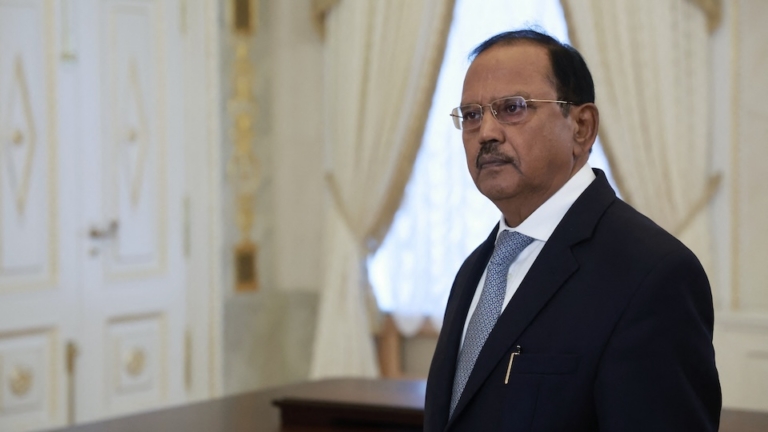
India’s National Security Adviser Ajit Doval is in Beijing for a high-level diplomatic engagement with China at a time when New Delhi and Beijing are attempting to stabilise relations while several sensitive issues remain unresolved. Doval’s two-day visit includes the 25th round of Special Representatives’ talks on the India-China boundary question with Chinese Foreign Minister Wang Yi, as well as a meeting with Chinese Vice President Han Zheng.
The visit comes at a strategically important moment for bilateral relations. India and China have been working to gradually restore dialogue after years of military tensions along their disputed Himalayan frontier, particularly following the deadly 2020 Galwan Valley clash and the prolonged military stand-off in eastern Ladakh.
The latest diplomatic engagement is also taking place ahead of two major international meetings in which India and China are expected to play important roles. The Shanghai Cooperation Organisation summit is scheduled to take place in Bishkek at the end of August, while India is preparing to host the BRICS summit in New Delhi in September. The possibility of Chinese President Xi Jinping travelling to India for the BRICS meeting has added further significance to the current diplomatic exchanges.
Doval’s Beijing visit comes at a crucial stage
Doval arrived in Beijing on August 24 for a two-day visit at the invitation of Wang Yi. He is representing India as its Special Representative for the boundary question, while Wang Yi is China’s designated Special Representative.
The two officials are scheduled to hold the 25th round of Special Representatives’ talks on August 25. The mechanism, established in 2003, remains one of the principal high-level political channels through which India and China address their long-running boundary dispute.
The talks are expected to focus primarily on the boundary question, but discussions are also likely to cover broader bilateral relations and regional and international developments. Chinese officials have described the Special Representatives mechanism as an important platform for communication between the two countries.
Doval is also scheduled to call on Han Zheng, China’s Vice President. The meeting gives the Indian side an opportunity to engage with another senior member of the Chinese leadership at a time when both governments are attempting to prevent border-related disagreements from damaging the broader relationship.
Border stability remains central to India-China relations
The disputed boundary remains the most sensitive issue between New Delhi and Beijing.
India and China share a Himalayan frontier stretching roughly 3,500 kilometres, although the two countries have differing assessments of the exact alignment of the Line of Actual Control. The absence of a mutually accepted boundary has repeatedly created the possibility of military confrontations.
Relations deteriorated sharply following the Galwan Valley clash in 2020, in which soldiers from both sides were killed. The confrontation triggered a prolonged military stand-off in eastern Ladakh and resulted in a substantial deterioration in political and economic relations.
Since then, military and diplomatic channels have been used repeatedly to reduce tensions. Both countries have taken steps aimed at preventing another major confrontation, although the larger boundary dispute remains unresolved.
For New Delhi, maintaining peace and tranquillity along the border remains closely connected with the broader question of normalising relations with Beijing. Indian officials have repeatedly stressed that improvements in economic, diplomatic and people-to-people relations depend on stability along the frontier.
Arunachal Pradesh adds another layer of tension
The eastern sector of the India-China boundary continues to be a particularly sensitive area.
China claims Arunachal Pradesh as part of what it describes as southern Tibet, while India firmly rejects the claim and maintains that Arunachal Pradesh is an integral part of the country. New Delhi has consistently opposed Chinese attempts to question India’s sovereignty over the state.
Recent reports of increased Chinese military activity near areas of Arunachal Pradesh have added to concerns surrounding the border. Indian officials have remained attentive to developments along the frontier, while Beijing has maintained that the overall border situation remains stable.
The competing positions underline the difficulty facing the Special Representatives. Even if the two sides can maintain peace along the LAC, reaching a final settlement of the boundary will require resolving deeply entrenched territorial and strategic differences.
What is expected from the 25th round of talks?
The 25th round is unlikely to produce an immediate settlement of the entire boundary dispute. Instead, the emphasis is expected to remain on managing differences, strengthening communication and creating conditions for continued stability.
Previous rounds of talks have focused on several aspects of the dispute, including boundary management, military disengagement, de-escalation and mechanisms for preventing future incidents.
Earlier this month, officials from India and China also held discussions under the Working Mechanism for Consultation and Coordination on India-China Border Affairs. The discussions covered issues including boundary delimitation, border management, institutional mechanisms and trans-border cooperation.
These preparatory engagements could provide a foundation for the latest Special Representatives meeting.
A key challenge is that disengagement at particular friction points does not automatically resolve the larger military or territorial dispute. Both countries therefore need mechanisms that can prevent local incidents from developing into wider confrontations.
Meeting with Han Zheng carries wider diplomatic importance
Doval’s meeting with Han Zheng is significant because it takes place beyond the narrow framework of the boundary negotiations.
While the talks with Wang Yi are specifically linked to the India-China boundary question, the meeting with the Chinese Vice President provides an opportunity to discuss the broader trajectory of bilateral relations.
The two countries have several areas of mutual interest as well as significant differences. These include trade, investment, supply chains, regional security, connectivity and developments in the wider Indo-Pacific region.
The leadership in both capitals is therefore attempting to separate areas where cooperation is possible from disputes that remain difficult to resolve.
For India, however, the border continues to be the foundation of that process. New Delhi has maintained that normalisation cannot progress sustainably if peace and stability along the LAC are repeatedly threatened.
BRICS summit adds urgency to diplomatic engagement
The timing of Doval’s visit is particularly important because India is preparing to host the BRICS summit in New Delhi on September 12 and 13.
Chinese President Xi Jinping is widely expected to attend the summit, although his participation has not been formally confirmed. If Xi travels to India, it could provide an opportunity for a meeting with Prime Minister Narendra Modi.
Such a meeting would be closely watched because it could indicate whether the improvement in India-China relations can be converted into a more stable and predictable bilateral relationship.
The outcome of the Doval-Wang discussions could therefore influence the diplomatic environment surrounding any potential Modi-Xi engagement.
Progress on border management could help create a more favourable atmosphere for discussions on wider bilateral issues. Conversely, renewed tensions along the frontier could overshadow attempts at political rapprochement.
SCO engagement also provides another diplomatic channel
The upcoming Shanghai Cooperation Organisation summit is another important factor in the current diplomatic calendar.
India and China are both major members of the grouping, and their leaders are expected to participate in the summit. Any interaction between Modi and Xi in Bishkek could provide an additional opportunity to discuss bilateral relations before the BRICS summit in New Delhi.
The sequence of high-level engagements makes the current period particularly important for both governments. Officials have an opportunity to assess the progress made since the worst phase of the border crisis and determine whether the recent diplomatic thaw can be sustained.
India-China relations remain complicated despite signs of improvement
Although relations have shown signs of improvement, the underlying differences have not disappeared.
The two countries continue to disagree over the boundary, particularly in areas such as eastern Ladakh and Arunachal Pradesh. Strategic competition also extends beyond the border, with both countries closely monitoring developments across South Asia and the wider Indo-Pacific.
At the same time, practical engagement between the two economies remains important. India and China have extensive commercial links, with Indian industries depending on Chinese imports for several categories of machinery, components and manufacturing inputs.
This creates a difficult balancing act for New Delhi. India wants greater economic engagement where it serves national interests, but it also remains focused on reducing strategic vulnerabilities and protecting its security interests.
A cautious diplomatic reset
Doval’s Beijing visit should therefore be viewed as part of a broader and gradual diplomatic reset rather than a sudden transformation in relations.
The two countries have recognised the importance of maintaining communication even when fundamental differences remain unresolved. Regular diplomatic and military channels can help prevent misunderstandings from escalating into another prolonged crisis.
The Special Representatives mechanism has an important role in this process because it provides a political channel for discussing the boundary at a level above routine military negotiations.
However, expectations surrounding the latest round of talks are likely to remain measured. A final settlement of the boundary dispute is a complex and long-term objective, while immediate priorities include maintaining peace, improving border management and reducing the possibility of fresh confrontations.
What lies ahead
The coming weeks could prove significant for India-China relations.
Doval’s discussions with Wang Yi and Han Zheng are taking place before the SCO summit and ahead of the BRICS summit in New Delhi. If the diplomatic process continues without major disruption, both governments could use these engagements to expand dialogue and address practical areas of cooperation.
For India, the central message remains that border peace is essential to wider normalisation. For China, maintaining stable relations with India could also be important amid a rapidly changing global geopolitical and economic environment.
The immediate outcome of the 25th round of Special Representatives’ talks will therefore be closely watched. While the meeting is unlikely to resolve the decades-old boundary dispute, even incremental progress in communication, border management and de-escalation could help consolidate the fragile improvement in bilateral ties.
Doval’s meeting with Han Zheng adds another dimension to that effort. It signals that the current engagement is not limited to the territorial dispute but forms part of a wider attempt by India and China to manage differences while keeping diplomatic channels open.
With major multilateral meetings approaching and the possibility of high-level Modi-Xi engagement, the latest round of talks could become an important test of whether the India-China thaw can withstand renewed pressure along the disputed frontier.