
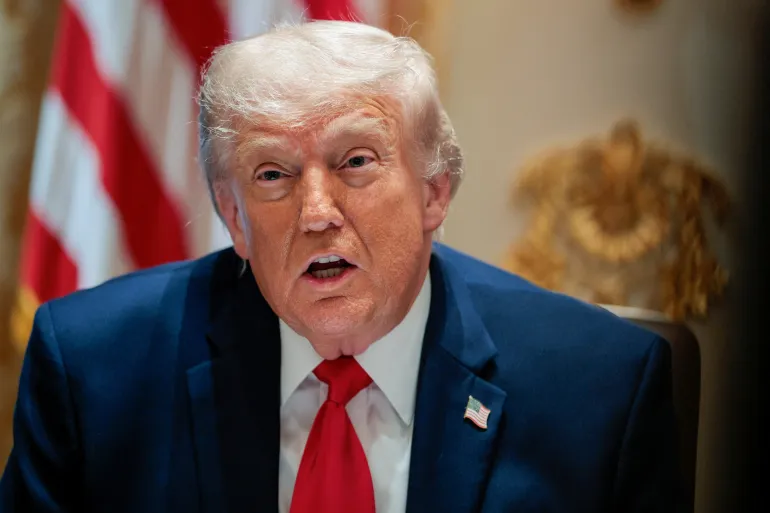
US President Donald Trump has issued a sharp warning to Oman amid rising tensions over the Strait of Hormuz, saying the United States could launch military action if Muscat interferes with Washington’s efforts to reopen and secure the strategically vital waterway.
The warning came during a television interview on Monday, August 17, as the broader US-Iran conflict remained unresolved and diplomatic efforts involving Oman continued. Trump’s remarks have added another layer of uncertainty to an already volatile regional situation, particularly because Oman has traditionally played an important mediating role between the United States and Iran.
Trump used unusually aggressive language while discussing the possibility of Oman becoming involved in the dispute over the Strait of Hormuz. He warned that the United States would respond forcefully if Oman attempted to obstruct American objectives in the strategic waterway.
The comments came as Iran and Oman were working on arrangements aimed at facilitating the reopening of the Strait of Hormuz to commercial shipping. The waterway has become one of the most important flashpoints in the continuing conflict because of its importance to global energy supplies and international maritime trade.
Strait of Hormuz becomes central to US-Iran standoff
The Strait of Hormuz, located between Iran and Oman, is one of the world’s most strategically important maritime passages. A significant share of global oil and energy shipments normally moves through the narrow waterway, making any prolonged disruption capable of affecting fuel prices, shipping costs and international markets.
Shipping activity through the strait has already fallen sharply amid the conflict. Recent maritime data indicated that only a small number of commercial vessels were passing through the waterway compared with earlier levels. The reduced traffic has intensified concerns among energy traders and governments that a prolonged confrontation could create further pressure on global oil supplies.
The United States has maintained pressure on Iran over the reopening of the waterway, while Tehran has insisted on its own conditions for restoring normal maritime traffic. The competing positions have left the strait at the centre of a wider dispute involving military operations, economic pressure and diplomatic negotiations.
Oman caught between Washington and Tehran
Oman’s position is particularly sensitive because of its geographic location and longstanding diplomatic relationship with both Washington and Tehran.
Unlike several other Gulf states, Oman has historically maintained channels of communication with Iran while also maintaining close relations with the United States. This has allowed Muscat to act as a mediator during periods of heightened tension between the two countries.
In recent months, Oman has again been involved in diplomatic efforts linked to the conflict. Tehran has indicated that discussions with Oman concerning the Strait of Hormuz were progressing, including plans to establish routes through which commercial vessels could resume transit.
The latest US warning therefore carries significance beyond rhetoric. Any direct confrontation involving Oman could undermine one of the few diplomatic channels still available for communication between the opposing sides.
Trump says there is no immediate rush for peace deal
Trump also indicated that he was not under pressure to conclude a new agreement with Iran immediately. His comments suggested that Washington was prepared to maintain economic and military pressure while negotiations remained stalled.
The US and Iran have been unable to resolve several major disagreements, including the future of the Strait of Hormuz, American military activity in the region, sanctions and Iran’s nuclear programme.
The expiration of a previously agreed negotiation period has further complicated efforts to prevent renewed escalation. The two sides continue to disagree over the conditions required for a broader settlement, while military tensions remain high.
Trump has repeatedly demanded that Iran make significant concessions, while Iranian officials have rejected demands that they view as compromising their sovereignty and control over the strategic waterway.
Iran-Oman discussions focus on reopening maritime traffic
Against this backdrop, Iran has been negotiating with Oman over a possible framework for restoring commercial shipping through the Strait of Hormuz.
The proposed arrangement is aimed at allowing vessels to navigate the waterway through mapped routes while addressing security concerns. Iranian officials have indicated that progress has been made in discussions with Oman, raising hopes that commercial traffic could gradually resume.
However, the broader US-Iran dispute remains unresolved. Any agreement involving Iran and Oman could face complications if Washington believes the arrangement undermines its own military or economic objectives.
This has created a delicate diplomatic situation for Oman. Muscat must balance its relationship with Iran, its strategic partnership with the United States and its interest in maintaining stability across the Gulf.
Global energy markets remain vulnerable
The uncertainty surrounding the Strait of Hormuz is also having consequences well beyond the Middle East.
Oil prices moved higher on Monday as markets reacted to stalled diplomatic efforts and continued uncertainty over shipping through the strait. Recent disruptions have already pushed energy prices higher, while analysts have warned that a complete halt in maritime traffic could produce a substantially greater shock.
The importance of the waterway means that prolonged disruption could affect countries that are not directly involved in the conflict. Asian economies in particular rely heavily on energy shipments moving through the Gulf, while international shipping companies face higher insurance and operational costs when navigating a conflict zone.
A sustained blockade or closure could therefore have implications for inflation, transportation costs and energy security across multiple regions.
Threat raises concerns over wider regional escalation
Trump’s warning to Oman comes at a particularly sensitive moment. The conflict has already expanded beyond the immediate US-Iran confrontation, with attacks and military activity affecting other parts of the Middle East.
Any direct military confrontation between the United States and Oman would represent a major escalation because Oman has generally sought to maintain a neutral and diplomatic role in regional disputes.
The threat also highlights the increasingly complicated nature of the Strait of Hormuz crisis. What began as a dispute involving Iran’s control over maritime traffic has evolved into a broader confrontation involving the United States, regional governments, international shipping companies and global energy markets.
For Oman, the immediate challenge will be to continue diplomatic engagement without being drawn directly into the military confrontation.
What happens next
The future of the Strait of Hormuz will depend heavily on whether Iran, the United States and regional mediators can reach an arrangement that restores safe commercial navigation.
A successful agreement could reduce pressure on energy markets, allow shipping traffic to recover and create space for wider negotiations over the conflict. Failure to reach an understanding, however, could result in further military escalation and continued disruption of one of the world’s most important maritime trade routes.
Trump’s latest warning has therefore increased uncertainty at a time when diplomatic efforts are already facing significant obstacles. With Iran maintaining its demands, Washington continuing its pressure campaign and Oman attempting to facilitate negotiations, the Strait of Hormuz remains one of the most dangerous flashpoints in the ongoing Middle East crisis.