
US President Donald Trump has intensified the confrontation with Iran by saying that the United States could declare the strategically vital Strait of Hormuz US territory after what he described as Iran’s defeat. The statement marks a significant escalation in Washington’s rhetoric over one of the world’s most important maritime passages and comes as the wider US-Iran conflict continues to disrupt shipping, energy markets and regional security.
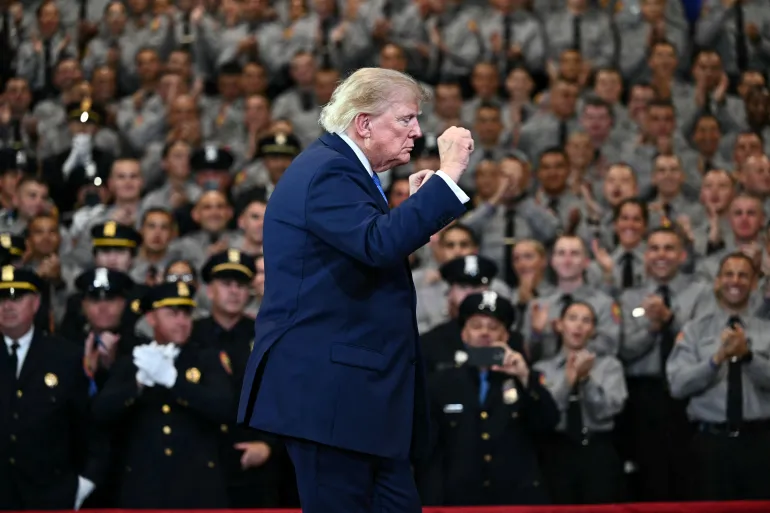
Speaking in New York, Trump said that the United States would move toward declaring the Strait of Hormuz an American territory “pretty soon” after defeating Iran. He presented the proposal as part of a broader effort to prevent Tehran from continuing to exert control over the waterway and to ensure that commercial shipping can move through the strategically important passage.
The declaration immediately drew a forceful response from Tehran. Iranian Deputy Foreign Minister Kazem Gharibabadi rejected the idea that Washington could take control of the strait, asserting that the waterway would remain under Iranian control. Iranian officials have repeatedly insisted that the country retains the ability to regulate access to the passage and have linked the reopening of maritime traffic to the resolution of the conflict and the withdrawal of US pressure.
The exchange has further complicated an already volatile confrontation between Washington and Tehran, with the Strait of Hormuz now emerging as one of the central points of the conflict.
Trump Highlights US Naval Blockade
Trump also highlighted the effectiveness of the US naval blockade around the Strait of Hormuz, describing American military power as capable of preventing vessels from passing without Washington’s approval.
The US blockade has become a major element of the broader pressure campaign against Iran. Washington has sought to use military and economic measures to force Tehran to change its position, while Iran has continued to insist on its right to control access through the waterway.
The latest confrontation follows the collapse of an earlier understanding intended to pause hostilities between the two countries. Mutual accusations of violations contributed to the breakdown of the arrangement, after which tensions surrounding the strait increased again.
The United States has portrayed its maritime operations as part of an effort to maintain pressure on Iran and protect shipping interests. Tehran, however, has treated the American presence as an infringement on its sovereignty and has warned that it will not accept attempts to impose external control over the waterway.
Iran Rejects Trump’s Territorial Claim
Iran’s response to Trump’s statement was uncompromising. Gharibabadi argued that the Strait of Hormuz could not simply be taken over through political declarations, military power or presidential orders.
He maintained that the strait has historically been Iranian, remains Iranian and will continue to be so. Iranian authorities have also warned that they will continue enforcing their position on the waterway as long as the United States refuses to acknowledge what Tehran describes as the reality of the conflict.
The Iranian response reflects the wider position of the country’s leadership, which has rejected US demands and continued to portray the American military presence in the region as a threat to Iranian sovereignty.
The dispute therefore goes beyond the immediate question of commercial shipping. Any attempt by Washington to formally claim the strait would raise major questions about territorial sovereignty, maritime law and the rights of other countries whose vessels depend on the waterway.
Why the Strait of Hormuz Matters
The Strait of Hormuz is one of the world’s most strategically important maritime corridors. Located between Iran and Oman, it connects the Persian Gulf with the Gulf of Oman and provides a crucial route for international energy shipments.
A substantial share of the world’s oil and gas exports traditionally moves through the strait. Any prolonged disruption can therefore have consequences far beyond the Middle East, affecting crude oil prices, fuel costs, shipping rates, insurance premiums and inflation in economies around the world.
The current crisis has already sharply reduced maritime traffic through the passage. With ships facing heightened security risks and uncertainty over whether they can safely transit the waterway, international energy markets have become increasingly sensitive to developments involving Iran, the United States and the surrounding Gulf states.
The strategic importance of Hormuz also explains why both Washington and Tehran view control over the passage as a major source of leverage.
Rising Pressure on Global Fuel Prices
Trump has acknowledged that the conflict is affecting fuel prices in the United States and has urged Americans to accept higher costs as part of the broader campaign against Iran.
The president has argued that short-term increases in petrol prices are an acceptable consequence of confronting Iran and preventing the country from posing what Washington considers a major security threat.
However, prolonged disruption in the Strait of Hormuz could create wider economic consequences. Higher transportation and energy costs can feed into the prices of goods and services, putting additional pressure on households and businesses.
For countries heavily dependent on imported energy, the uncertainty surrounding the waterway presents an additional economic risk. Markets are closely monitoring tanker movements, military developments and diplomatic efforts to determine whether the disruption will deepen or ease.
A New Dimension in the US-Iran Conflict
Trump’s proposal to declare the Strait of Hormuz US territory represents a striking expansion of the political stakes surrounding the conflict.
Until now, the dispute over the waterway has largely centered on navigation rights, Iran’s attempts to restrict shipping and US efforts to maintain access. A formal American territorial claim would introduce an entirely different dimension, potentially turning the question of maritime access into a direct dispute over sovereignty.
Such a move would also have implications for regional countries, commercial shipping operators and other major powers whose economies depend on uninterrupted energy supplies through the Gulf.
Iran, meanwhile, has shown little indication that it intends to surrender its position. Its officials continue to insist that Tehran retains authority over the passage and that US military pressure will not force it to accept Washington’s demands.
Diplomatic Efforts Remain Uncertain
The latest confrontation comes amid uncertainty over the possibility of renewed negotiations between the United States and Iran.
Messages have reportedly continued to move through regional intermediaries, but Iranian officials have indicated that such communications should not automatically be interpreted as formal negotiations. Tehran has maintained that any progress toward reopening the waterway or reaching a broader settlement would depend on Washington meeting Iranian conditions.
The absence of a clear diplomatic breakthrough leaves the Strait of Hormuz at the center of an increasingly dangerous standoff.
Both sides continue to use military and economic pressure, while the possibility of further escalation remains a concern for countries across the Gulf.
What Trump’s Statement Could Mean
Trump’s declaration should be viewed in the context of the wider US strategy toward Iran rather than as an immediately implemented territorial change. He did not provide a detailed legal or administrative framework explaining how the United States would establish such a claim.
Nevertheless, the statement carries considerable geopolitical weight because of the importance of the waterway and the ongoing military confrontation.
For Iran, accepting an American territorial claim would represent a major loss of strategic control. For Washington, securing long-term access to the strait would reduce Iran’s ability to use the waterway as economic leverage.
The competing positions therefore leave little room for compromise in the short term.
Global Attention Turns to Hormuz
The Strait of Hormuz has become a defining flashpoint in the continuing US-Iran confrontation. Trump’s threat to declare the waterway US territory has added a new layer of tension to an already unstable situation, while Iran’s rejection shows that Tehran has no intention of backing away from its claims.
The consequences extend well beyond the two countries. Any prolonged restriction on shipping through Hormuz could affect energy markets, international trade and consumer prices across multiple regions.
As military pressure continues and diplomatic prospects remain uncertain, the future of the Strait of Hormuz is likely to remain closely tied to the wider outcome of the US-Iran conflict. For global markets and governments, the central concern will be whether the confrontation moves toward negotiations and a reopening of the waterway—or develops into an even broader struggle over control of one of the world’s most important maritime routes.