
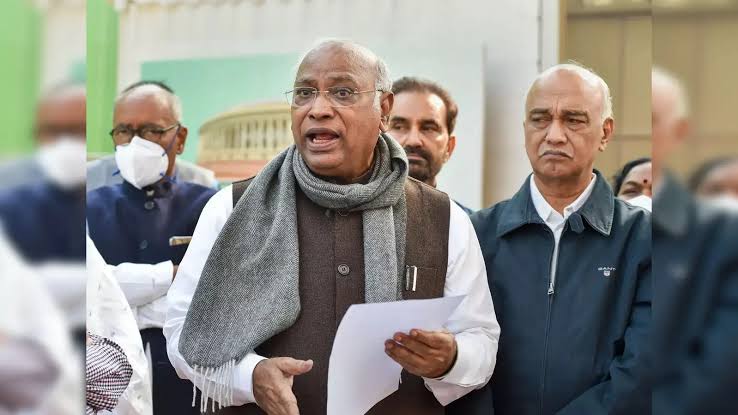
The political confrontation between the government and the Opposition intensified on Tuesday as Congress president and Leader of Opposition in the Rajya Sabha Mallikarjun Kharge rejected allegations that the Opposition was repeatedly changing its demands to prevent Parliament from functioning.
Kharge said the Opposition’s position had remained unchanged since the beginning of the ongoing dispute and maintained that its demands were centred on three specific issues. According to him, the Opposition wants clear answers from the government over the alleged use of force against protesting students, including allegations involving pellet guns, the reported controversy surrounding donations meant for the Ram temple, and an apology over the issues.
The remarks came as the Monsoon Session continued to face disruptions, with repeated adjournments and sharp exchanges between the treasury benches and Opposition parties. The continuing stalemate has increasingly become a political contest over which side is responsible for preventing substantive business from being conducted in Parliament.
Kharge says Opposition has maintained the same position
Speaking to reporters in the Parliament complex, Kharge dismissed the charge that the Opposition had shifted its demands during the standoff. He argued that the issues being raised today were the same concerns that had been placed before the government from the beginning of the confrontation.
The Congress leader said the Opposition wanted the Union Home Minister to address the House specifically on the allegations surrounding police action against protesting students. The Opposition has been seeking clarification on who authorised the alleged firing and the circumstances in which force was used.
Kharge also referred to injuries suffered by protesters. He claimed that several students were affected during the police action, with some requiring medical treatment, while others were allegedly injured by pellet guns.
According to Kharge, the Opposition believes that the government has not provided the kind of direct explanation it has been seeking in Parliament. He said the matter had remained unresolved for 18 days and argued that merely making a general statement would not address the questions being raised by the Opposition.
Three demands remain at the centre of the dispute
Kharge outlined three issues that he said continued to form the basis of the Opposition’s position.
The first relates to the alleged police action against students. The Opposition wants the Home Minister to clarify whether he authorised the firing and to explain how the police response was ordered and implemented.
The second concerns allegations of irregularities involving donations associated with the Ram temple. The Congress has demanded that the matter be addressed by Prime Minister Narendra Modi.
The third demand involves an apology from the government over the issues raised by the Opposition.
Kharge maintained that these demands were not new and had not been replaced by other issues during the course of the parliamentary standoff. He indicated that the Opposition would continue pressing the government until it received satisfactory answers.
The Congress has described the demands as non-negotiable, making the possibility of an immediate resolution to the deadlock more difficult.
Government accuses Opposition of shifting its demands
The Opposition’s position has been challenged by the ruling side, which has accused Congress and its allies of repeatedly changing the conditions for allowing Parliament to function.
The government has maintained that it is prepared to hold a discussion on the student protests and the subsequent police action. It has also indicated that Home Minister Amit Shah is prepared to respond to the debate.
However, the Opposition has argued that the government’s offer does not address its specific demand for a direct clarification from Shah regarding the alleged firing and the decision-making behind the police response.
This difference in interpretation has emerged as one of the key reasons behind the continuing impasse.
While the government says it has offered a parliamentary discussion and a response from the Home Minister, the Opposition insists that the discussion must directly address the questions it has raised.
Rahul Gandhi questions the proposed government response
Leader of Opposition in the Lok Sabha Rahul Gandhi has also criticised the government’s position. He has argued that the Opposition is not seeking a broad or general debate but wants the Home Minister to answer specific questions concerning the police action.
Gandhi has particularly focused on the question of whether the Home Minister authorised the use of pellet guns against protesting students. He has also demanded accountability from the government over the handling of the protests.
The Congress has further argued that Prime Minister Narendra Modi should address the controversy surrounding the alleged theft or misuse of donations connected to the Ram temple.
The dispute has therefore expanded beyond a procedural disagreement over parliamentary debates and has developed into a broader political confrontation involving questions of accountability, police action and alleged financial irregularities.
Jharkhand student protests remain another point of contention
Kharge also addressed the issue of student protests in Jharkhand, which has become part of the wider political debate.
He maintained that the Jharkhand issue should be treated separately rather than combined with every other matter being raised in Parliament. His argument was that Parliament routinely deals with different subjects through separate discussions and that several issues cannot necessarily be treated as one single controversy.
The government and Opposition, however, have continued to use the student protests as a major point of political argument, with both sides accusing the other of avoiding accountability.
The Opposition has sought to link the wider concerns over police action with its demand for answers from the central government, while the ruling side has argued that the Opposition should participate in the proposed debate instead of disrupting proceedings.
Parliament remains caught in prolonged deadlock
The continuing confrontation has significantly affected the functioning of Parliament during the Monsoon Session. Proceedings in both Houses have repeatedly been disrupted as Opposition MPs raise slogans and press their demands, while the government has called for discussions to be conducted through established parliamentary procedures.
The stalemate has also produced increasingly sharp political rhetoric outside the Houses. Leaders from both sides have blamed the other for the disruptions and accused their opponents of undermining parliamentary democracy.
The government has argued that elected representatives should allow legislative business to proceed and use debates to raise concerns. The Opposition, meanwhile, maintains that meaningful parliamentary functioning requires the government to answer questions on issues it considers serious and urgent.
With neither side showing signs of immediately abandoning its position, the deadlock could continue unless negotiations produce an understanding over the terms of discussion.
Political confrontation likely to continue
Kharge’s latest remarks indicate that the Congress is not currently prepared to withdraw its principal demands. By insisting that the Opposition has maintained a consistent position, he has directly challenged the government’s narrative that the demands have changed repeatedly.
At the heart of the dispute is a disagreement over what constitutes an acceptable parliamentary response. The government says it is ready to facilitate discussion and provide answers, while the Opposition wants specific political accountability from senior members of the government.
The coming days of the Monsoon Session will therefore be closely watched to determine whether the two sides can find common ground. Unless the government and Opposition reach an agreement on how the disputed issues will be discussed, disruptions are likely to remain a major feature of parliamentary proceedings.
For now, Kharge’s statement makes the Congress position clear: the Opposition maintains that its demands have been consistent from the outset and that Parliament cannot return to normal functioning without addressing the issues it has placed before the government.