
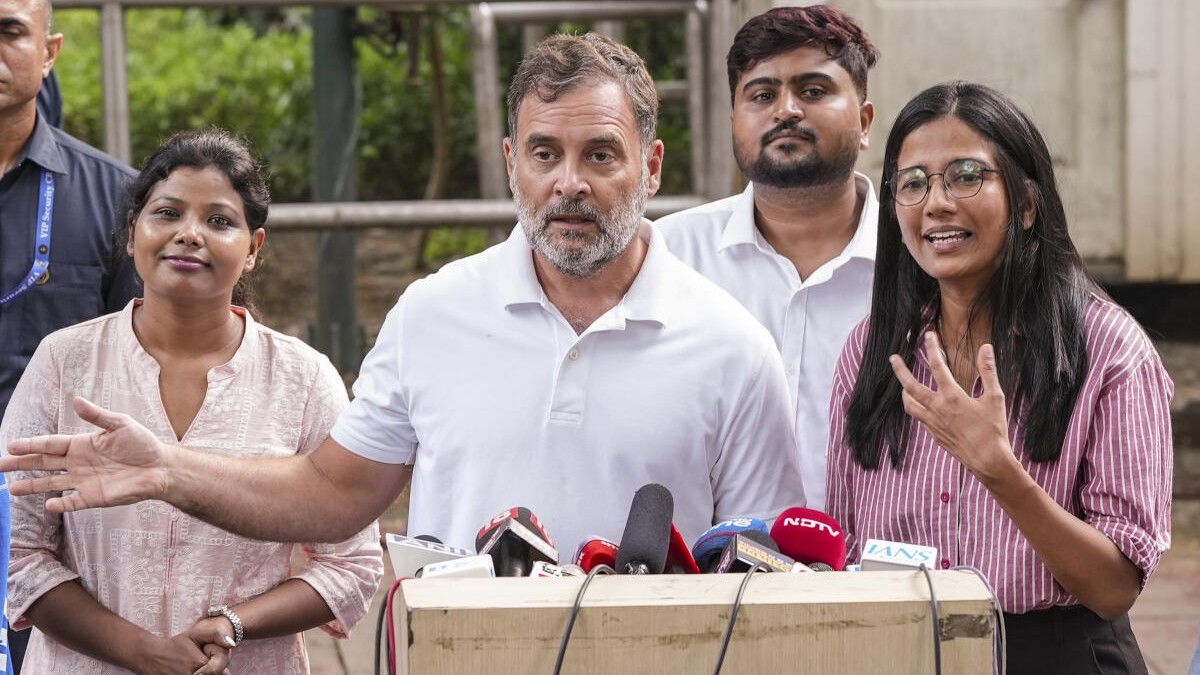
Leader of the Opposition Rahul Gandhi on Wednesday came out in support of students and young activists who alleged harassment and violence during protests at Jantar Mantar, strongly criticising Union Home Minister Amit Shah over the police action. Gandhi said that questioning the education system or demanding reforms cannot be considered a crime and accused the government of failing to address the concerns of protesting students.
Standing alongside five young activists who claimed they faced police excesses, online harassment, physical injuries and emotional trauma following the protest, Gandhi said that the students were only raising concerns about what they described as a failing education system. He argued that criticism and demands for improvement are part of a democratic process and should not be met with force.
“Complaining about the education system, which is a flawed system, a collapsing system, a useless system, is not a crime. If anything, the system needs to be changed; it needs to be corrected,” Gandhi said while addressing the media.
He maintained that the protesters were not involved in violence or aggressive behaviour and alleged that they were subjected to unnecessary force by authorities. According to Gandhi, the students were expressing their concerns peacefully but were instead beaten, assaulted and threatened.
The Congress leader also targeted the central government’s leadership, alleging that senior officials were avoiding accountability over the incident. He claimed that those in power lacked the courage to directly respond to questions raised by the affected students and activists.
“They are young people who are standing here, in front of India’s press. But Amit Shah and the Prime Minister don’t have the courage to stand here,” Gandhi said, alleging that the Home Minister was responsible for the violence during the protest.
Gandhi further claimed that the use of pellet guns and alleged injuries suffered by protesters required a serious investigation. He argued that either the Home Ministry was unaware of the actions taken by security personnel, which according to him would indicate administrative failure, or that there was direct approval for the use of force.
“There are only two possibilities: One, he did not know that this violence was being carried out on the children, in which case he is incompetent. Two, he ordered the shooting of the pellet gun and the violence on these children. It means he is culpable. Either way, he is responsible,” Gandhi said.
During the interaction, the young activists shared their experiences and described the difficulties they allegedly faced after participating in the Jantar Mantar demonstration.
Nutan Toppo, a resident of Jharkhand, claimed that she suffered injuries from pellet firing during the July 20 protest. She alleged that the action by security personnel caused physical harm and trauma.
Other activists, including Fahranaz from Uttar Pradesh and Muskan, accused police personnel of excessive use of force, communal profiling and unfair treatment during the demonstration. They alleged that peaceful protesters were subjected to baton charges and intimidation.
Fahranaz claimed that police personnel physically assaulted protesters and questioned their patriotism. She alleged that authorities separated individuals and accused them of being against the country.
Another protester, Bharat Banait, described the incident as one of the darkest experiences of his life. He alleged that several protesters suffered serious injuries, including broken heads and legs, due to the police action.
The allegations made by the activists and Gandhi’s remarks have intensified political debate over the handling of student demonstrations and the role of law enforcement agencies during protests. While Gandhi demanded accountability from the Union Home Ministry, the government’s response to the allegations remains awaited.
The controversy has once again brought attention to questions surrounding freedom of expression, students’ rights to protest, and the manner in which authorities respond to public demonstrations in a democratic system.