
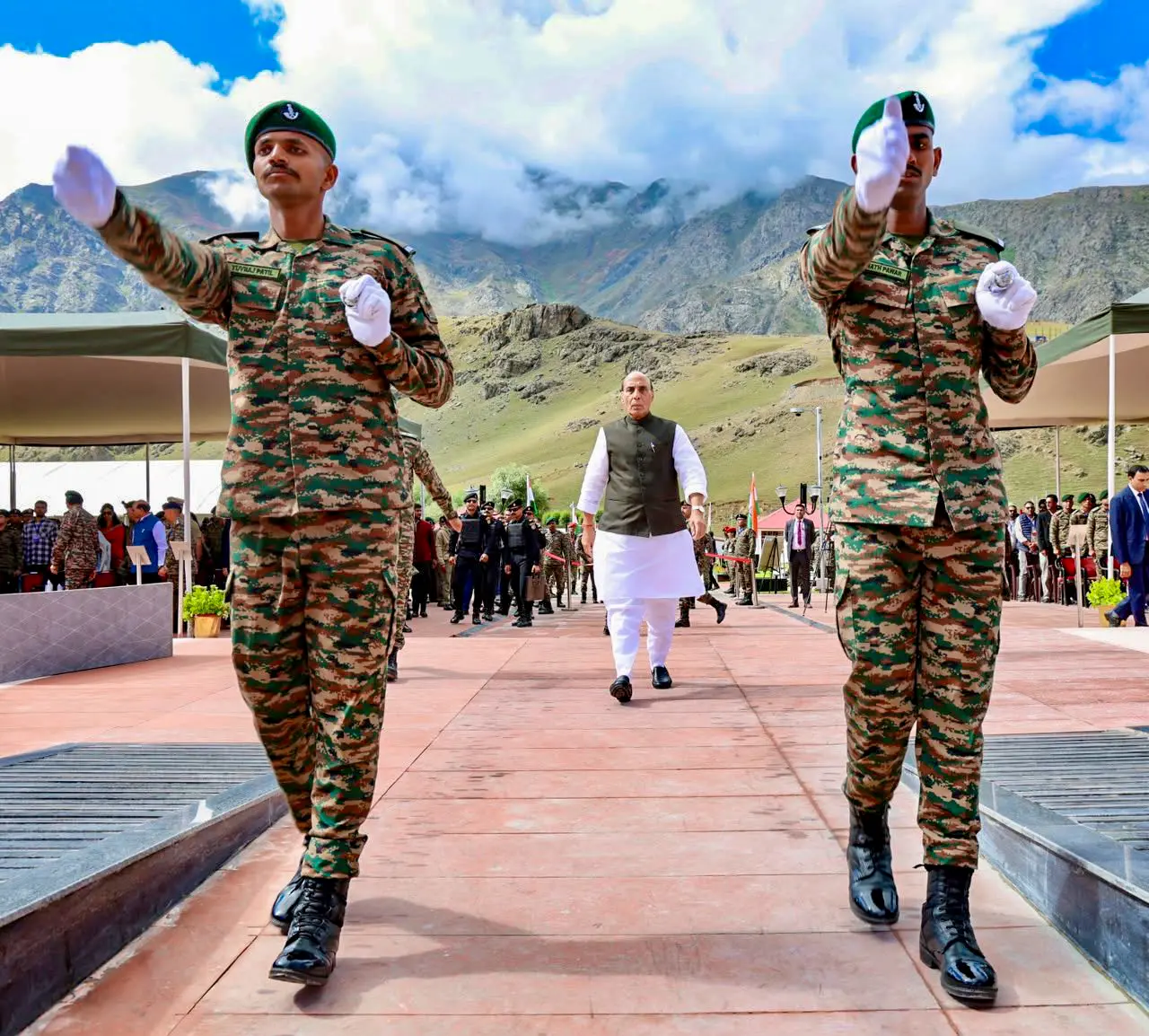
Defence Minister Rajnath Singh has issued a strong warning to Pakistan, saying India will respond firmly to any future threat to its sovereignty and security. Speaking at the 27th Kargil Vijay Diwas celebrations in Dras, Singh said the experience of the Kargil War and subsequent developments had demonstrated the need for India to remain constantly prepared to deal with threats along its borders.
Singh said India could no longer treat Pakistan’s military establishment and terrorist organisations as entirely separate entities, alleging that the country’s security forces have supported and worked alongside militant groups. According to the defence minister, the Indian government had made this position clear during Operation Sindoor, underlining that those who carry out attacks and those who support or facilitate them cannot be viewed in isolation.
The remarks came during a ceremony commemorating the Indian armed forces’ victory in the 1999 Kargil conflict. The event was held in Dras, one of the key areas associated with the war, and was attended by senior military officials, including Army chief General Dhiraj Seth.
Rajnath Singh links Operation Sindoor to India’s security doctrine
In his address, Singh referred to Operation Sindoor as an example of India’s willingness and ability to respond decisively to attacks and security challenges. He said the operation had demonstrated that India could retaliate against any hostile action from Pakistan with a response that the country would not anticipate.
The defence minister made it clear that India’s approach towards Pakistan had changed in the context of cross-border terrorism. He argued that when a state and terrorist organisations operate in coordination, the distinction between the two becomes difficult to maintain from a security perspective.
Singh’s comments reflect the Indian government’s broader position that terrorism originating from across the border remains a major challenge to national security. He said that any attempt to threaten India’s sovereignty would be met with a determined response.
He also indicated that India would not consider dialogue with Pakistan on a wide range of issues under the present circumstances, maintaining that discussions should be limited to Pakistan-occupied Kashmir.
Kargil War remains a lesson in vigilance
The Kargil Vijay Diwas ceremony served as a reminder of the 1999 conflict, when Pakistani soldiers and intruders occupied strategic mountain positions along the Line of Control. Indian forces launched military operations to recapture the heights, eventually pushing back the intruders after intense fighting in extremely difficult terrain.
The conflict claimed the lives of 527 Indian soldiers. Estimates of Pakistani military casualties have varied considerably, with no universally accepted official figure.
Singh said the Kargil conflict had left India with important lessons about the importance of maintaining constant vigilance along the country’s borders. He stressed that security preparedness could not be limited to particular seasons or situations and that the armed forces needed to remain ready to respond to emerging threats at all times.
The war also led to significant changes in India’s defence and security structure. The lessons drawn from the conflict contributed to improvements in intelligence coordination, military preparedness, border management and the modernisation of the armed forces.
Singh said the events of Kargil demonstrated the importance of ensuring that India’s borders remain secure under every circumstance.
Defence minister draws sharp contrast between India and Pakistan
During his speech, Singh also contrasted India’s development priorities with what he described as Pakistan’s continued focus on terrorism and cross-border infiltration.
He said India was concentrating on areas such as technological innovation, semiconductor manufacturing, start-ups, space exploration and digital infrastructure, while accusing Pakistan of developing networks associated with terrorism, radicalisation and infiltration.
The defence minister used a series of comparisons to highlight what he described as the different directions taken by the two countries over the years. He argued that while India was investing in modern technology and economic development, Pakistan continued to face allegations of supporting militant networks and proxy operations.
Singh also alleged that terrorist financing and radicalisation networks remained part of the security challenge facing India. His comments were framed within the wider context of India’s longstanding concerns over cross-border terrorism and militant infiltration.
Focus on strengthening India’s indigenous defence capabilities
A significant part of Singh’s address focused on India’s efforts to increase domestic defence production and reduce dependence on foreign suppliers.
Referring to the famous slogan associated with Kargil war hero Captain Vikram Batra, “Yeh Dil Maange More”, Singh said India should continue to aim for greater achievements in defence manufacturing and military technology.
He highlighted a range of indigenously developed and manufactured defence platforms and weapons systems, including the Akash missile system, INS Vikrant, Tejas light combat aircraft, Prachand light combat helicopter, Dhruv advanced light helicopter, Arjun main battle tank, Pinaka rocket launcher and Astra air-to-air missile.
The minister also pointed to the growing role of drones and counter-drone technologies in modern warfare. He said India would continue working towards the development and production of more advanced weapons, fighter aircraft, submarines and missile systems within the country.
The emphasis on domestic defence manufacturing comes amid India’s broader push for self-reliance in the defence sector. The government has increasingly promoted indigenous production as a key component of national security, arguing that domestic capabilities are essential for maintaining operational readiness and reducing vulnerabilities in times of conflict.
Kargil Vijay Diwas highlights sacrifices of Indian soldiers
The annual Kargil Vijay Diwas commemorations are held to honour the soldiers who fought in the 1999 conflict and to remember the sacrifices made during the war.
The fighting took place across a difficult mountainous frontier extending for roughly 170 kilometres, from the Mashkoh Valley towards the Turtuk region. Indian troops faced challenging terrain, extreme weather conditions and heavily fortified enemy positions while attempting to recapture strategically important heights.
The conflict remains a defining moment in India’s modern military history. It also continues to influence the country’s defence planning and approach to border security.
Singh said the lessons of the war should not be forgotten. He emphasised the need for continuous vigilance, technological advancement and military preparedness to ensure that India is capable of responding to any future challenge.
India signals firm position on cross-border terrorism
Singh’s latest remarks underline the government’s continued hard-line position on terrorism and Pakistan. His assertion that Pakistan’s military and militant organisations cannot be viewed separately represents a strong statement on how New Delhi assesses the security threat emanating from across the border.
The defence minister’s message was delivered against the backdrop of the Kargil War’s legacy and India’s evolving defence strategy. By linking the lessons of 1999 with the country’s recent military response, Singh sought to emphasise that India would not tolerate attempts to undermine its sovereignty or security.
His address also placed renewed emphasis on the importance of modernising India’s armed forces and expanding domestic defence production. The government has increasingly presented these efforts as essential not only for strengthening military capabilities but also for ensuring strategic autonomy.
As India remembers the soldiers who fought and died during the Kargil conflict, the defence minister’s message was clear: vigilance, preparedness and the ability to respond decisively will remain central to the country’s national security policy.