
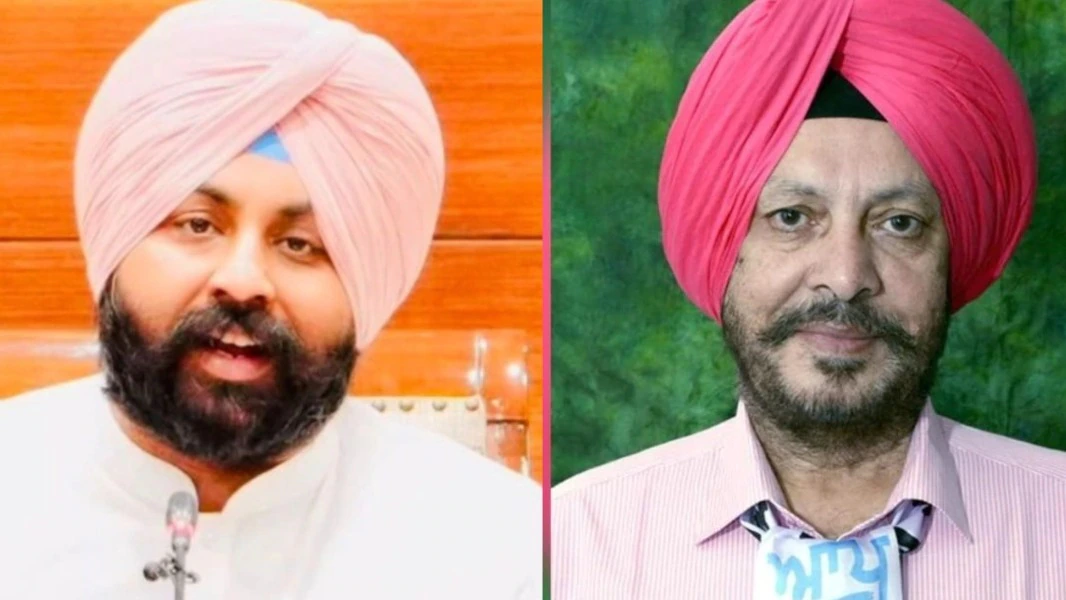
The political controversy over alleged examination irregularities in Punjab has intensified, with the Bharatiya Janata Party (BJP) demanding the resignation of state Education Minister Harjot Singh Bains. The demand has gained momentum following the resignation of Union Education Minister Dharmendra Pradhan, which has once again brought the issue of examination integrity and accountability into the national political spotlight.
The BJP has accused the Aam Aadmi Party (AAP)-led Punjab government of failing to take responsibility for alleged paper leak incidents and irregularities in several examinations. The party has questioned why similar accountability has not been sought from Punjab’s education minister, while the opposition has alleged that multiple examination papers were compromised in the state.
BJP spokesperson Shehzad Poonawalla said Pradhan’s resignation represented accountability and questioned why the Punjab government had not taken comparable action. He alleged that several paper leak incidents had occurred in Punjab and criticised the state leadership for not holding the education minister responsible.
The controversy has also drawn criticism from other opposition parties. Shiromani Akali Dal leaders have alleged that multiple examination-related irregularities took place in Punjab, citing examinations such as the Punjab Teacher Eligibility Test, the Class 12 English examination and the pharmacy officer recruitment test. Opposition leaders have demanded a thorough investigation and greater accountability from the state government.
Ravneet Singh Bittu has also called for the resignation of Punjab’s education minister, while Punjab Congress president Amrinder Singh Raja Warring and other opposition leaders have raised concerns over the functioning of the state’s examination system. The Congress has indicated that it will continue to raise the issue of alleged examination irregularities and demand action from the government.
The controversy comes against the backdrop of growing national concern over the security and credibility of competitive examinations. Questions surrounding paper leaks, cheating networks and examination malpractice have become a major political issue, with students and opposition parties demanding stronger systems to protect the integrity of recruitment and entrance examinations.
Punjab Chief Minister Bhagwant Mann, however, has rejected the opposition’s allegations of widespread paper leaks. Mann has maintained that no competitive examination paper was leaked during the AAP government’s tenure in the state. He has argued that allegations of paper leaks should not be confused with isolated incidents of cheating or attempts to manipulate examinations.
While defending the state’s examination system, Mann acknowledged that cheating-related incidents had been detected at two locations. According to his account, authorities acted against those allegedly involved in an organised cheating operation. He said some individuals had used digital devices and Bluetooth-enabled technology to obtain assistance from outside during an examination.
Mann stated that the investigation into the alleged cheating network had resulted in arrests. He also claimed that individuals involved in providing answers to candidates had demanded large sums of money, with the alleged transactions running into several lakh rupees. The chief minister said law enforcement agencies had taken action against those involved.
The incident has highlighted the growing challenge posed by technology-assisted cheating in competitive examinations. The use of electronic devices, digital communication tools and organised networks has made it increasingly difficult for examination authorities to maintain strict control over test centres. The issue has also raised questions about whether existing security mechanisms are sufficient to prevent malpractice.
The political debate has intensified because of the contrasting positions taken by the ruling AAP and opposition parties. While the opposition is demanding ministerial accountability over alleged examination irregularities, the Punjab government insists that there is no evidence of widespread paper leaks in competitive examinations under its administration.
The AAP has meanwhile welcomed Pradhan’s resignation at the Centre and presented it as evidence of the impact of student protests and public pressure. Bhagwant Mann said the development demonstrated the influence of the younger generation in demanding accountability from governments. AAP national convenor Arvind Kejriwal also described the resignation as a significant development for democratic accountability.
The resignation of Pradhan followed months of controversy surrounding the National Eligibility-cum-Entrance Test for undergraduate medical admissions. The examination controversy had triggered widespread concern among students and political parties, eventually leading to a re-examination for affected candidates. The Union government subsequently assigned the education portfolio to another senior minister as additional responsibility.
The developments have now brought the focus back to Punjab, where the opposition is seeking answers from the state government over alleged irregularities in examinations. At the centre of the dispute is the question of whether allegations of paper leaks should lead to political accountability even when authorities describe the incidents as cases of cheating or examination malpractice.
For students preparing for competitive and recruitment examinations, the controversy carries significance beyond political arguments. The credibility of examinations depends heavily on secure question-paper distribution, strict monitoring at test centres, effective technological safeguards and prompt action against those involved in malpractice. Any allegation of a compromised examination can affect thousands of candidates and raise doubts about the fairness of the selection process.
The Punjab government now faces increasing political pressure to clarify the nature and extent of the alleged examination irregularities. The opposition is expected to continue demanding accountability, while the government is likely to maintain that cheating incidents were detected and that legal action was taken against those responsible.
The wider debate also underlines the importance of maintaining public confidence in India’s examination systems. Whether the allegations in Punjab ultimately lead to further investigations or political consequences remains to be seen, but the issue has already become a significant point of confrontation between the AAP government and opposition parties.
As political parties continue to debate responsibility, the larger challenge remains ensuring that students can take competitive examinations with confidence that the process is secure, transparent and fair. The controversy has once again placed examination integrity at the centre of India’s political and public discourse.