
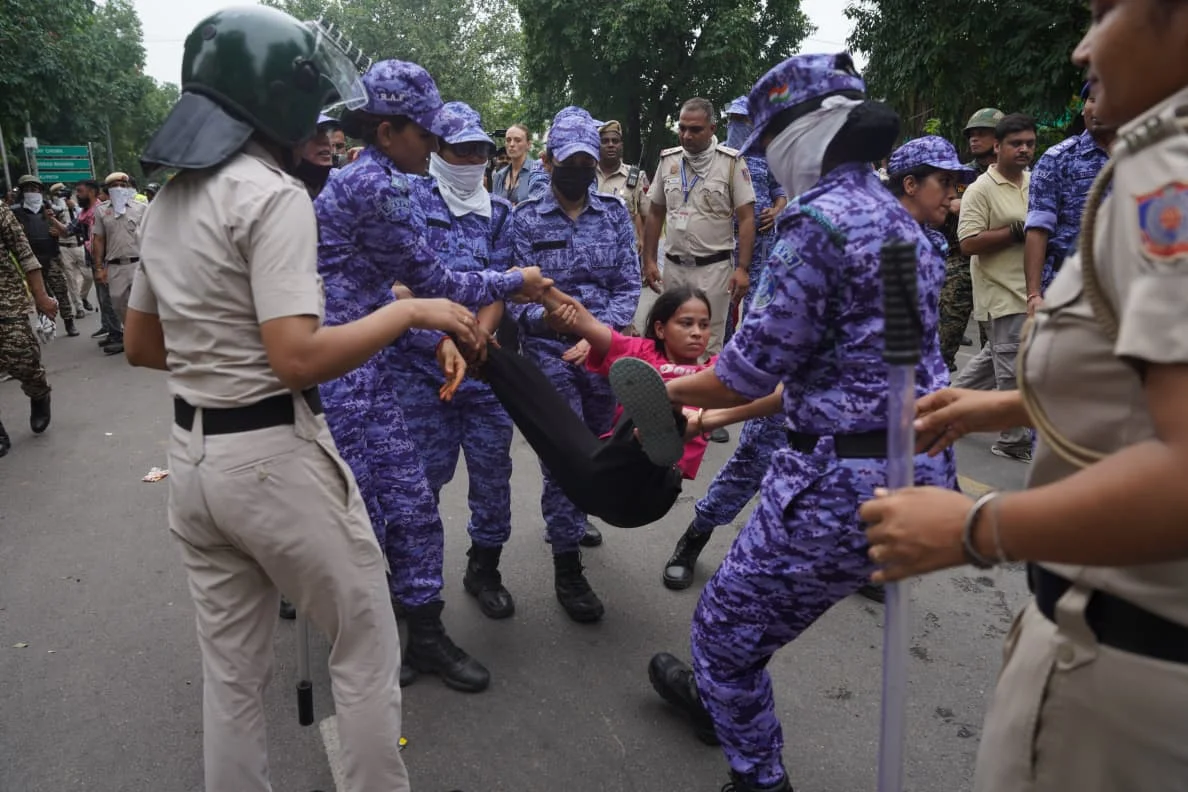
The Delhi government has authorised the Commissioner of Police to exercise preventive detention powers under the National Security Act (NSA), 1980, for a period of three months from July 19 to October 18. The order empowers the city police chief to act as the detaining authority under the provisions of the law in cases where the necessary legal conditions for preventive detention are met.
The decision has attracted attention because of its timing, coming at a period when protests are taking place in the national capital. However, Delhi Police officials have clarified that the order is part of a routine administrative process and is not connected to the ongoing demonstrations involving students and members of the activist platform Cockroach Janta Party (CJP).
According to the government notification, the Lieutenant Governor has authorised the Delhi Police Commissioner to exercise powers under Section 3(2) of the National Security Act. The authorisation will remain in effect until October 18.
The notification was issued under Section 3(3), read with Section 2(e), of the National Security Act, 1980. It was issued by the Home (Police-II) Department of the Delhi government.
What the NSA Powers Mean
The National Security Act is a preventive detention law that allows authorities to detain individuals in certain circumstances when their activities are considered potentially harmful to national security, the maintenance of public order, or the supply of essential services and commodities to the community.
Preventive detention is different from the usual criminal justice process. While ordinary criminal proceedings generally follow an alleged offence and involve investigation and prosecution, preventive detention is intended to prevent a person from engaging in activities that authorities believe could pose a threat to specified national or public interests.
However, the exercise of preventive detention powers is governed by the provisions of the law and is subject to prescribed procedures and safeguards.
The latest notification does not mean that the National Security Act has been imposed across Delhi or that residents are automatically subject to detention. Instead, it authorises the Police Commissioner to exercise the relevant powers during the specified period in cases that meet the statutory requirements.
Police Deny Connection With Ongoing Protests
The timing of the order had led to questions over whether the preventive detention powers were being renewed in response to the protests currently taking place in Delhi.
Police officials, however, have rejected any such connection and described the notification as a routine renewal of administrative powers.
According to the police, such authorisations are renewed every three months. The latest order was issued on July 7 and covers the period from July 19 to October 18.
Officials also pointed out that the renewal process began before the latest protests involving students and the CJP. Police maintained that the current notification was not issued in response to the demonstrations and that no specific request was made for the powers in connection with the protests.
The clarification comes amid increased public and political attention surrounding demonstrations in the national capital. The use of preventive detention laws in such circumstances can often generate public debate, particularly when questions arise over whether such powers could be used against protesters.
Delhi Police, however, has emphasised that the latest authorisation should be viewed as a routine administrative measure rather than as an indication of planned action against protesters or any specific organisation. 
Order Does Not Mean Automatic or Blanket Detention
The notification does not give the Delhi Police Commissioner unlimited authority to detain individuals without following the provisions of the law.
Preventive detention under the National Security Act can only be exercised when the circumstances of an individual case fall within the scope of the legislation. The authorisation allows the Police Commissioner to exercise the powers of the detaining authority, but any action taken under the Act must still comply with the legal framework governing preventive detention.
This distinction is important because the mere existence of the notification does not mean that individuals participating in protests, public meetings or demonstrations will automatically face detention under the NSA.
Any decision to invoke preventive detention powers would have to be based on the facts and circumstances of a particular case and carried out in accordance with the applicable legal provisions.
Authorisation Remains Valid Until October 18
The current authorisation will remain effective until October 18. During this period, the Police Commissioner will be able to exercise the powers assigned under the notification in cases where the legal conditions for preventive detention are satisfied.
The renewal comes at a time when Delhi continues to witness political activity and public demonstrations. Nevertheless, police officials have maintained that the order should not be interpreted as a direct response to the current protests.
The administration’s position is that the authorisation forms part of a regular three-month renewal process. The police have also stressed that the order was initiated before the latest demonstrations began, thereby rejecting speculation that the powers were specifically renewed to deal with the ongoing protests.
The development has nevertheless brought renewed attention to the use of preventive detention laws in the national capital. Such laws are designed to address situations that authorities believe could pose risks to national security or public order, but their application remains subject to statutory requirements and legal safeguards.
For the time being, the notification primarily represents the continuation of an existing administrative arrangement under which the Delhi Police Commissioner is empowered to exercise preventive detention authority for a defined period.
The practical impact of the order will depend on whether the powers are invoked in individual cases during the three-month period. Unless a fresh order is issued, the present authorisation will remain valid until October 18.
The Delhi Police’s clarification is intended to counter speculation about the timing of the notification and to emphasise that the renewal was part of a routine administrative process rather than a measure specifically introduced in response to the ongoing protests.