
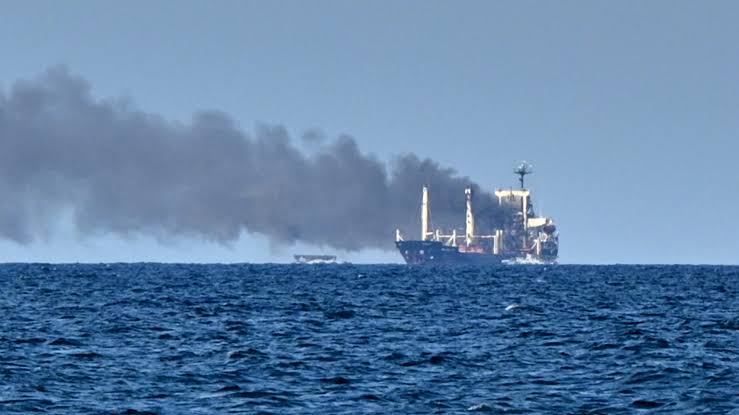
India has summoned Russia’s Charge d’Affaires following an attack on a merchant vessel off the Ukrainian coast that resulted in the deaths of four Indian seafarers, escalating diplomatic concerns over the safety of civilian crew members operating in waters affected by the ongoing conflict.
The vessel involved in the incident has been identified as MV Golden Leo, a Guinea-Bissau-flagged merchant ship that came under attack shortly after leaving the southern Ukrainian port of Odesa on Sunday. The incident reportedly caused multiple casualties among those on board, including four Indian nationals.
The development has prompted India to raise the issue directly with the Russian diplomatic mission in New Delhi. The move comes a day after the Indian government publicly condemned the attack and expressed concern over the targeting of commercial shipping and the risks faced by innocent seafarers caught in conflict zones.
The summoning of the Russian diplomat reflects the seriousness with which New Delhi is viewing the deaths of the Indian crew members. While India has not publicly attributed responsibility for the attack in its official statement, the diplomatic engagement indicates that the government is seeking greater clarity over the circumstances surrounding the incident and the safety of Indian nationals working aboard commercial vessels in the region.
The attack occurred as the vessel was departing Odesa, a major Ukrainian port on the Black Sea that has remained strategically important amid the Russia-Ukraine conflict. Commercial ships operating from the region face significant security risks because of the continuing military confrontation and the possibility of attacks affecting civilian maritime traffic.
According to the available information, the attack resulted in the deaths of 10 seafarers aboard the vessel. Four of those killed were Indian nationals, highlighting the wider impact of the conflict on Indian citizens working in the global maritime sector.
India’s response has focused on the broader principle that commercial vessels and civilian crews should not become targets during armed conflicts. The government has stressed that attacks on merchant shipping can have serious humanitarian and economic consequences, particularly when innocent seafarers from different countries are involved.
In its statement condemning the incident, India reiterated its opposition to attacks that endanger civilian crew members or interfere with commercial maritime activity. It also emphasised the importance of protecting freedom of navigation and ensuring that international trade routes remain secure.
The incident has once again drawn attention to the vulnerability of seafarers working in conflict-affected regions. Merchant ships routinely carry crews made up of nationals from several countries, meaning that attacks on commercial vessels can quickly become an international issue involving multiple governments.
For India, the incident is particularly significant because of the country’s large maritime workforce. Indian seafarers are employed on commercial vessels operating across international waters, making their safety a recurring concern for the government, especially when ships pass through areas affected by armed conflict, piracy or other security threats.
The latest diplomatic action also comes against the backdrop of India’s efforts to maintain close relations with both Russia and Ukraine while continuing to call for the protection of civilians and peaceful resolution of conflicts. New Delhi has consistently maintained that civilian lives must be protected and that international maritime commerce should not be disrupted by military hostilities.
The deaths of the four Indian seafarers are therefore likely to remain a matter of concern for Indian authorities as they seek further information about the circumstances of the attack. The government will also be closely monitoring developments related to the affected vessel and the welfare of other crew members who may have been involved in the incident.
The attack has renewed calls for greater protection of merchant shipping in conflict zones. Beyond the immediate loss of life, incidents involving commercial vessels can disrupt supply chains, increase insurance and transportation costs and create additional risks for workers who have no direct involvement in military operations.
The situation also underlines the importance of international cooperation in safeguarding maritime routes. With global trade heavily dependent on secure shipping lanes, attacks on civilian vessels can have consequences far beyond the immediate location of an incident.
India’s decision to summon Russia’s Charge d’Affaires signals that New Delhi considers the matter serious and expects attention to the safety of Indian citizens working in the maritime sector. At the same time, India’s public condemnation has been framed around the broader principle of protecting civilian shipping rather than directly assigning responsibility for the attack.
As diplomatic discussions continue, attention is expected to remain focused on establishing the precise circumstances of the incident, determining how the vessel was attacked and assessing the risks faced by other commercial ships operating in the region.
The deaths of four Indian seafarers have brought the human cost of the conflict into sharp focus for India. For the families of the victims, the incident represents a devastating loss, while for the wider maritime community, it highlights the dangers faced by civilian crews working on international shipping routes during periods of armed conflict.
The Indian government’s response reinforces its position that commercial shipping must be protected and that civilian seafarers should not be exposed to unnecessary danger because of military confrontations. The latest diplomatic engagement with Russia is expected to remain an important part of India’s efforts to seek accountability, protect its citizens and press for greater safety for commercial vessels operating in conflict-affected waters.