
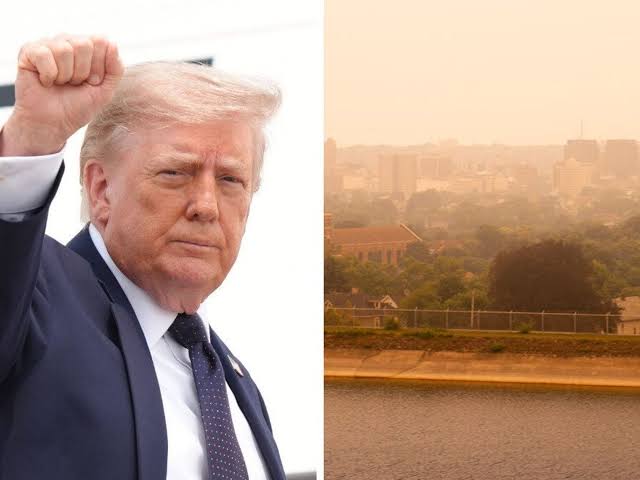
Relations between the United States and Canada have entered another period of tension after US President Donald Trump warned that his administration could impose even higher tariffs on Canadian goods, citing smoke from Canada’s widespread wildfires as a major source of air pollution affecting American cities.
The remarks have added a fresh dimension to the ongoing trade disagreements between the two neighboring countries, combining environmental concerns with economic policy. Trump’s comments come at a time when massive wildfires continue to burn across several Canadian provinces, producing dense smoke that has crossed the border and significantly reduced air quality in parts of the United States.
Trump Links Wildfire Smoke to Trade Measures
Speaking about the issue, Trump argued that the smoke drifting into the United States from Canadian wildfires has caused serious environmental and public health concerns. He suggested that Canada should take stronger measures to control the fires and prevent pollution from affecting American communities.
The US President warned that if the situation continues without significant improvement, his administration could consider raising tariffs on Canadian imports. According to Trump, such economic measures could be used as leverage to encourage Canada to address the wildfire crisis more effectively.
Although no specific tariff rates or implementation dates were announced, the statement immediately drew attention because it connected an environmental emergency with international trade policy.
Wildfire Smoke Continues to Affect Millions
Canada has been experiencing one of its most destructive wildfire seasons in recent years. Thousands of fires have burned across forests in several provinces, forcing evacuations, damaging ecosystems, and stretching emergency response resources.
The smoke generated by these fires has repeatedly crossed into the United States, affecting air quality in multiple northern and eastern states. Public health authorities have issued air quality advisories on several occasions, warning residents to limit outdoor activities, especially children, older adults, and individuals with respiratory or heart conditions.
Experts have noted that wildfire smoke can travel hundreds or even thousands of kilometers depending on wind patterns, making cross-border air pollution a recurring challenge during severe wildfire seasons. 
Environmental Crisis Meets Trade Tensions
Trump’s comments introduce a new element into the already complex relationship between Washington and Ottawa. While tariffs have traditionally been imposed over trade imbalances, industrial policies, or national security concerns, linking them to environmental issues is highly unusual.
Trade analysts believe such a move could further complicate bilateral relations between two of the world’s closest economic partners. The United States and Canada share one of the largest trading relationships globally, with billions of dollars in goods and services moving across the border every year.
Any increase in tariffs could affect industries ranging from manufacturing and agriculture to energy and consumer goods, potentially increasing costs for businesses and consumers on both sides of the border.
Canada Continues Wildfire Response
Canadian authorities have been working to combat the extensive wildfire outbreaks through coordinated efforts involving provincial agencies, firefighters, military personnel, and international assistance. Emergency crews continue to battle numerous active fires, while governments have allocated additional resources to protect communities and critical infrastructure.
Officials have consistently stated that extreme weather conditions, prolonged drought, and rising temperatures have contributed to the severity and frequency of wildfires. Climate scientists have also pointed to changing climate patterns as a major factor increasing wildfire risks across North America.
Public Health Concerns Remain Significant
Medical experts continue to emphasize the health risks associated with prolonged exposure to wildfire smoke. Fine particulate matter carried in the smoke can penetrate deep into the lungs and bloodstream, potentially worsening asthma, chronic respiratory illnesses, cardiovascular diseases, and other health conditions.
Health agencies recommend that people living in affected areas monitor local air quality, reduce outdoor activities during periods of heavy smoke, use air filtration systems where possible, and wear appropriate protective masks if exposure cannot be avoided.
Diplomatic Implications
Trump’s latest warning is expected to generate discussions between US and Canadian officials as both governments navigate the intersection of environmental challenges and economic relations.
Observers believe that while wildfire smoke remains a genuine cross-border concern requiring cooperation, using tariffs as a response could increase diplomatic tensions rather than encourage collaborative solutions. Environmental experts argue that large-scale wildfire management requires coordinated international efforts, investment in prevention strategies, and long-term climate resilience rather than trade penalties.
As Canada continues its firefighting operations and the United States monitors the impact of smoke on public health, the controversy highlights how climate-related disasters are increasingly influencing political and economic debates. Whether Trump’s tariff warning develops into formal trade action remains uncertain, but the statement has already intensified attention on the broader challenges posed by increasingly severe wildfire seasons across North America.