
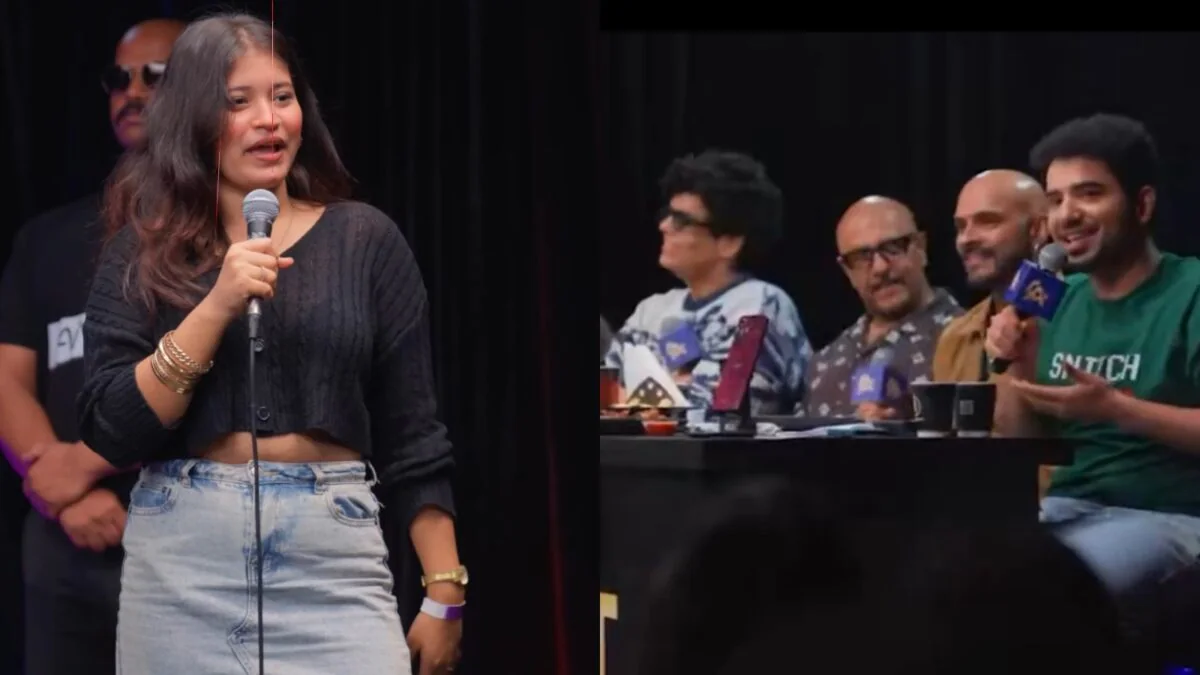
The latest season of India’s Got Latent has found itself at the center of another controversy after contestant Sakshi Jha made remarks during an episode that quickly went viral on social media. The comments, which many viewers described as offensive and insensitive toward men, have sparked widespread criticism and reignited discussions about the limits of comedy, gender-based humor, and responsibility in entertainment.
The incident unfolded during an interaction with comedian and host Samay Raina, where Sakshi Jha introduced herself in a humorous manner. She jokingly referred to herself as a “man hater,” setting the tone for a segment that would soon become one of the most talked-about moments from the show.
Remarks That Sparked the Debate
During the conversation, Sakshi claimed that she had no interest in getting married and added that if she ever did, she would want her husband to die after consuming alcohol. The statement, delivered in a comedic context, immediately drew strong reactions from viewers.
The audience present at the venue laughed during the exchange, and Samay Raina responded by joking that it would at least make her a widow. The lighthearted exchange continued on stage, but clips from the episode soon spread across social media platforms, where reactions were far more divided.
Many internet users argued that jokes targeting a particular gender should not be normalized, regardless of whether they are made in the name of comedy. Critics claimed that if similar remarks had been directed at women, the public response would likely have been much stronger.
Social Media Users Express Outrage
The viral clip generated thousands of comments across multiple platforms. A significant number of users accused the contestant of promoting hate speech against men, while others questioned why such comments were included in the final edit of the show.
Several viewers criticized the production team for allowing the segment to air, arguing that entertainment should not encourage jokes involving violence or death. Others pointed out what they perceived as a double standard in public reactions to gender-related humor.
Some comments suggested that comedy should avoid statements that appear to celebrate harm toward any individual or group, regardless of the intended comedic effect. 
Divided Opinion Over Comedy
Not everyone viewed the controversy in the same way. Some users defended the contestant, arguing that stand-up comedy and comedy reality shows often rely on exaggerated, fictional, or provocative statements designed to entertain rather than reflect genuine beliefs.
Supporters said audiences should distinguish between scripted jokes, improvisation, and real-life opinions. According to this section of viewers, controversial humor has long been a feature of comedy performances, and isolated clips taken out of context can sometimes create a misleading impression.
However, critics countered that comedians and participants still bear responsibility for the impact of their words, particularly when performances are viewed by millions online.
A Show Frequently Surrounded by Online Controversies
This is not the first time India’s Got Latent has generated headlines for controversial moments. The show has frequently gone viral because of its unfiltered style, spontaneous interactions, and edgy humor.
Its format encourages contestants and judges to engage in candid conversations that often blur the line between comedy and controversy. While this approach has helped the show attract a large digital audience, it has also resulted in repeated criticism whenever jokes are perceived as offensive or insensitive.
The latest debate surrounding Sakshi Jha’s remarks has once again highlighted the challenges faced by comedy-based entertainment in the age of social media, where individual clips can spread rapidly and generate intense public scrutiny.
The Larger Conversation
The controversy has also fueled a broader discussion about freedom of expression in comedy versus the need for responsible content. Entertainment experts and viewers continue to debate where the boundary should lie between satire, dark humor, and statements that could be interpreted as promoting hostility.
With digital platforms amplifying every controversial moment almost instantly, performers and content creators increasingly face public accountability for jokes that may resonate differently with diverse audiences.
As discussions continue online, the incident serves as another reminder that comedy remains one of the most debated forms of entertainment, particularly when it touches on sensitive social issues such as gender stereotypes and violence.
For now, neither the contestant nor the show’s makers have publicly addressed the growing criticism surrounding the viral exchange. Meanwhile, the clip continues to circulate across social media, keeping the conversation alive over what constitutes acceptable humor in contemporary entertainment.