
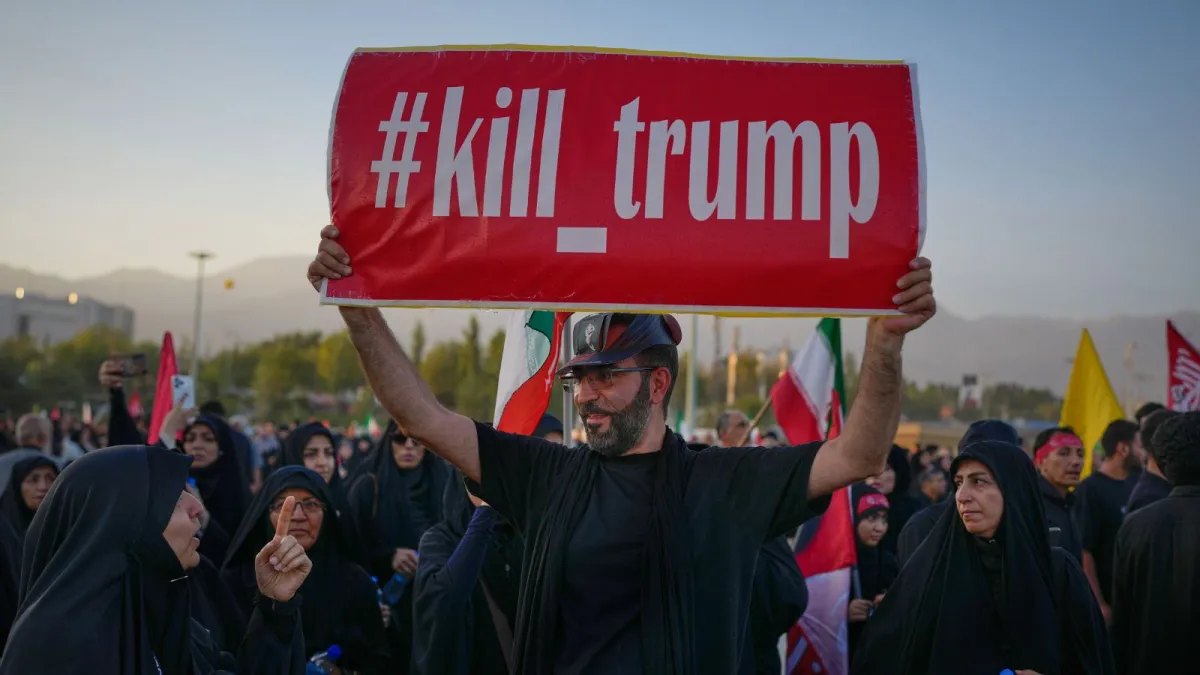
A funeral ceremony held in Tehran for Iran’s Supreme Leader, Ayatollah Ali Khamenei, became the center of renewed geopolitical tensions after sections of the gathered crowd were heard chanting slogans calling for the death of former United States President Donald Trump. The incident has drawn international attention, underscoring the continued hostility between Iran and the United States even as the region grapples with prolonged instability and diplomatic uncertainty.
The funeral attracted hundreds of thousands of mourners, senior Iranian political leaders, military officials, members of the Islamic Revolutionary Guard Corps (IRGC), religious scholars, and citizens from across the country. It was one of the largest public gatherings in Iran in recent years, reflecting Khamenei’s central role in shaping the country’s political, religious, and military direction over several decades.
Anti-US Sentiment Dominates the Ceremony
Throughout the funeral procession, crowds repeatedly chanted slogans expressing opposition to the United States and Israel. Among the most widely reported chants were direct calls targeting Donald Trump, whose presidency witnessed one of the lowest points in modern Iran-US relations.
The slogans reflected longstanding resentment over policies implemented during Trump’s administration, particularly the withdrawal of the United States from the 2015 nuclear agreement, the reimposition of extensive economic sanctions on Iran, and the military operation that killed senior Iranian military commander General Qassem Soleimani in January 2020.
For many hardline supporters in Iran, those events continue to symbolize what they describe as American aggression against the Islamic Republic. Public demonstrations and state-organized events have frequently featured similar slogans over the past several years.
Historical Context Behind the Hostility
Relations between Tehran and Washington have remained deeply strained since the 1979 Islamic Revolution. Diplomatic ties were severed following the seizure of the US Embassy in Tehran, and decades of sanctions, military confrontations, proxy conflicts, and disputes over Iran’s nuclear programme have kept the two countries at odds.
The killing of General Soleimani marked another turning point in bilateral relations. Iranian authorities repeatedly vowed that those responsible would face justice, while state media and public rallies often portrayed Trump as personally accountable for the military strike.
These unresolved grievances continue to influence public discourse within Iran and remain a significant factor behind anti-American rhetoric during major national events.
Massive Security Presence During Funeral
Authorities implemented extensive security measures throughout Tehran to manage the enormous crowds attending the funeral. Security personnel, police units, and members of the Revolutionary Guard were deployed across key routes to maintain order and oversee the movement of mourners.
The ceremony featured religious prayers, official speeches, military honours, and processions carrying symbolic tributes to the late Supreme Leader. Government officials described the gathering as a demonstration of national unity and loyalty to the Islamic Republic.
Images broadcast by Iranian state media showed vast crowds filling major roads and public squares while waving national flags, religious banners, and portraits of Khamenei.
Political Messaging at a Sensitive Time
The funeral also served as a significant political event, allowing Iran’s leadership to reinforce messages of resistance against perceived foreign adversaries.
Observers noted that anti-US and anti-Israel slogans formed a central part of the ceremony’s political symbolism. Officials delivering speeches reiterated Iran’s commitment to maintaining its regional influence and resisting external pressure despite years of sanctions and international isolation.
The event comes at a time when diplomatic efforts concerning Iran’s nuclear programme remain uncertain, while regional conflicts continue to complicate relations between Tehran and Western governments.
International Implications
Although public slogans at state ceremonies do not necessarily represent formal government policy, such demonstrations often attract close scrutiny from foreign governments because they reflect the broader political atmosphere within Iran.
The renewed anti-Trump chants are likely to further complicate already fragile relations between Iran and the United States. Analysts believe that symbolic displays of hostility can influence diplomatic perceptions, especially during periods of heightened regional tension.
With multiple conflicts unfolding across the Middle East and negotiations over Iran’s future international engagement remaining uncertain, the funeral has become more than a moment of national mourning. It has also highlighted the enduring ideological divisions that continue to shape Iran’s foreign policy and its relationship with Washington.
Outlook
As Iran enters a new political chapter following the death of Ayatollah Ali Khamenei, the country’s future domestic leadership and international posture will be closely watched by governments around the world. The emotional and politically charged atmosphere witnessed during the funeral illustrates that longstanding disputes with the United States remain deeply embedded in public rhetoric and official narratives.
Whether these developments translate into concrete policy changes or remain symbolic expressions of political sentiment will depend on the direction taken by Iran’s new leadership and the broader geopolitical environment in the months ahead.