
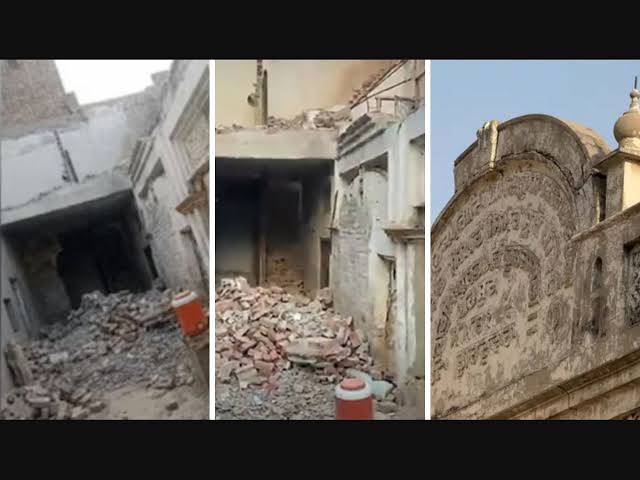
The demolition of the historic Gurdwara Singh Sabha, a Sikh place of worship believed to be around 125 years old, has triggered widespread concern among Sikh communities, heritage conservationists, and political leaders. The incident has reignited debates over the preservation of religious and cultural heritage sites in Pakistan, particularly those associated with minority communities.
Indian authorities strongly condemned the demolition, describing it as a deeply troubling act that undermines efforts to protect places of historical and religious significance. The development has also drawn attention to the broader issue of safeguarding centuries-old monuments that reflect the region’s diverse cultural and religious history.
Historic Significance of Gurdwara Singh Sabha
Gurdwara Singh Sabha was regarded as one of the oldest Sikh religious structures in the area. Constructed more than a century ago, the shrine stood as a reminder of the vibrant Sikh presence that once flourished across the Punjab region before the Partition of India in 1947.
The gurdwara carried immense spiritual and historical importance for Sikhs around the world. While regular religious activities at the site had significantly declined over the decades, the structure remained a valuable heritage landmark representing Sikh history in present-day Pakistan.
Experts have noted that such monuments are not merely places of worship but also serve as cultural archives that preserve architectural traditions and document the shared heritage of the Indian subcontinent.
Demolition Sparks Immediate Backlash
The demolition reportedly took place as part of redevelopment activities in the locality, leading to widespread criticism from Sikh organizations and heritage activists.
Images and videos circulating on social media showing the damaged structure generated strong reactions, with many questioning how a historically significant religious monument could be demolished despite its cultural value.
Community representatives argued that heritage sites should be protected regardless of their current level of use, emphasizing that religious monuments represent the identity and history of entire communities rather than simply functioning as active places of worship.
Several Sikh groups demanded an independent investigation into the circumstances surrounding the demolition and urged authorities to ensure accountability. /newsdrum-in/media/media_files/2026/07/01/pak-gurudwara-2026-07-01-20-48-14.jpg)
India Expresses Strong Protest
India condemned the demolition in unequivocal terms, calling upon Pakistan to fulfill its responsibility to safeguard religious sites belonging to minority communities.
Officials stated that the destruction of a historic Sikh shrine sends a disturbing message regarding the protection of religious heritage and urged Pakistani authorities to take immediate corrective measures.
The condemnation also highlighted repeated concerns regarding attacks, neglect, or damage to minority religious properties in Pakistan. Indian officials emphasized that preserving such monuments is essential for maintaining religious harmony and respecting cultural diversity.
Pakistan’s Position
Pakistani authorities indicated that the matter would be examined and that reports surrounding the demolition were being reviewed. Officials maintained that action would be taken if any violations of heritage protection regulations were found.
Local administrative authorities have also been asked to determine whether the demolition complied with existing legal procedures governing historical and religious structures.
The incident has renewed calls within Pakistan for stronger enforcement of heritage conservation laws and improved coordination between civic authorities and organizations responsible for protecting religious monuments.
Importance of Sikh Heritage in Pakistan
Pakistan is home to several sites that hold immense significance in Sikhism, including numerous gurdwaras associated with the lives of Sikh Gurus and important historical events.
Many of these sites attract thousands of pilgrims annually through religious tourism initiatives. Conservation experts believe preserving these monuments is vital not only for religious reasons but also for promoting cultural understanding and historical awareness.
The destruction of any heritage structure, they argue, risks erasing important chapters of the shared history of South Asia.
Growing Calls for Heritage Preservation
The demolition has intensified demands for stronger legal protections for historical religious sites, irrespective of the communities they represent.
Heritage conservation organizations stress that governments have an obligation to preserve monuments that reflect the multicultural legacy of their nations. They argue that proper restoration, documentation, and maintenance can help protect these landmarks for future generations.
Experts have also recommended comprehensive surveys of vulnerable heritage structures to prevent similar incidents and ensure that redevelopment projects do not compromise historically important buildings.
Broader Diplomatic Implications
The incident is likely to add another sensitive issue to India-Pakistan relations, where concerns over the treatment of religious minorities frequently emerge in diplomatic discussions.
While both countries have occasionally cooperated on facilitating religious pilgrimages, incidents involving places of worship often generate strong public reactions and diplomatic exchanges.
Observers believe that transparent investigations, accountability, and stronger heritage preservation measures will be essential to rebuilding confidence among affected communities.
Conclusion
The demolition of the 125-year-old Gurdwara Singh Sabha has become more than a local heritage issue. It has evolved into an international concern involving religious freedom, cultural preservation, and diplomatic sensitivity.
As calls for accountability continue, the incident serves as a reminder of the importance of protecting historical monuments that represent centuries of shared heritage. The future handling of the case will be closely watched by Sikh communities, heritage experts, and governments seeking stronger safeguards for religious and cultural landmarks.