
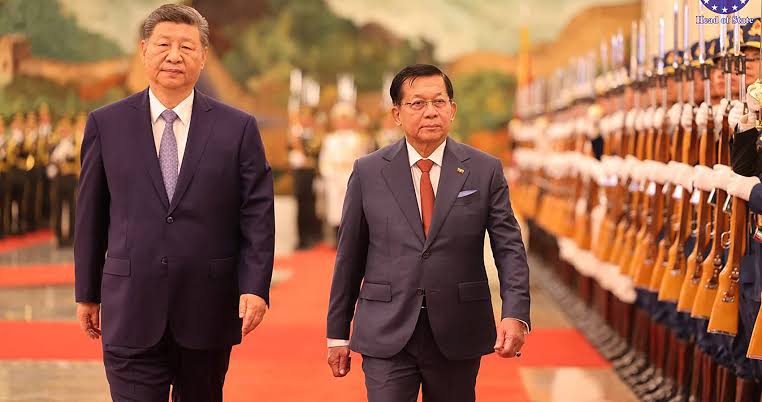
Chinese President Xi Jinping has reiterated Beijing’s commitment to safeguarding Myanmar’s sovereignty, independence, and territorial integrity during a high-level meeting with Myanmar’s military leader, underscoring China’s continued engagement with its neighboring country amid ongoing political instability and armed conflict.
The meeting marked a significant diplomatic moment as China sought to reinforce its strategic ties with Myanmar while emphasizing principles of non-interference and regional stability. Xi’s remarks reflected Beijing’s long-standing foreign policy approach toward Myanmar, where China remains one of the most influential economic and political partners.
China Stresses Stability and Sovereignty
During discussions with Myanmar’s military leadership, Xi emphasized that China firmly supports Myanmar in pursuing a development path suited to its national conditions. He reaffirmed Beijing’s position that the country’s sovereignty and territorial integrity must be respected and protected.
The Chinese leader also highlighted the importance of maintaining national stability and advancing economic development, indicating that China remains committed to deepening cooperation with Myanmar despite the country’s complex internal situation.
Beijing has consistently advocated for peaceful solutions to Myanmar’s challenges while avoiding direct criticism of the military authorities. China’s leadership views stability in Myanmar as crucial for regional security, border management, and the success of major infrastructure and connectivity projects linking the two nations.
Strategic Importance of China-Myanmar Relations
China and Myanmar share a lengthy border and maintain extensive economic ties. Myanmar occupies a strategically important position within China’s regional connectivity ambitions, serving as a gateway between southwestern China and the Indian Ocean.
Several major infrastructure initiatives, including transportation corridors, energy pipelines, and industrial development projects, have strengthened the partnership between the two countries. These projects are considered vital components of broader regional economic integration efforts.
For China, a stable Myanmar is essential not only for protecting investments but also for ensuring security along shared border regions where armed groups and conflict have periodically created challenges. 
Myanmar’s Ongoing Political Crisis
Myanmar has been grappling with political turmoil since the military takeover in 2021, which triggered widespread protests, armed resistance, and international condemnation. The conflict has evolved into a prolonged crisis involving clashes between the military and multiple resistance groups across different parts of the country.
The instability has resulted in significant humanitarian concerns, displacement of civilians, and disruptions to economic activity. International efforts to promote dialogue and reconciliation have faced substantial obstacles, with fighting continuing in several regions.
Against this backdrop, China has sought to balance its strategic interests while maintaining communication with various stakeholders involved in Myanmar’s complex political landscape.
Beijing’s Diplomatic Approach
China has repeatedly stated that developments in Myanmar should be resolved through dialogue and political consultation. Chinese officials have emphasized the need to prevent further escalation of violence while encouraging measures that support peace and stability.
Xi’s latest remarks reinforce Beijing’s message that external actors should respect Myanmar’s sovereignty and avoid actions that could complicate the situation further. This stance aligns with China’s broader diplomatic principle of non-interference in the internal affairs of other nations.
Analysts view China’s engagement with Myanmar as part of a wider effort to maintain influence in Southeast Asia while protecting critical economic and security interests in the region.
Regional and International Implications
The meeting comes at a time when geopolitical competition and security concerns are shaping diplomatic relations across Asia. Myanmar’s strategic location and ongoing instability have drawn attention from regional powers and international organizations seeking to promote stability and economic development.
China’s reaffirmation of support for Myanmar’s sovereignty signals that Beijing intends to remain a key partner for the country despite continuing political uncertainty. The commitment also reflects China’s broader objective of maintaining strong relations with neighboring states and preserving stability along its borders.
As Myanmar continues to navigate its internal challenges, China’s role is expected to remain significant, particularly in areas related to economic cooperation, infrastructure development, and diplomatic engagement. The latest discussions between Xi Jinping and Myanmar’s military leadership underscore the enduring importance of the bilateral relationship and Beijing’s determination to protect its strategic interests while advocating stability and national sovereignty.