
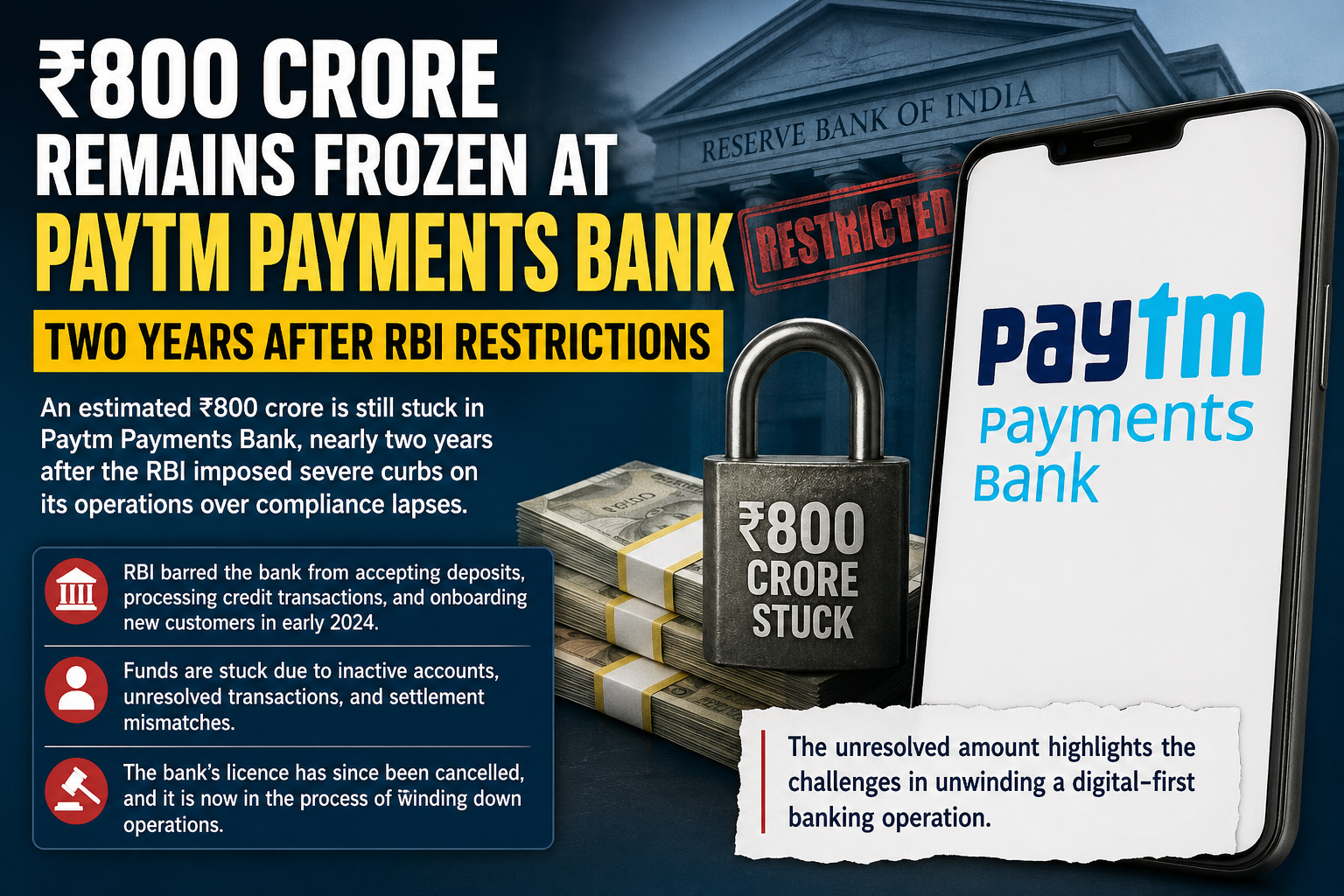
Nearly two years after regulatory restrictions halted the core operations of Paytm Payments Bank, an estimated ₹800 crore remains stuck within the system, raising fresh concerns about unresolved financial liabilities and the long tail of regulatory intervention in India’s fintech sector.
The situation stems from the Reserve Bank of India’s decisive action in early 2024, when it imposed strict curbs on the payments bank following repeated instances of non-compliance. The regulator had identified significant lapses in areas such as customer verification processes, governance standards, and adherence to banking norms. As a result, the bank was barred from accepting new deposits, processing credit transactions, or onboarding customers—effectively bringing its primary operations to a standstill.
While customers were allowed to withdraw their existing balances, the operational freeze triggered a complex transition phase. During this period, a portion of funds—now estimated at around ₹800 crore—became entangled in unresolved transactions, inactive or dormant accounts, and settlement mismatches. These funds have yet to be fully reconciled, even as the bank has moved toward winding down its operations.
Industry sources indicate that the stuck amount may include a mix of customer wallet balances, merchant settlement dues, and intermediary funds that were disrupted when the regulatory restrictions came into force. The sudden halt in operations created logistical and technical challenges, particularly in reconciling high volumes of digital transactions processed through the platform.
The regulatory action against Paytm Payments Bank was not abrupt but followed years of scrutiny. The central bank had previously flagged issues related to Know Your Customer (KYC) compliance, data integrity, and the linking of multiple accounts to single identities. These concerns raised red flags about potential systemic risks and the misuse of financial channels, prompting tighter oversight.
In the aftermath of the restrictions, Paytm was forced to significantly restructure its financial ecosystem. The company shifted its payment processing and banking partnerships to other regulated institutions, aiming to ensure continuity of services for its large user base. Despite these efforts, legacy issues tied to the payments bank continue to persist, with the unresolved ₹800 crore emerging as a key concern.
The eventual cancellation of the payments bank’s licence marked the final step in a prolonged regulatory process. Authorities cited continued non-compliance and risks to depositor interests as the basis for their decision. The bank has since entered a wind-down phase, focused on settling outstanding obligations and closing remaining accounts.
However, the persistence of such a substantial unreconciled amount underscores the complexities involved in dismantling a large-scale digital banking operation. Unlike traditional banks, payments banks operate on high-volume, low-value transactions, making reconciliation during shutdown particularly challenging.
The episode highlights broader lessons for India’s rapidly growing fintech industry. It underscores the critical importance of regulatory compliance, strong internal controls, and transparent governance frameworks. As digital financial services continue to expand, regulators are expected to maintain strict oversight to safeguard consumer interests and ensure systemic stability.
For stakeholders, the ₹800 crore still stuck in the system serves as a reminder that regulatory actions can have long-lasting financial implications, even years after initial enforcement. The resolution of these funds will be closely watched as the final chapter in the Paytm Payments Bank case unfolds.