
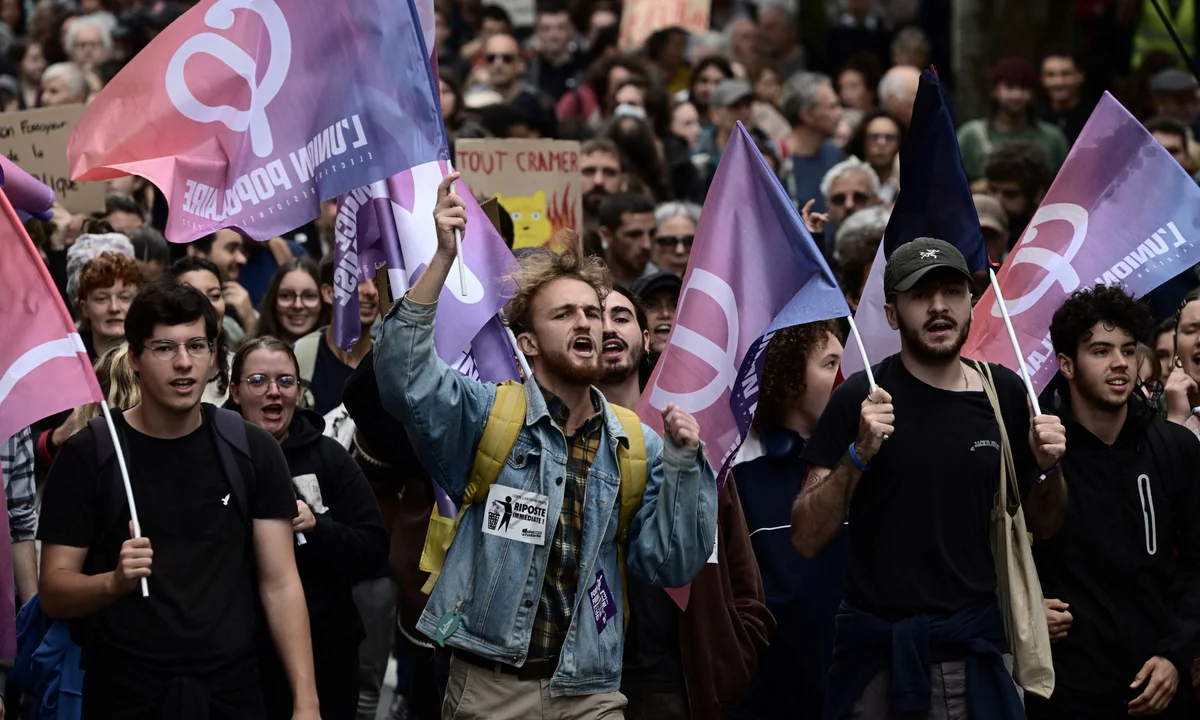
France witnessed a dramatic wave of unrest as nationwide protests erupted following the ouster of Prime Minister François Bayrou and the announcement of sweeping budget cut plans. Demonstrators under the “Block Everything” movement flooded streets across major cities, demanding an end to austerity policies and voicing anger at the political establishment.
The protests began in the early hours with demonstrators setting up barricades, blocking highways, burning refuse, and clashing with police in several urban centers including Paris, Lyon, Marseille, Toulouse, Bordeaux, and Nantes. In Paris, rubbish bins were set ablaze, barricades were erected on the ring road, and tramlines were obstructed. Security forces responded with tear gas and mass arrests as they attempted to disperse the crowds and restore order.
According to official figures, nearly 200 protesters were detained across the country, with more than 130 arrests in Paris alone. The demonstrations drew comparisons to the “Yellow Vest” movement that shook France between 2018 and 2020, reflecting deep-seated frustration with economic inequality and government policies perceived as unfair to ordinary citizens.

The unrest came in the backdrop of a failed confidence vote that forced Prime Minister François Bayrou’s resignation. His government’s proposed 2026 budget, which included €44 billion in deficit reduction measures, triggered outrage. The controversial plan involved higher taxes, pension freezes, the abolition of two national holidays, and cuts to healthcare spending. Critics argued that these measures placed a disproportionate burden on working-class families while sparing the wealthy and corporations.
In anticipation of the protests, the French government deployed nearly 80,000 security personnel nationwide, including 6,000 in Paris. Armored vehicles, drones, and helicopters were pressed into service to ensure the functioning of transport services and prevent sabotage of key infrastructure such as refineries, airports, and train stations. Despite the heavy presence of law enforcement, protests turned volatile, with scenes of street fires, blocked railway tracks, and violent clashes reported from multiple regions.
Interior Minister Bruno Retailleau warned that while demonstrations were expected, the government would not tolerate attempts to paralyze the country. He accused protest organizers of trying to destabilize France during a politically sensitive period following the prime minister’s exit.
The “Block Everything” movement, largely decentralized and organized through social media, has quickly gained traction. Its call for widespread disruption resonated with citizens already struggling with the rising cost of living, unemployment, and dissatisfaction with political leadership. Protesters voiced anger not just over budget cuts but also over what they perceive as an unresponsive political elite disconnected from public needs.

Observers note that these protests could mark a turning point in French politics, signaling the growing power of grassroots movements to influence national debates. As the government scrambles to appoint a new prime minister and rebuild political stability, the unrest underscores the deepening divide between France’s ruling class and its people.