
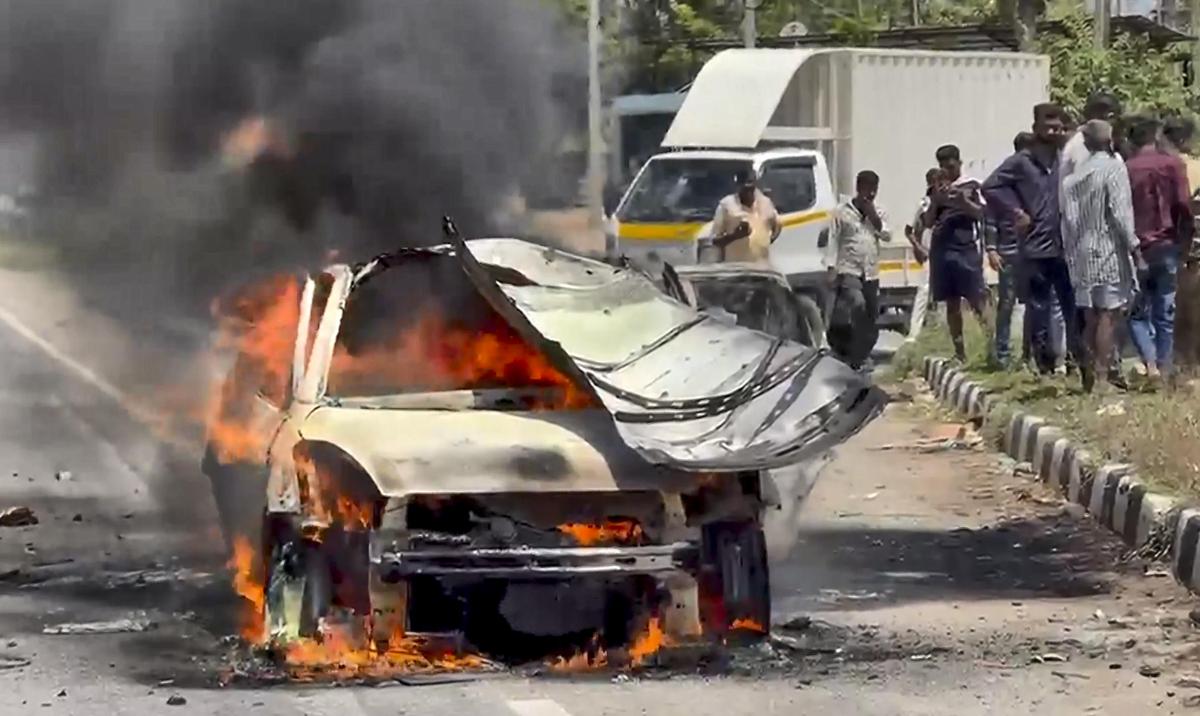
Authorities in Karnataka’s Tumakuru district have intensified their investigation into a suspected illegal crude bomb supply network following a deadly explosion on National Highway-48 that claimed one life and exposed potential gaps in the handling of explosive materials.
The incident, which occurred near Jogihalli in Sira taluk, involved a cab that suddenly caught fire after a powerful explosion inside the vehicle. The blast resulted in the death of one passenger, while a woman travelling with him and the driver managed to escape the vehicle before it was completely engulfed in flames. Both survivors sustained injuries and were rushed to a nearby hospital for treatment.
Preliminary findings suggest that the explosion was not accidental but was triggered by a crude, country-made explosive device. Forensic examination of the burnt vehicle has revealed traces of explosive substances, prompting investigators to suspect that the device was either carried inside the cab or assembled shortly before the incident.
Police officials indicated that the sequence of events began with a dispute inside the moving vehicle. During the altercation, the accused is believed to have assaulted the woman, forcing the driver to stop the cab. Shortly after the vehicle halted, the explosion occurred, leading to a rapid fire outbreak that destroyed the car.
Investigators are currently exploring multiple angles, including the possibility that the deceased individual deliberately carried explosive materials with him. While early evidence points toward a planned act, authorities have not ruled out other possibilities, including emotional instability or premeditated criminal intent.

Following the incident, a formal case was registered at Kallambella police station, and multiple investigative teams were deployed to the scene. Forensic experts, explosives specialists, and intelligence units are jointly working to determine the exact composition of the substance used in the blast and whether it was locally manufactured or sourced through an illegal supply chain.
A key focus of the investigation is the suspected network involved in the distribution of crude explosive materials. Police are examining whether chemical components used in the blast were obtained from unauthorized sources, diverted from legitimate industrial use, or assembled using easily accessible materials available in local markets.
Officials are also investigating possible connections between this incident and other cases involving crude explosives in the region. Surveillance data, communication records, and witness statements are being analysed to identify patterns that may point to a larger organized network.
Senior officers have confirmed that the probe has now expanded beyond the immediate incident. The objective is to identify and dismantle any organized groups involved in manufacturing, assembling, or distributing illegal explosive devices. Authorities believe that such networks pose a serious threat to public safety, especially when materials can be transported discreetly along major highways.
The explosion also caused significant disruption to traffic on NH-48, one of the busiest highways in the region. Emergency response teams worked for several hours to control the fire, clear debris, and restore normal traffic flow.
Officials have stated that strict legal action will be taken once the source of the explosive material is identified. The investigation remains ongoing, with authorities treating the case as a serious security concern due to the possibility of a wider criminal network operating behind the scenes.