
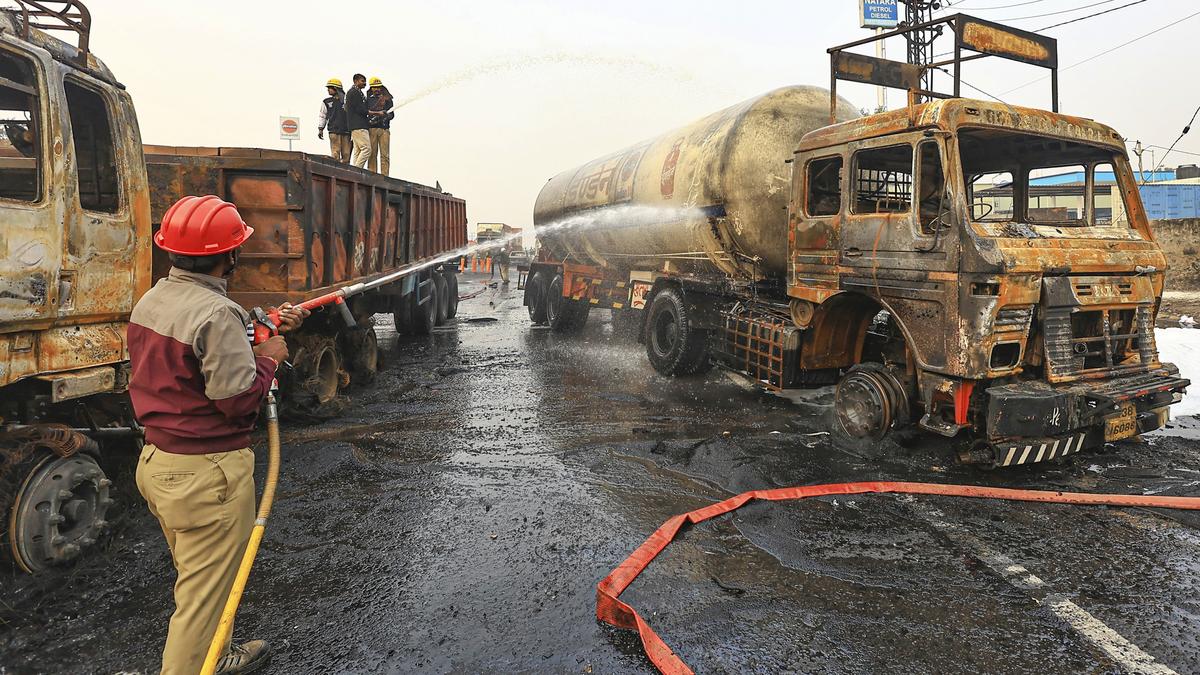
A catastrophic accident late Tuesday on the Jaipur–Ajmer National Highway left the stretch reeling after a truck loaded with LPG cylinders caught fire following a collision with a chemical tanker. The chain reaction of explosions, flying cylinders, and roaring flames triggered widespread panic among commuters and nearby residents, necessitating an urgent emergency response from authorities.
The Incident and Immediate Aftermath
Around 10:30–11:00 pm, the collision occurred near the Dudu / Muzammabad / Mozmabad area, reportedly when a high-speed chemical tanker rammed into the rear or side of the stationary LPG truck (which might have been paused near a roadside eatery or rest point). The impact was severe enough to rupture many of the LPG cylinders, which then burst open, producing a series of explosions likened to missiles, with fireballs and sound waves felt and heard several kilometers away. Some cylinders were thrown dozens of meters from the crash site.
Eyewitnesses described a terrifying scene: the truck’s metal body “melted like wax,” explosions lighting up the midnight sky, and the distinct smell of burning gas. The roar of blast waves echoed through nearby villages, and tremors were felt in adjacent fields and structures.
Rescue, Response, and Casualties
Fire brigade units, police, disaster management teams, and local administration converged quickly. Many of the cylinders continued to detonate intermittently, complicating efforts to approach safely. Officials confirmed two to three people were injured, including possibly the tanker driver, who was rushed to a local hospital for treatment of severe burns and shock. Other individuals—such as the driver and helper of the LPG truck—were initially unaccounted for, prompting search operations in the blaze-damaged remains.
Traffic was immediately halted in both directions. The highway remained closed for several hours as emergency crews worked to douse the flames, secure the wreckage, and clear debris. Nearby towns and medical centers were put on alert to receive any additional casualties.
High-ranking officials, including the Rajasthan Chief Minister, Deputy Chief Minister, and top police leadership, visited the site to oversee operations. A full inquiry has been ordered, and on-site reviews were directed to assess safety protocols, road design, and the handling of hazardous materials.
Potential Causes and Safety Concerns
Preliminary investigations suggest multiple contributing factors:
- The tanker may have lost control or failed to brake in time, leading to a high-impact collision
- Poor lighting and visibility in the area might have hindered driver reaction
- Lack of buffer zone or safe parking space for the LPG truck
- Potential noncompliance with safety protocols (e.g., cylinder crowding, weak container integrity, inadequate hazard markings)
The incident raises serious questions about the enforcement of hazardous materials transport regulation, route safety for LPG and chemical carriers, and whether road design or oversight is adequate to prevent such disasters.
Public Safety Impact and Sectoral Ramifications
This accident revives memories of earlier fatal LPG explosions on the same highway and elsewhere, reminding both authorities and citizens of the extreme vulnerability posed by combustible cargo. For the public, the event is a stark reminder that infrastructure weak points—especially on major highways—can rapidly escalate into mass casualty events when hazardous substances are involved.
For transport regulators, petroleum and chemical companies, and emergency services, the implications are profound. There is renewed pressure to:
- Reassess hazardous cargo routes and timing
- Strengthen fire suppression systems on highways and near service areas
- Mandate stricter vehicle safety audits for LPG and chemical carriers
- Ensure emergency response readiness (fire tenders, water supply, access roads) along critical stretches.