
External Affairs Minister Dr. S. Jaishankar, during a press conference on August 21, firmly defended India’s ongoing energy trade with Russia amid continued Western scrutiny. Addressing concerns raised by international actors—particularly the United States—Jaishankar pointed out that India is neither the largest importer of Russian crude oil nor liquefied natural gas (LNG). He stated clearly, “We are not the biggest purchasers of Russian oil—that is China. We are not the biggest purchasers of LNG—that is the European Union.”
He emphasized that the sharp spike in Russia’s overall trade post-2022 was not driven by India, subtly hinting at other nations that have contributed more significantly to Moscow’s trade growth. “We are not the country which has the biggest trade surge with Russia after 2022; I think there are some countries to the South,” he noted, without naming specific nations.
Jaishankar highlighted what he called the “contradictions” in Western positions. He recalled past U.S. statements encouraging India to contribute to global energy stability, which included sourcing oil from a variety of countries—including Russia. “Incidentally, we also buy oil from the US,” he added, underlining that India’s imports of American crude have been steadily increasing.
Expressing surprise at the repeated criticism of India’s energy policy, Jaishankar said he was “perplexed at the logic” behind the complaints. He reaffirmed that India’s energy purchases are based on affordability and security considerations, not on geopolitical alignments. “Our interest lies in diversifying sources and ensuring stable supplies,” he said.
https://twitter.com/i/broadcasts/1ypKdqRBVWnGW
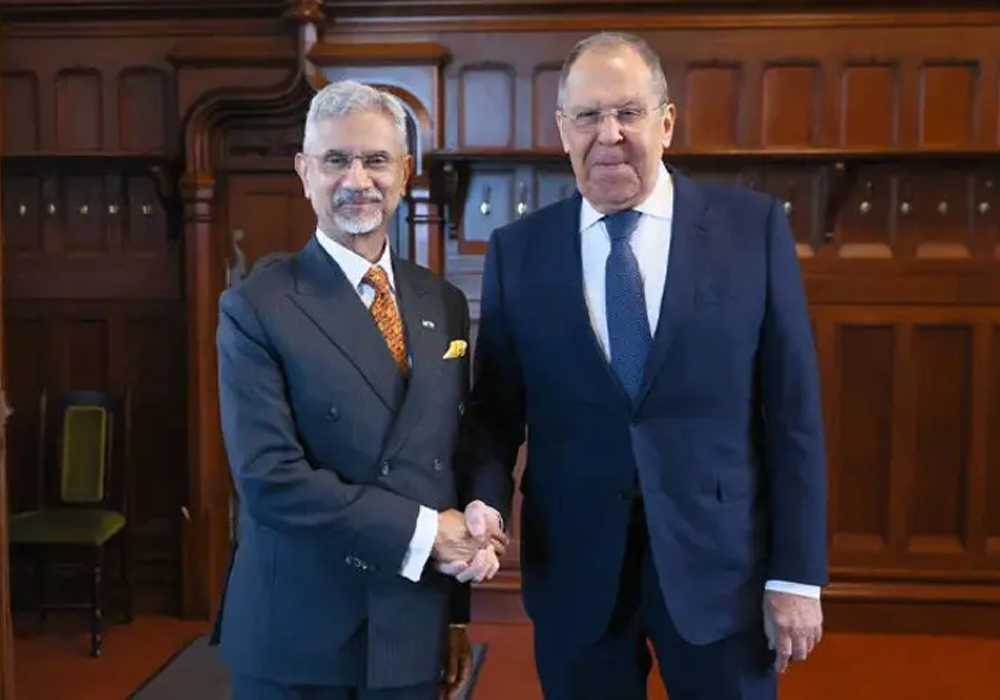
During his visit to Moscow, Jaishankar held a meeting with Russian Foreign Minister Sergey Lavrov. The two leaders reviewed bilateral relations and discussed preparations for the upcoming annual India-Russia summit. “Our meeting today allowed us to assess the strategic partnership and cooperation roadmap ahead,” Jaishankar said.
Lavrov welcomed Jaishankar and emphasized the emergence of a multipolar global order, citing the growing influence of international groupings like SCO, BRICS, and the G20. “This is a multipolar system of international relations. I hope for fruitful talks today,” Lavrov said.
Economic cooperation also featured prominently during the visit. Russia’s Deputy Prime Minister Denis Manturov noted that India’s trade turnover with Russia has grown nearly 700% over five years, placing India among Moscow’s top three trading partners. However, Jaishankar expressed concern over the widening trade imbalance. “Bilateral trade rose from USD 13 billion in 2021 to USD 68 billion in 2024–25. But the trade imbalance increased from USD 6.6 billion to USD 58.9 billion, which is worrying,” he said.
Jaishankar also co-chaired the 26th Session of the India-Russia Inter-Governmental Commission on Trade, Economic, Scientific, Technological, and Cultural Cooperation (IRIGC-TEC) along with Manturov. The session covered discussions on sectors including energy, mobility, education, agriculture, and culture. “We proposed concrete steps to make IRIGC-TEC more effective in expanding our economic partnership,” Jaishankar said.
As part of his Moscow visit, he also paid tribute at the Tomb of the Unknown Soldier, commemorating the soldiers who died in World War II.