
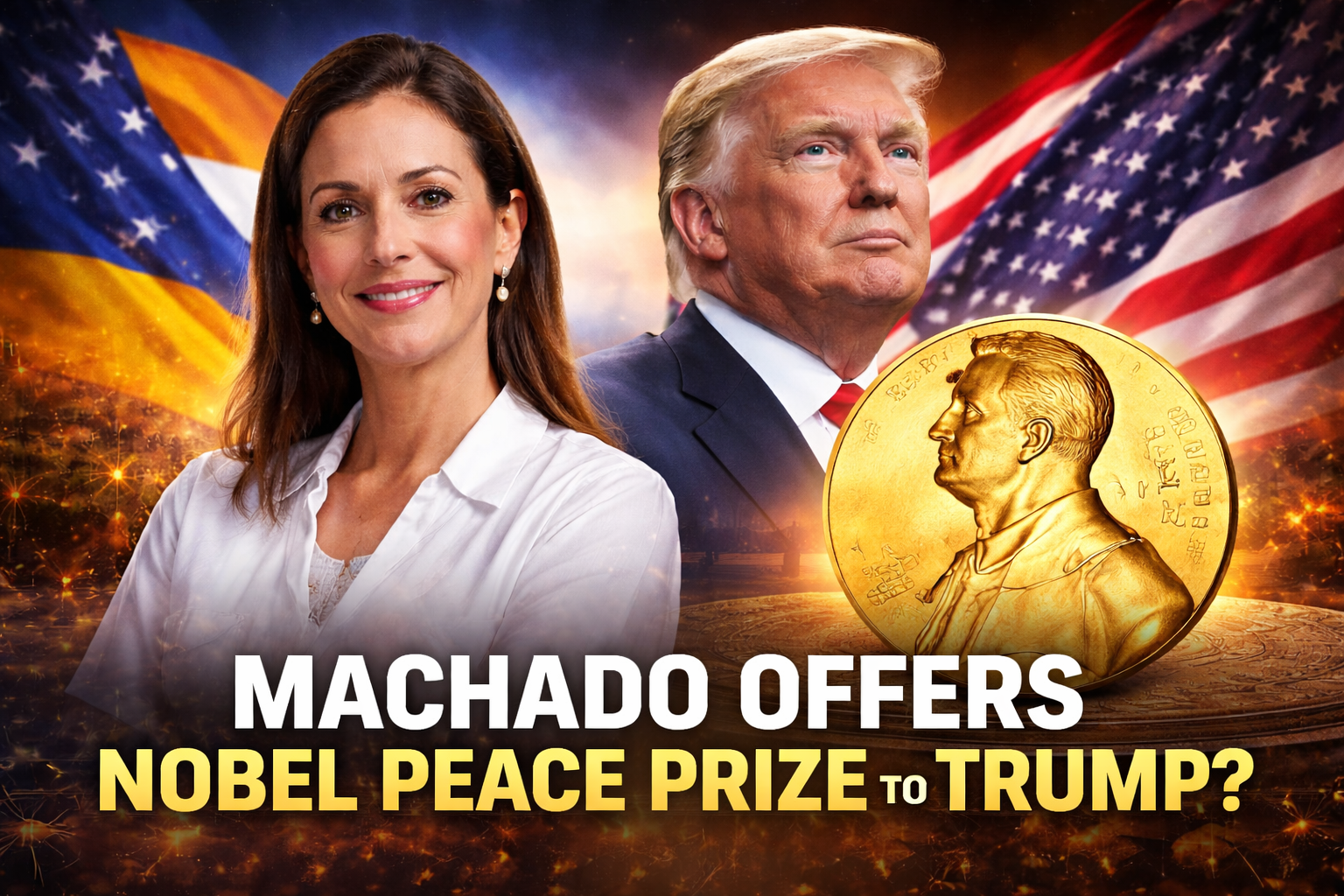
The Norwegian Nobel Committee has firmly ruled out any possibility of the Nobel Peace Prize being shared or transferred after Venezuelan opposition leader Maria Corina Machado expressed her intention to offer the prestigious award to United States President Donald Trump. The committee made it clear that Nobel rules do not allow a laureate to pass on, divide, or reassign the prize once it has been awarded.
Machado, who was recently honoured with the Nobel Peace Prize for her long-standing struggle for democracy, human rights, and political freedom in Venezuela, made headlines when she publicly stated that she would like to give her prize to Trump. Her comments immediately sparked global debate, raising questions about whether such an action was legally or institutionally possible under Nobel regulations.
In response, the Nobel Committee reiterated that the Peace Prize is strictly personal to the recipient. Once the award is announced and conferred, it becomes final and irrevocable. The committee explained that there is no mechanism within the Nobel statutes that permits a winner to share the prize with another individual or to transfer it, regardless of personal intention or political sentiment.
Machado’s Statement and Political Context
Machado’s remarks were widely interpreted as a political gesture reflecting her appreciation of Trump’s role in shaping international pressure against authoritarian regimes, particularly in Latin America. She has consistently acknowledged foreign leaders who, in her view, have supported Venezuela’s democratic movement and opposed dictatorship.
By offering to give the Nobel Peace Prize to Trump, Machado aimed to highlight what she described as his contribution to defending freedom and confronting oppressive governments. However, her statement was symbolic rather than procedural, as Nobel regulations make it impossible for such an action to be formally recognised.
The move also drew attention because Trump has, in the past, repeatedly claimed that he deserved the Nobel Peace Prize for his role in international diplomacy, including efforts related to Middle East peace agreements and negotiations with rival nations.
Trump’s Reaction
Following Machado’s statement, Trump responded positively, saying he would be honoured to accept the prize if it were offered to him. He described the possibility as a great recognition of his diplomatic efforts and repeated his long-standing argument that his presidency contributed to global peace and stability.
However, his response did not change the institutional position of the Nobel Committee, which remains firm that only the officially declared laureate can hold the title and the honour associated with the prize.
Nobel Committee’s Clear Stand
The Nobel Committee clarified that:
- The Nobel Peace Prize cannot be shared after it has been awarded.
- It cannot be transferred to another person.
- It cannot be revoked or reassigned.
- The identity of the laureate remains permanent and exclusive.
The committee also noted that it does not comment on how laureates choose to use their recognition or express their personal opinions, but such actions do not alter the legal status of the prize.
This statement effectively ended speculation that Machado’s offer could carry any official weight.
Why the Prize Cannot Be Shared
The Nobel Peace Prize is governed by strict statutes established under Alfred Nobel’s will. These rules are designed to protect the independence, credibility, and historical integrity of the award. While multiple winners can be named in the same year, this decision must be made by the committee at the time of the announcement. Once the laureate is declared, no changes are allowed.
This framework ensures that political influence or personal preferences cannot reshape the outcome after the fact.
Global Reactions
The episode has generated mixed reactions worldwide. Supporters of Machado view her offer as a symbolic gesture of gratitude and political alignment. Critics argue that the move unnecessarily politicises a globally respected institution.
Diplomatic observers note that the controversy highlights how international awards often become part of broader geopolitical narratives, especially when high-profile political figures are involved.
A Symbolic Gesture, Not a Legal One
Ultimately, Machado’s offer remains symbolic. While it reflects her personal admiration and political perspective, it does not have any legal standing within the Nobel framework. The Nobel Committee’s response reinforces the principle that the Peace Prize is an institutional honour governed by strict rules, not a transferable political endorsement.
The incident has once again brought global attention to the rules surrounding the Nobel Peace Prize and underscored the importance of maintaining its neutrality and prestige in an increasingly politicised world.
Leave a Reply