

Several Tesla owners across different regions have reported eerie incidents where their vehicle screens displayed human-like figures despite no one being physically present nearby. The phenomenon, captured in multiple user videos and widely shared on social media, has sparked curiosity and speculation online.
Owners described how their Tesla’s autopilot visualisation system — which uses cameras and sensors to detect pedestrians, vehicles, and obstacles — began showing mysterious silhouettes in deserted areas. Some incidents were reported near empty parking lots, highways, and even graveyards, heightening the sense of unease among users.
In one account, a Tesla driver claimed the car’s screen showed several human-like forms moving across a cemetery late at night, though there was “absolutely no one around.” Similar experiences have been shared by owners from the United States, Canada, and parts of Europe, all pointing to a peculiar glitch in the vehicle’s detection system.
Technical Explanation: Software Error or Optical Illusion?
Automotive technology experts have since dismissed any supernatural interpretation, explaining the phenomenon as a false-positive detection error in Tesla’s vision-based sensor system. Unlike most other manufacturers, Tesla relies almost entirely on cameras and neural-network algorithms rather than radar or lidar.
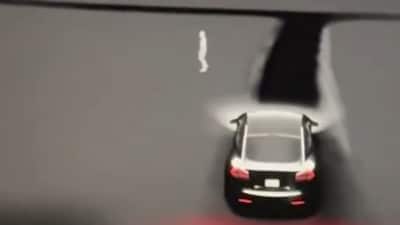
This makes the system highly sensitive to visual distortions caused by shadows, low lighting, or reflective surfaces. In complex environments — such as graveyards with tombstones, fences, or monuments — the software can misinterpret static objects as pedestrians.
Engineers say these “ghost detections” are likely due to how Tesla’s AI processes depth perception and movement patterns. The car’s system attempts to predict and track possible human shapes for safety, sometimes overcompensating in ambiguous visual situations.
Tesla’s Response and Safety Implications
Tesla has not issued an official comment on the specific incidents, but the company has previously acknowledged that false detections can occur in its Full Self-Driving (FSD) and Autopilot systems, especially in low-visibility or unstructured environments.
The automaker continues to stress that its vehicles are not fully autonomous and that drivers must remain attentive at all times. Industry analysts view these incidents as reminders that AI-driven safety systems, while advanced, are still prone to unpredictable errors that require human oversight.
Experts have also highlighted the importance of regular software updates and improved data calibration to help Tesla’s systems differentiate between real and artificial objects more accurately in the future.
Public Reaction
The bizarre “ghost sightings” have quickly gone viral online, drawing mixed reactions. While some users reacted with humour, others expressed concern over the reliability of Tesla’s autonomous technology.
For many owners, the incidents underline the fine line between technological marvel and mechanical misjudgment — a reminder that even the most advanced systems can sometimes play tricks on the human imagination.
Leave a Reply