
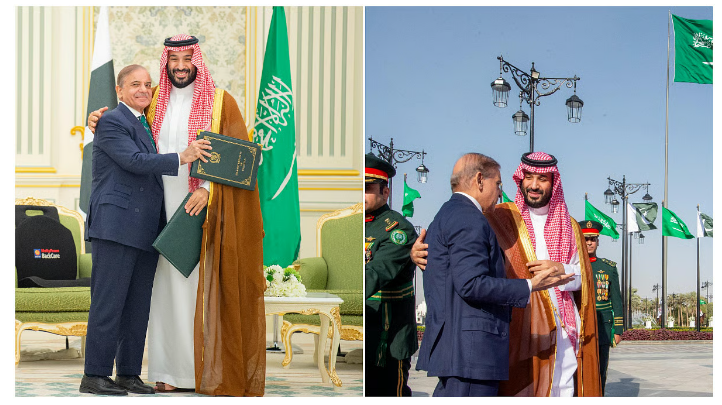
Saudi Arabia and Pakistan on Wednesday signed a landmark Strategic Mutual Defence Agreement, significantly upgrading their military cooperation.
The pact, inked during Pakistan Prime Minister Shehbaz Sharif’s state visit to Riyadh at the invitation of Saudi Crown Prince Mohammed bin Salman, formalizes the decades-old defence partnership between the two Islamic nations.
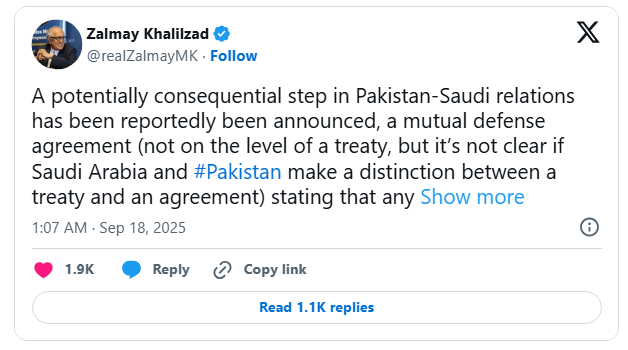
According to the joint statement, the agreement aims to deepen defence collaboration, strengthen joint deterrence, and enhance security in the region. The pact explicitly states that any aggression against either nation will be treated as aggression against both, marking a major shift from informal defence cooperation to a NATO-style collective security arrangement.
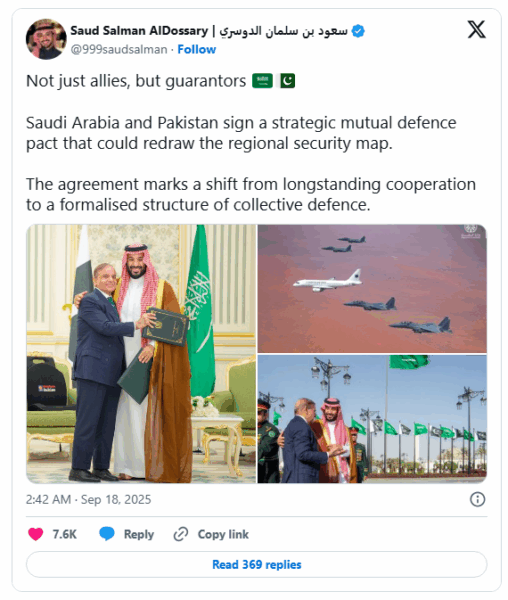
Observers note that this development could give Pakistan additional leverage in its regional posturing, particularly regarding its disputes with India. With Riyadh’s backing, Islamabad may feel emboldened to take a harder stance, especially on Kashmir.
The timing of the pact is significant. It comes just months after the deadly Pahalgam terror attack, where 26 people were killed by heavily armed militants of The Resistance Front, a Lashkar-e-Taiba offshoot.
In response, India launched Operation Sindoor, striking nine high-value terror infrastructures across Pakistan and Pakistan-occupied-Kashmir (PoK). Pakistan retaliated with counterstrikes, escalating tensions in the region.
In the aftermath of these clashes, India launched Operation Sindoor Outreach, dispatching delegations to friendly nations to expose Pakistan’s role in cross-border terrorism. One such delegation, led by BJP MP Baijayant Panda, had visited Saudi Arabia to brief officials on Pakistan’s alleged involvement in terrorism.
The pact now raises fresh concerns for New Delhi. While India shares strong economic ties with Saudi Arabia — Riyadh is India’s fifth-largest trade partner, and New Delhi is the Kingdom’s second-largest partner — the agreement provides Pakistan with a new layer of diplomatic and military support.
Analysts say this may complicate India’s regional security calculations, especially if Pakistan seeks to invoke the pact during future conflicts.
Reacting to the development, the Ministry of External Affairs (MEA) said, “We have seen reports of the signing of a strategic mutual Defence pact between Saudi Arabia and Pakistan.
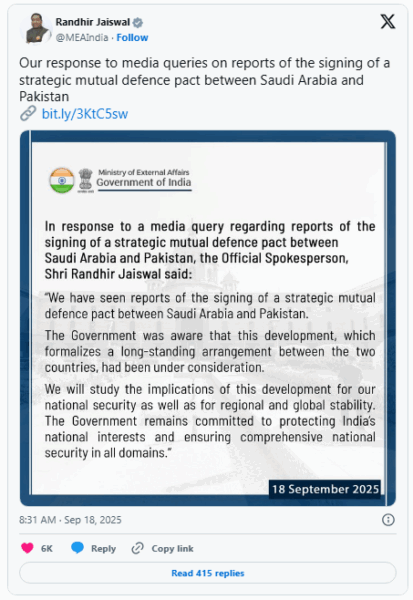
The Government was aware that this development, which formalises a long-standing arrangement between the two countries, had been under consideration. We will study the implications of this development for our national security as well as for regional and global stability.”
The pact is being seen as a significant diplomatic win for Pakistan and could have far-reaching geopolitical implications, particularly in the context of rising tensions in South Asia and the Middle East.
The agreement was signed shortly after a 40-nation Islamic Summit in Doha, where a NATO-like alliance was discussed in response to Israel’s attacks on Qatar.
Leave a Reply