
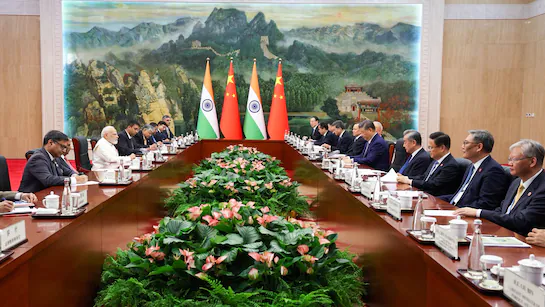
Prime Minister Narendra Modi met Chinese President Xi Jinping in Tianjin on Sunday, August 31, ahead of the Shanghai Cooperation Organisation (SCO) Summit. This marked Modi’s first visit to China in seven years and his first bilateral engagement with Xi since 2018, making it a significant moment in India-China relations after a prolonged phase of tension. National Security Adviser Ajit Doval and Foreign Secretary Vikram Misri were also present during the meeting.
PM Modi began the talks by thanking Xi Jinping for inviting him to the SCO Summit and appreciating China’s successful chairmanship of the grouping. He announced that both countries had reached an agreement on border management through their special representatives, creating an “atmosphere of peace and stability” along the frontier. The Prime Minister noted that disengagement of troops from key friction points had reduced tensions, recalling that the 2024 Kazan meeting had given a positive direction to bilateral ties.
One of the major developments was the resumption of the Kailash Mansarovar Yatra, which will now allow Indian pilgrims to travel to Tibet again. PM Modi also confirmed the restoration of direct flights between India and China, a step seen as crucial for normalising people-to-people exchanges.
Highlighting the global importance of the relationship, PM Modi stressed that the cooperation between India and China affects the welfare of 2.8 billion people and contributes to global stability. He reiterated India’s commitment to future ties based on “mutual trust, respect, and sensitivity.”
The bilateral meeting took place a day before the SCO Summit in Tianjin, where over 20 world leaders, including Russian President Vladimir Putin and Turkish President Recep Tayyip Erdogan, are expected to participate. The meeting also came against the backdrop of rising trade tensions globally, with US President Donald Trump recently imposing a 50% tariff on India over Russian oil imports while exempting China. This development has added greater significance to India-China engagement within the SCO framework.
Leave a Reply