
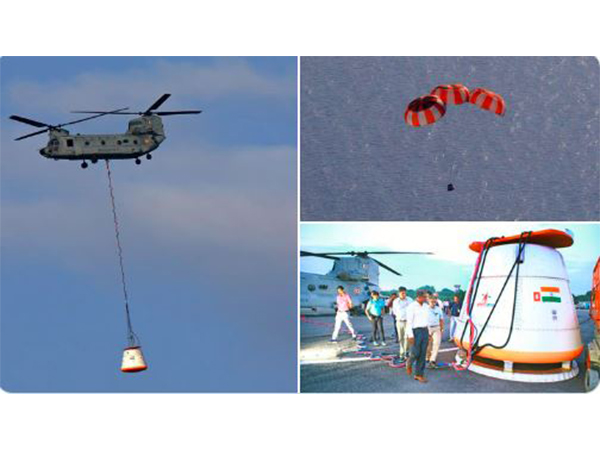
The Indian Space Research Organisation (ISRO) has achieved a significant milestone in India’s ambitious human spaceflight programme, Gaganyaan, by successfully completing its first Integrated Air Drop Test (IADT-01). The test, conducted on August 24, demonstrated the end-to-end functionality of the parachute-based deceleration system, which plays a critical role in ensuring the safe landing of the crew module.
The IADT-01 was a joint effort involving ISRO and multiple national defence and research agencies, including the Indian Air Force, Defence Research and Development Organisation (DRDO), Indian Navy, and Indian Coast Guard. Announcing the achievement on X, ISRO stated, “ISRO successfully accomplishes first Integrated Air Drop Test (IADT-01) for end-to-end demonstration of parachute-based deceleration system for Gaganyaan missions.”
Earlier, Union Minister of State for Science and Technology Dr. Jitendra Singh informed Parliament that development and ground testing of the Human Rated Launch Vehicle (HLVM3) have already been completed for the Gaganyaan programme. He also highlighted the progress on the Orbital Module, which includes the Crew Module and Service Module propulsion systems, as well as the Environmental Control and Life Support System (ECLSS) engineering model.
Singh further stated that the Crew Escape System (CES) has undergone successful static testing of all five motor types. Key infrastructure, including the Orbital Module Preparation Facility, Gaganyaan Control Centre, crew training facilities, and modifications to the second launch pad, has also been established.
The programme has already seen precursor missions like the successful TV-D1 test flight to validate the CES, with TV-D2 and other tests currently in progress. Ground network configuration has been finalised, including IDRSS-1 feeder stations and terrestrial links, while recovery assets and plans for crew recovery operations are in place.
Looking ahead, the first uncrewed Gaganyaan mission (G1) is progressing with components such as the C32-G stage, HS200 motors, and CES modules already realised. Crew Module Phase-1 checks have also been completed.
The Gaganyaan mission is a stepping stone toward India’s long-term vision of establishing itself as a leading spacefaring nation. After proving the core capabilities of human spaceflight, India plans to develop a space station in low Earth orbit by 2035 under the Bharatiya Antariksha Station (BAS) programme, followed by a manned Moon landing by 2040. Approval for the first BAS module has already been obtained, marking another major step in India’s space ambitions.
Leave a Reply