
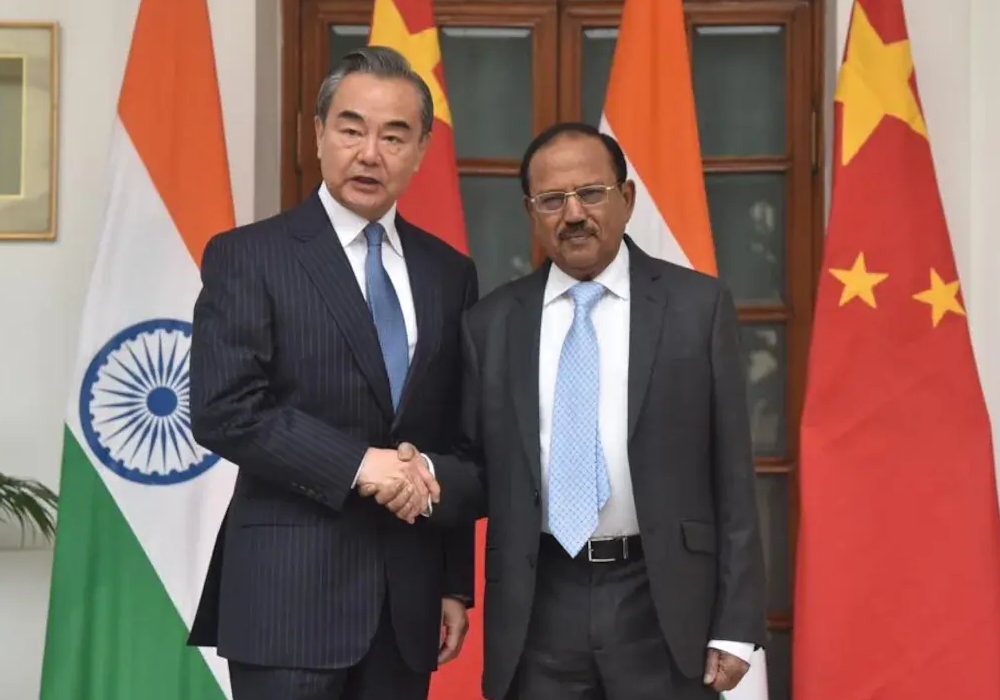
National Security Adviser (NSA) Ajit Doval has highlighted a “new environment” fostering positive momentum in India-China relations, just ahead of the upcoming Shanghai Cooperation Organisation (SCO) Summit. Doval made these remarks during his meeting with Chinese Foreign Minister Wang Yi in New Delhi, where the two held the 24th round of Special Representative-level talks on the boundary issue.
The discussions follow Wang Yi’s meeting with External Affairs Minister S. Jaishankar and come in the wake of an earlier interaction between Prime Minister Narendra Modi and Chinese President Xi Jinping on the sidelines of the BRICS summit in Kazan last October.
Doval noted significant improvement in bilateral engagement since the last round of talks in Beijing in December 2024. “The border has remained quiet, peace and tranquillity have prevailed, and our engagements have become more substantive,” he said, expressing gratitude to both leaders for initiating this “upward trend.”
Responding to Doval, Wang Yi admitted that the past setbacks in bilateral ties were not in the interest of either nation. He emphasized that a “healthy and stable” relationship between India and China is crucial not only for both nations but also for the wider developing world. “History and reality show that closer ties benefit both our countries and are welcomed by the global South,” Wang said.
The positive tone of the meeting is being seen as a precursor to several Confidence Building Measures (CBMs) to be announced during PM Modi’s scheduled visit to Tianjin for the SCO summit later this month.
Resumption of Bilateral Initiatives
In a significant development, direct flights between India and China will resume after a five-year hiatus. Both nations have also eased restrictions for the Kailash Mansarovar Yatra, allowing more pilgrims to visit the sacred site.
India’s Ministry of External Affairs (MEA) confirmed that trade through key Himalayan passes—Lipulekh (Uttarakhand), Shipki La (Himachal Pradesh), and Nathu La (Sikkim)—has resumed. In a major boost to India’s automobile and manufacturing sectors, China has reportedly agreed to lift restrictions on the export of rare earths, magnets, minerals, and tunnel boring machines. These components are critical, especially as India imports over 90% of its rare earth requirements from China.
Strategic Watchpoints Remain
Despite the progress, former ambassador and China expert Ashok Kantha warned against premature optimism. “This is a welcome shift, but challenges remain—particularly the unilateral Chinese decision to construct a megadam on the Yarlung Tsangpo (upper Brahmaputra) without consulting India. We must also be mindful of deepening Pakistan-China cooperation during Operation Sindoor, which showed high levels of battlefield coordination,” he noted.
The recent thaw in diplomatic exchanges is being closely watched, with hopes that it will pave the way for sustained dialogue and resolution of long-standing disputes.
Leave a Reply