
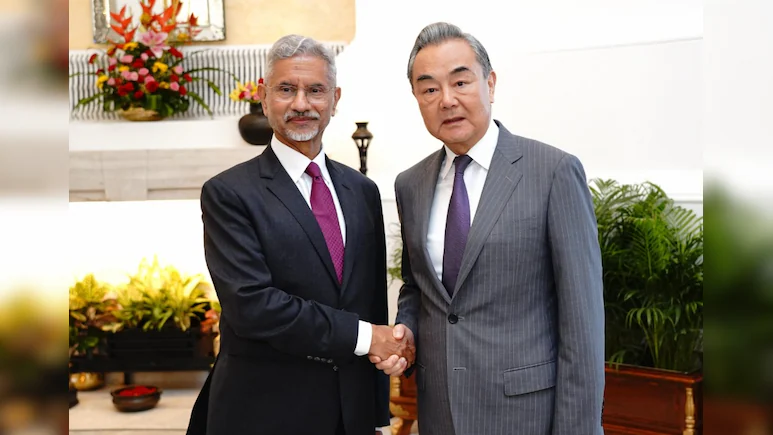
New Delhi: Five years after the Galwan clash, India and China are working to repair their strained ties as the US, under former President Donald Trump, escalates its tariff war against New Delhi. Chinese Foreign Minister Wang Yi is currently visiting India and held crucial talks with External Affairs Minister Dr. S Jaishankar on Tuesday.
Dr. Jaishankar said the visit provides an opportunity to review bilateral relations and move past a difficult phase. “In that endeavour, we must be guided by the three mutuals — mutual respect, mutual sensitivity, and mutual interest. Differences must not become disputes, nor competition turn into conflict,” he emphasized.
The discussions covered trade, border issues, river data sharing, connectivity, pilgrimages, and people-to-people exchanges. Wang Yi will also meet National Security Adviser Ajit Doval to deliberate on maintaining peace in border areas and pushing forward the de-escalation process.
Addressing broader global concerns, Dr. Jaishankar said, “We seek a fair, balanced, and multi-polar world order, including a multi-polar Asia. Reformed multilateralism is the call of the day.”
China has assured India of addressing key concerns, including the supply of fertilizers, rare earth elements, and tunnel boring machines. Rare earths, critical for advanced technology and defense manufacturing, remain largely concentrated in China, making them strategically significant.
Following the meeting, China issued a statement criticizing Washington’s economic pressure. Wang Yi said, “The world is undergoing a once-in-a-century transformation at an accelerating pace. Unilateral bullying is rampant, and free trade and the international order face severe challenges.”
He added that India and China, as the two largest developing countries, should work together to strengthen the global south, promote multipolarity, and contribute to democratizing international relations.
The thaw in ties follows last year’s meeting between Prime Minister Narendra Modi and Chinese President Xi Jinping in Kazan, which set the stage for renewed dialogue and cooperation. Both nations have resumed exchanges, maintained peace at the borders, and facilitated pilgrimages, signaling a positive trend in bilateral relations.
Meanwhile, the rapprochement comes as Washington imposes steep 50% tariffs on Indian exports for continuing oil imports from Russia. The US has refrained from penalizing China for similar purchases, explaining that most Russian oil Beijing imports is refined and re-exported globally.
Leave a Reply