
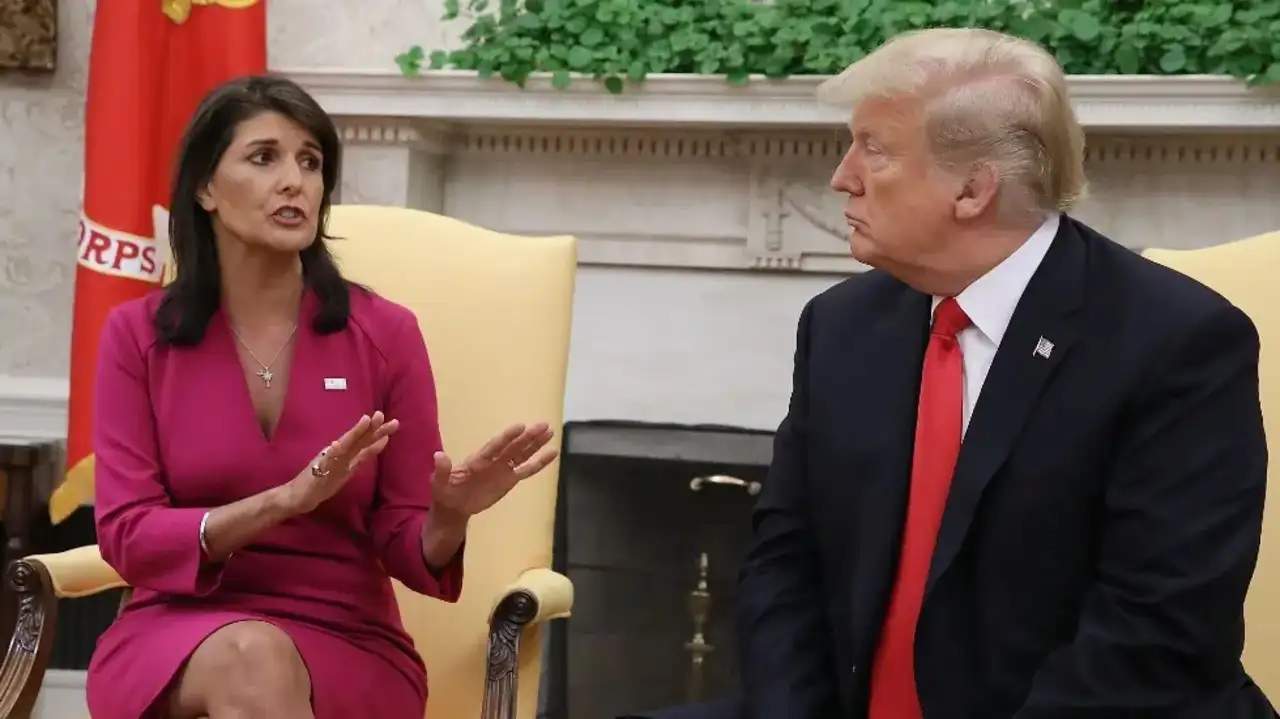
Former US Ambassador to the United Nations, Nikki Haley, has issued a strong criticism of President Donald Trump’s plan to impose high tariffs on Indian exports, cautioning that such a decision could jeopardize the US-India relationship at a pivotal moment. She advised Trump against allowing an ‘adversary’ like China to benefit while damaging ties with an ally such as India.
The Republican leader also pointed out the inconsistency of the Trump administration, noting a lenient approach to trade with China, where the US has temporarily suspended tariffs for 90 days.
In a message on the social media platform X, Haley stated, ‘India should not be purchasing oil from Russia. However, China, which is an adversary and the largest buyer of Russian and Iranian oil, received a 90-day pause on tariffs.’
‘We must not give China a free pass and jeopardize our relationship with a vital ally like India,’ she further remarked.
Haley, a long-time advocate for stronger US-India relations, has frequently stressed the importance of countering China’s global dominance by fostering closer alliances with democratic nations in the Indo-Pacific, especially India.
Her remarks came after Trump’s recent interview with CNBC, during which he revealed intentions to significantly increase tariffs on Indian goods, which are already set at 25 percent effective from August 1, within a 24-hour timeframe. He associated this proposed action with India’s ongoing purchase of Russian oil, claiming that New Delhi was ‘fueling the war machine.’
‘India has the highest tariffs of any nation,’ Trump stated in the interview. ‘They conduct a considerable amount of business with us, but we do not engage much with them. We had agreed on 25 percent tariffs, but I am now going to raise that significantly due to their trade in Russian oil,’ Trump remarked, attempting to instill concern in India.
Trump also recognized that India had proposed to reduce tariffs on US goods to zero under a new agreement but dismissed this offer as insufficient. ‘Zero tariffs are not adequate when they are contributing to funding a war we oppose,’ he stated.
India has consistently upheld its energy policy, asserting that its oil imports are driven by national interest and cost-effectiveness.
The Ministry of External Affairs has highlighted that Western nations, including the US and EU, persist in maintaining their own trade and energy relationships with Russia, even as they publicly criticize others for similar actions.
Trump’s tariff warning has already sparked economic worries. On Monday, Indian ratings agency ICRA adjusted its GDP growth forecast for FY26 downward from 6.2 percent to 6.0 percent, attributing this change to escalating US trade tensions and increasing policy uncertainty.
ICRA observed that Indian exports may lose their competitive edge in crucial sectors such as textiles, auto components, chemicals, and gems and jewellery — industries that heavily depend on the US market. India’s trade surplus with the US, which was USD 41 billion in FY25, could suffer if the proposed tariffs are implemented.
Nonetheless, the effects are anticipated to differ across various sectors. Pharmaceuticals, petroleum products, and telecom instruments — which represent a substantial portion of India’s exports to the US — are expected to remain relatively resilient in the short term. In particular, pharma exports constitute over 37 percent of India’s total shipments to the US and have thus far been unaffected by the tariff threats.
Haley’s criticism highlights the growing concern among some Republicans regarding Trump’s strategy towards key global partners. While Trump has taken a hardline approach to trade, Haley and others contend that distancing democratic allies like India could have strategic repercussions, especially given the increasing authoritarian influence from China.
As Washington and New Delhi continue to navigate their intricate relationship — balancing strategic collaboration with economic frictions — Haley’s comments serve as a reminder of the significant stakes involved.
The White House has yet to officially address Haley’s remarks or India’s recent statements defending its oil imports from Russia.
Leave a Reply