
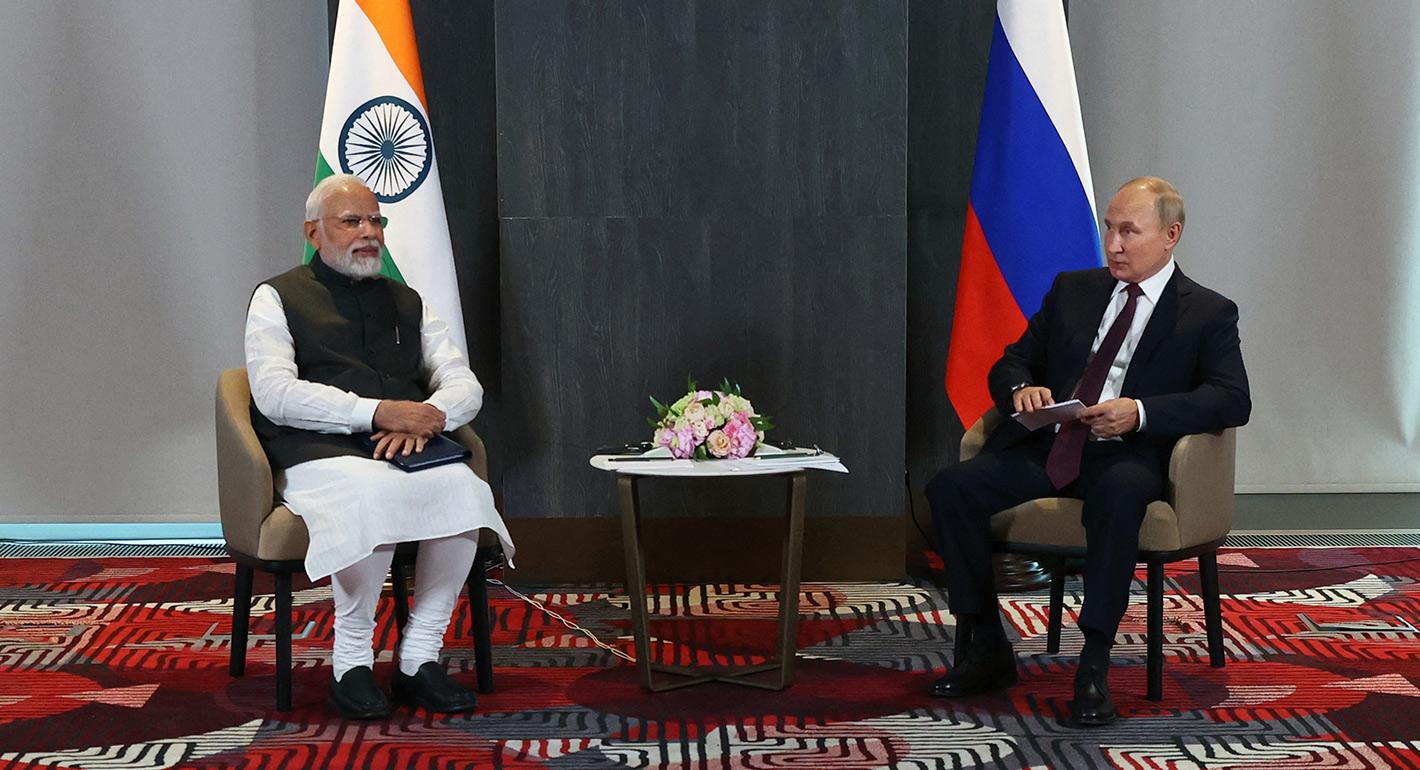
On Monday, India defended its energy trade with Russia following accusations from U.S. President Donald Trump, who claimed that New Delhi was benefiting from discounted Russian oil and threatened to impose higher tariffs. The Ministry of External Affairs issued a strong statement asserting that India’s imports are essential for providing affordable energy to its citizens, labeling the actions of the U.S. and EU as “unjustified and unreasonable.”
India has faced criticism from both the United States and the European Union for its oil imports from Russia since the onset of the Ukraine conflict. The Ministry of External Affairs clarified that India turned to Russian oil because traditional supply routes were redirected to Europe after the conflict began.
“The targeting of India is unjustified and unreasonable. As a major economy, India will take all necessary steps to protect its national interests and economic security.”
“India’s imports are intended to ensure stable and affordable energy prices for Indian consumers. They are a necessity driven by the current global market conditions.” However, it is “revealing” that the very countries criticizing India are also engaging in trade with Russia, according to the MEA. “In contrast to our situation, such trade is not even a critical national necessity.”
In 2024, the European Union conducted a bilateral trade worth Euro 67.5 billion in goods with Russia. Additionally, trade in services was estimated at Euro 17.2 billion in 2023. This amount significantly exceeds India’s total trade with Russia during that year and beyond. Notably, European imports of LNG in 2024 reached a record 16.5 million tonnes, surpassing the previous record of 15.21 million tonnes set in 2022.
Trade between Europe and Russia encompasses not only energy but also fertilizers, mining products, chemicals, iron and steel, as well as machinery and transport equipment, the MEA stated. Regarding the United States, it continues to import uranium hexafluoride from Russia for its nuclear sector, palladium for its electric vehicle industry, as well as fertilizers and chemicals, it noted.
Trump’s recent tariff warning
In a new trade warning directed at India, President Donald Trump stated on Monday that he intends to “significantly” increase US tariffs on New Delhi, accusing the nation of purchasing large quantities of Russian oil and profiting from its resale.
Last week, the Trump administration imposed a 25 percent tariff on all goods from India. The US president also declared a penalty for acquiring the “vast majority” of Russian military hardware and crude oil, although this was not specified in the official announcement.
“India is not only purchasing large volumes of Russian oil, but they are also selling a significant portion of that oil on the open market for substantial profits,” Trump remarked in a social media update on Monday.
“They are indifferent to the number of people being killed in Ukraine by the Russian war machine. As a result, I will be significantly increasing the tariffs that India pays to the USA,” he continued.
India’s import of crude oil from Russia has surged from 0.2 percent of total imports prior to the Russia-Ukraine conflict to 35-40 percent. New Delhi is now the largest purchaser of Russian oil after China.
On August 1, Trump enacted an Executive Order titled ‘Further Modifying The Reciprocal Tariff Rates’, which raised tariffs for over sixty countries, including a substantial 25 percent for India.
However, the executive order did not reference the “penalty” that Trump indicated India would incur due to its acquisition of Russian military supplies and energy.
White House Deputy Chief of Staff Stephen Miller, in an interview with Fox News Sunday, emphasized that President Trump has made it very clear that “it is unacceptable for India to keep financing” the war in Ukraine by buying oil from Russia.
Last week, Trump launched a pointed criticism of India and Russia for their close relationship, stating that the two nations could bring their “ailing economies down together.” This comment led New Delhi to assert that India is the fastest-growing major economy in the world.
Trump declared that the US faces a significant trade deficit with India, noting that while “India is our friend,” the two countries have historically conducted relatively little trade due to India’s excessively high tariffs, which rank among the highest globally, and its particularly burdensome non-monetary trade barriers.
He also pointed out that India has consistently procured a large portion of its military hardware from Russia and is the largest buyer of Russian energy, alongside China, at a time when there is widespread pressure for Russia to cease its aggression in Ukraine — all of which Trump deemed unfavorable!
These statements are perceived as a strategy to compel New Delhi to comply with US demands in the proposed trade agreement. The US is requesting tariff reductions for its agricultural products, dairy, and genetically modified (GM) foods. However, India opposes any concessions in these areas, as they are crucial to the livelihoods of millions of small and marginalized farmers.
Leave a Reply