
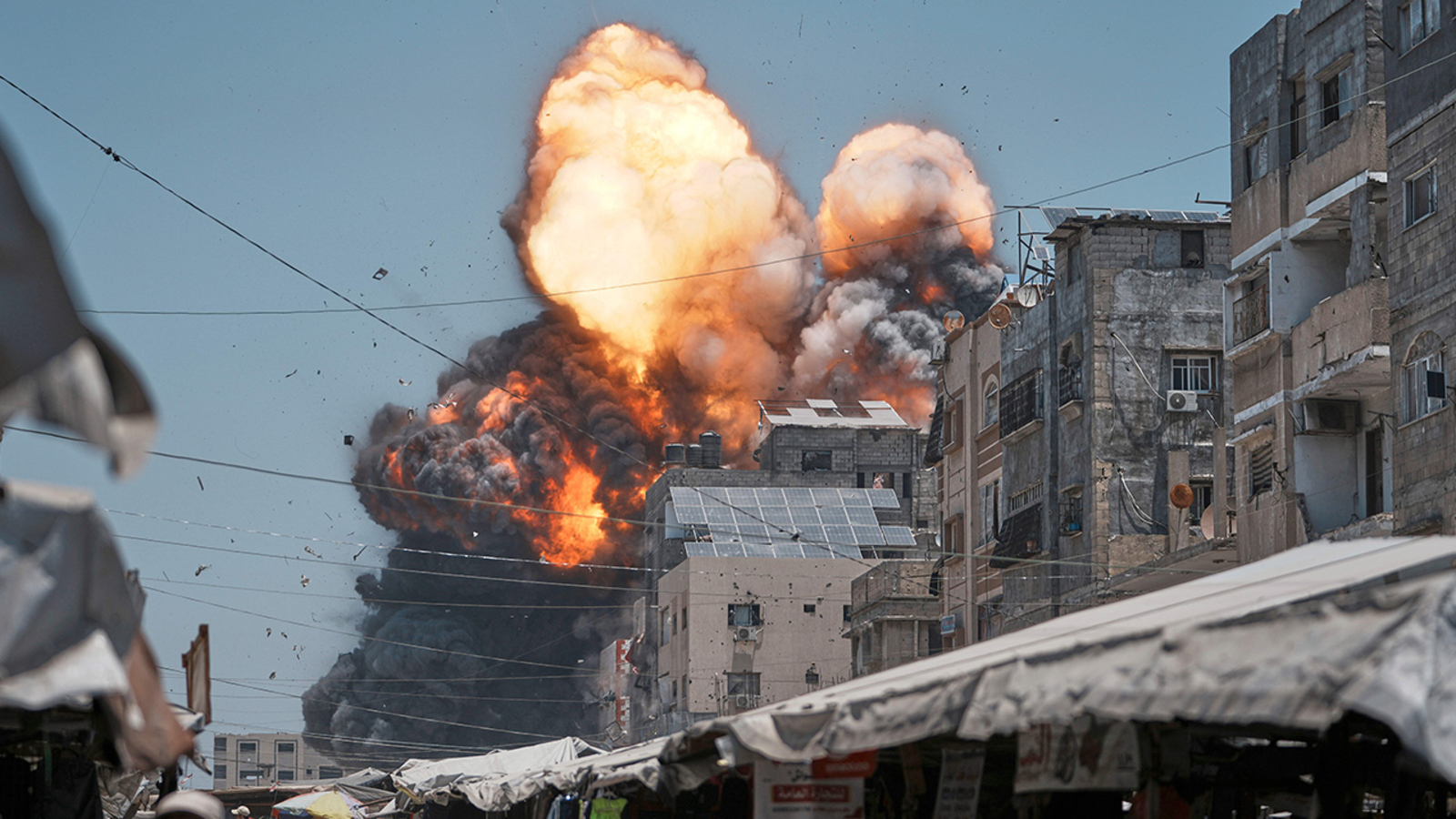
Israeli airstrikes and gunfire resulted in the deaths of at least 78 Palestinians throughout the Gaza Strip on Monday, including a pregnant woman whose baby was delivered posthumously but also did not survive, according to local health officials. Many were killed while trying to obtain food, even as Israel began to relax restrictions on aid entry.
Facing increasing pressure due to the escalating hunger crisis in Gaza, Israel announced over the weekend that the military would suspend operations in Gaza City, Deir al-Balah, and Muwasi for 10 hours each day and establish secure routes for aid delivery. International airdrops of assistance have also resumed.
Aid organizations claim that the new measures are insufficient to address the worsening starvation situation in the region.
Martin Penner, a spokesperson for the UN food agency, informed The Associated Press that all 55 of its aid trucks that arrived on Sunday were emptied by crowds before they could reach their intended destinations. Another UN representative stated that conditions on the ground remain unchanged and that no alternative routes have been permitted.
Israel indicated that it would persist with military operations in conjunction with the new humanitarian initiatives.
Newborn dies following intricate surgery
A baby girl passed away just hours after being delivered via a complicated emergency cesarean section. She had been placed in an incubator and was receiving assistance from a ventilator, as shown in AP footage.
Her mother, Soad al-Shaer, who was seven months pregnant, was among 12 Palestinians who lost their lives in an Israeli airstrike targeting a house and adjacent tents in the Muwasi area of Khan Younis, as reported by Nasser Hospital, which received the deceased.
Another airstrike struck a two-story residence in Khan Younis, resulting in the deaths of at least 11 individuals, more than half of whom were women and children, according to the hospital. Additionally, at least five others were killed in strikes in other parts of Gaza, as reported by other medical facilities.
The Israeli military did not promptly respond to a request for comments regarding most of the strikes. It stated that it was unaware of one strike in Gaza City during the pause that health officials reported had resulted in one fatality.
Israel claims it exclusively targets militants and attributes civilian casualties to Hamas, as the militants operate within densely populated regions. The ongoing airstrikes throughout the territory often result in the deaths of women and children.
Israel permits an increase in aid shipments
Photographs of malnourished children have ignited global outrage, including from Israel’s close allies. On Sunday, US President Donald Trump described the images of starving and undernourished children in Gaza as “terrible.”
Throughout the conflict, Israel has imposed varying degrees of restrictions on aid. In March, it halted the entry of all goods, including fuel, food, and medicine, to exert pressure on Hamas to release hostages.
In May, Israel partially eased these restrictions but also advanced a new US-supported aid delivery system that has been plagued by chaos and violence. Traditional aid organizations have faced significant challenges due to a breakdown in law and order affecting their deliveries.
COGAT, the Israeli military organization responsible for coordinating aid shipments, reported that UN agencies gathered 120 trucks for distribution on Sunday, with an additional 180 trucks permitted entry into Gaza.
The United Nations and humanitarian organizations assert that the territory requires 500-600 trucks daily to satisfy its needs. Israel’s blockade and military actions have devastated nearly all food production in the area, which is home to approximately 2 million Palestinians.
Aid organizations argue that airdrops are ineffective
On Monday, two air force planes from Jordan and the United Arab Emirates airdropped 17 tons of humanitarian aid in Gaza — a quantity insufficient to fill even one aid truck.
Aid organizations contend that airdrops are frequently ineffective and perilous, with falling packages landing on individuals or in combat zones and other hazardous locations.
“Currently, 2 million people are confined to a small area that constitutes just 12 percent of the entire strip — if anything lands in this region, injuries are unavoidable,” stated Jean Guy Vataux, emergency coordinator in Gaza for Doctors Without Borders.
“If airdrops are delivered in regions where Israel has mandated displacement, individuals will be compelled to enter militarized zones — once again jeopardizing their lives for sustenance,” he remarked. Officials report dozens have died while seeking assistance.
According to health officials and witnesses, at least 25 individuals were killed by Israeli forces while attempting to receive aid from a truck convoy traversing the southern Gaza Strip. The Israeli military has not provided an immediate response.
Among the deceased were four children, as per records from Nasser Hospital, which received the bodies. The incident occurred in a military corridor established by Israel between the southern cities of Khan Younis and Rafah. It remains unclear who was responsible for supplying the convoy.
Survivors at the hospital reported that Israeli forces had opened fire on the crowds. Since May, over 1,000 Palestinians have lost their lives due to Israeli gunfire while seeking assistance, according to the UN human rights office, witnesses, and local health officials.
The Israeli military claims it only discharges warning shots at individuals approaching its forces.
The Awda hospital in central Gaza reported receiving the bodies of seven Palestinians, who it stated were killed by Israeli fire near an aid distribution site operated by the Gaza Humanitarian Foundation, an Israeli-supported American contractor.
Fares Awad, head of the Gaza health ministry’s emergency service, indicated that at least five Palestinians were killed and approximately 30 others injured by Israeli gunfire while awaiting aid trucks from the Zikim Crossing near Gaza City.
Hamas initiated the conflict with its attack on 7 October 2023, during which Palestinian militants killed around 1,200 individuals and abducted 251 others. They currently hold 50 hostages, and Israel suspects that more than half of the remaining captives are deceased. Most of the others were released during ceasefires or other agreements.
Israel’s counteroffensive has resulted in the deaths of over 59,800 Palestinians, as reported by Gaza’s health ministry. This tally does not differentiate between combatants and non-combatants. The ministry functions under the Hamas administration. The United Nations and various international organizations regard it as the most credible source of casualty data.
Leave a Reply