
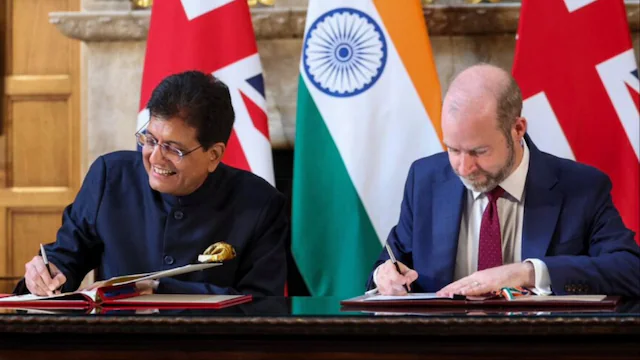
India and the UK have finalized a Comprehensive Economic and Trade Agreement (CETA) aimed at increasing imports and exports to over $100 billion by 2030, up from the current $56 billion. This marks the first of several significant agreements that the Narendra Modi administration hopes to establish amid the global turmoil caused by US President Donald Trump’s tariffs. A bilateral trade agreement with the US is expected to follow, with both parties reportedly nearing a deal.
The CETA with the UK, India’s former colonial ruler, is the 16th trade agreement for India and will eliminate taxes on labor-intensive goods such as leather, footwear, and clothing in the UK market, creating nearly $23 billion in new opportunities. Likewise, British whisky and automobiles will become more affordable in India.
The agreement, signed by Prime Minister Narendra Modi and British Prime Minister Keir Starmer after three years of negotiations during the uncertainty of Trump’s tariffs, requires approval from the British parliament before it can be implemented, a process that may take around a year.
Greater Opportunities
This agreement is vital for the UK as it opens up access to the world’s fastest-growing economy, five years post-Brexit.
Under the terms of the agreement, India will reduce the import duty on Scotch whisky and gin from the UK from 150% to 75% initially, and then to 40% by the tenth year. Tariffs on automotive imports will decrease to 10% from over 100% under quotas established by both nations. Indian manufacturers will also gain entry to the UK market for electric and hybrid vehicles, again under a quota system.
“A new chapter begins today in the India-UK economic partnership!” Modi stated in a post on X. “The signing of the Comprehensive Economic and Trade Agreement (CETA) demonstrates our mutual commitment to boosting trade, fostering inclusive growth, and creating opportunities for farmers, women, youth, MSMEs, and professionals.
India’s exports to the UK increased by 12.6%, reaching $14.5 billion, while imports rose by 2.3% to $8.6 billion in FY25. The tariffs imposed by India on British goods will decrease from 15% to 3%.
Modi stated: “The India-UK CETA will enhance the momentum of growth and export promotion driven by ‘Make in India’. This agreement will also ensure that Indian consumers have access to high-quality products at competitive prices. The future indeed promises greater prosperity and stronger connections between our nations!”
Since 2014, India has established five trade agreements with Mauritius, the UAE, Australia, EFTA, and the UK.
Starmer remarked that the agreement would yield “significant advantages” for both nations, making trade more affordable, faster, and simpler. “We have entered a new global era, which demands that we take action rather than remain passive… by fostering deeper partnerships and alliances,” he stated. The agreement was formalized by commerce and industry minister Piyush Goyal and the UK’s secretary of state for business and trade, Jonathan Reynolds.
They also introduced a renewed Comprehensive Strategic Partnership — the UK-India Vision 2035.
“The trade agreement, projected to enhance bilateral trade by £25.5 billion annually, represents both India’s most extensive deal to date and the UK’s most economically significant bilateral trade agreement since exiting the EU,” the UK announced in a statement, noting that it greatly enhances market access for businesses in both nations, resulting in lower prices for consumers. The two parties declared the completion of the FTA negotiations on May 6.
India benefits
India has asserted that it has safeguarded the interests of local farmers by excluding dairy products, edible oils, oats, and apples from the trade agreement while achieving zero tariffs on 95% of agricultural and processed food items.
“This FTA will act as a catalyst for inclusive growth, benefiting farmers, artisans, workers, MSMEs, startups, and innovators while protecting India’s fundamental interests and propelling our progress towards becoming a global economic powerhouse.”
Indian staples like turmeric, pepper, and cardamom, along with processed items such as mango pulp, pickles, pulses, and marine products including shrimp and tuna, will benefit from duty-free access to the UK market.
Over 95% of agricultural and processed food tariff lines will incur no duties on fruits, vegetables, cereals, pickles, spice blends, fruit pulps, ready-to-eat meals, and processed foods.
“Duty-free access is anticipated to boost agricultural exports by more than 20% within the next three years,” an official stated.
The CETA allows for zero-duty access for shrimp, tuna, fishmeal, animal feeds, coffee, spices, beverages, and processed food.
“The nearly £6 billion in new investments and export achievements announced today signal a promising future, as collaboration extends into advanced technologies, critical minerals, green finance, and more,” Reynolds remarked.
“For financial and professional business services, guaranteed access will provide the certainty needed to grow in India’s expanding market, along with measures such as binding India’s foreign investment cap for the insurance sector, ensuring that UK financial services firms are treated equally to local suppliers,” the UK stated in a release.
Twenty-six British firms have revealed new business ventures in India. Airbus and Rolls-Royce are set to commence the delivery of Airbus aircraft — with over half powered by Rolls-Royce engines — to major Indian airlines as part of contracts worth approximately £5 million that were recently finalized.
As part of the renewed partnership, the UK and India have also agreed to enhance cooperation in combating corruption, serious fraud, organized crime, and irregular migration through improved intelligence sharing and operational collaboration.
Services and digital trade
The agreement will also simplify access for temporary business visitors, although visas are not included. Britain and India have also concurred that workers will no longer need to make social security contributions in both countries during temporary assignments in the other nation.
India has successfully reached an agreement regarding the Double Contribution Convention. This agreement will relieve Indian professionals and their employers from making social security contributions in the UK for a period of up to three years, thereby enhancing the cost competitiveness of Indian talent.
The CETA offers improved market access for IT and IT-enabled services, as well as for financial and legal services, professional and educational services, and digital trade.
According to the commerce and industry ministry, “Indian professionals, including those sent by companies to work in the UK across various service sectors, as well as those on contracts such as architects, engineers, chefs, yoga instructors, and musicians, will benefit from streamlined visa processes and more flexible entry categories, facilitating easier employment opportunities in the UK.”
As part of the trade agreement, British companies will gain access to India’s procurement market for projects in areas like clean energy, and it will also encompass service sectors such as insurance.
The official mentioned, “They have limited access to our procurement, while we enjoy unrestricted access to theirs.”
Discussions regarding a separate bilateral investment treaty are ongoing.
The ministry further stated, “Women and youth entrepreneurs, farmers, fishermen, startups, and MSMEs will have new opportunities to engage with global value chains, supported by measures that foster innovation, encourage sustainable practices, and minimize non-tariff barriers.”
GI push
Products such as Bhagalpur silk, Pashmina shawls, Kolhapuri chappal, and Thanjavur dolls are now likely to find shelf space in malls and stores throughout Britain, as the free trade agreement will offer duty concessions for a variety of traditional Indian products. Additionally, Makhana, shahi litchi, Araku coffee, and Kashmiri saffron will also enjoy improved access to the UK market.
Leave a Reply