
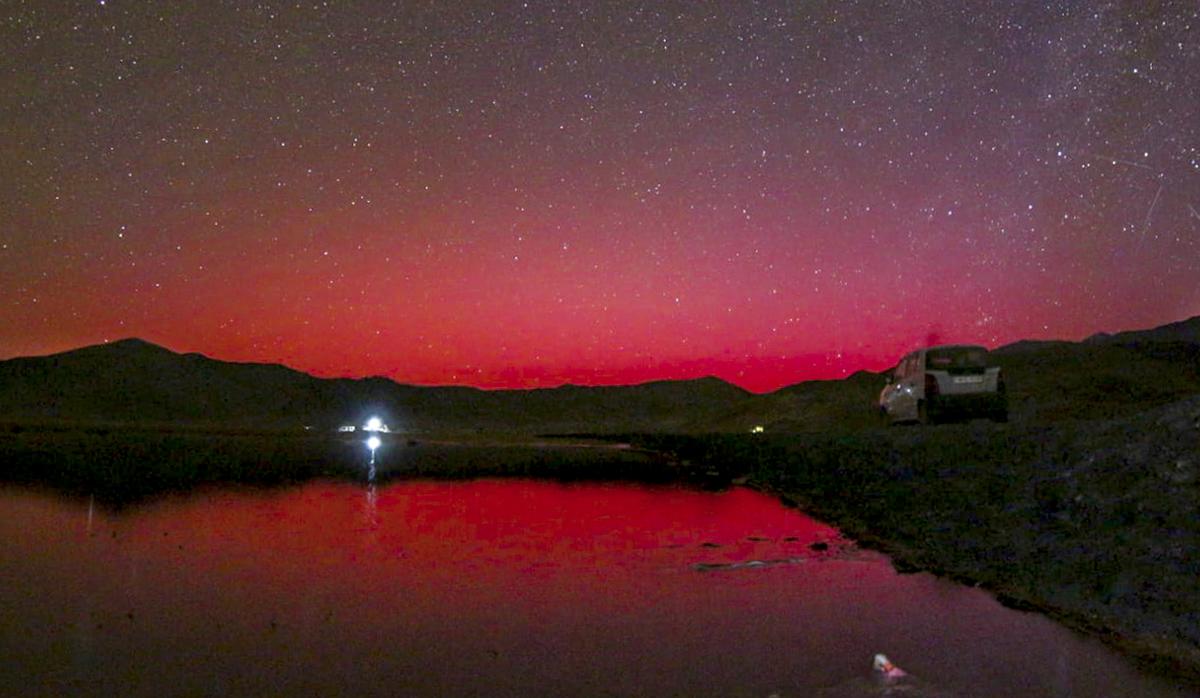
In May 2024, the remote Himalayan skies above Ladakh were unexpectedly illuminated by a rare celestial phenomenon, the northern lights, or auroras, which are usually only observable much nearer to the poles.
Now, more than a year later, astronomers from the Indian Institute of Astrophysics (IIA) have revealed the extraordinary sequence of events that led to this unusual display: a record-setting solar storm triggered by six massive, interacting Coronal Mass Ejections (CMEs) that erupted from the Sun in rapid succession.
CMEs are vast bubbles of magnetized plasma expelled from the Sun’s outer atmosphere. When these solar eruptions are directed towards Earth, they can initiate severe geomagnetic storms, which have the potential to disrupt satellites, communication networks, and even electrical grids. However, the event on May 10, 2024, was unprecedented in the last twenty years.
“This was a distinctive sequence of six interacting CMEs, linked with solar flares and filament eruptions, all emanating from a highly active region on the Sun,” stated Dr. Wageesh Mishra, a faculty member at IIA.
Utilizing data from space-based observatories operated by NASA and ESA, scientists at IIA’s Indian Astronomical Observatory in Hanle, Ladakh, created sophisticated models to track both the trajectory and thermal behavior of these solar storms as they moved through the solar system.
Their research, published in Astronomy and Astrophysics, offers the first continuous thermal profile of multiple interacting solar eruptions.
Lead author and doctoral researcher Soumyaranjan Khuntia noted, “At first, the CMEs emitted heat, but as they progressed further, they started to absorb and retain heat, stabilizing into a nearly constant temperature state—a surprising and intricate behavior.”
Closer to Earth, instruments such as NASA’s Wind spacecraft detected another anomaly: the final solar cloud contained twin magnetic structures, or “double flux ropes,” that resembled twisted braids of magnetic fields. These interacted in unusual manners, resulting in the stunning auroras observed in Ladakh.
“This research establishes the groundwork for a new era in space weather forecasting,” stated Anjali Agarwal, one of the study’s co-authors. With the Aditya-L1 solar mission from India now active, the team aims to enhance their models by utilizing solar data and observations gathered in proximity to Earth.
Dr. Mishra remarked, “India is progressing towards becoming a leader in heliophysics research, enabling us to anticipate and prepare for future space weather events that could impact technology and everyday life on Earth.”
Leave a Reply